The last memories

Mom has been unusually calm these days. She has been a fighter against her Alzheimer’s, not going easily into the twilight world of forgetfulness and unable to accept her greatly diminishing physical abilities, so her peacefulness is a surprise. I am so happy she now allows me to take care of her, to sit outside watching the moon with her, to tuck her in bed with a kiss, without fussing and worrying about the horrors of old age. “Who said this is the ‘golden age,’” was her mantra.

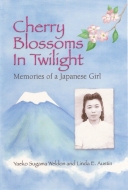
There’s not much to say when I visit—since I come so often, there’s not much news, and I don’t like repeating myself endlessly anyway—but she loves my presence beside her. It makes her feel safe, despite the fact that those who work there are loving caregivers. The one thing she does remember that we can talk about together is her childhood. Thankfully, since I’ve written her stories into a book, I now know those stories better than she does so I can prompt her memories as well as join in.

Last night, sitting outside in the evening, Mom sang a Japanese children’s lullaby to the moon, over and over—the one I sing to her after I tuck the quilt around her at bedtime. “Mikazuki-sama, konban wa.” Today she talked about the old festivals of Japan. She sang an old folk song (again and again), swaying her hands to movements half-remembered. I stood up and did the beginning of the dance for her, the only part I could remember.

I’m so glad I have her old memories written down. And it is so beautiful to wrap the memories around us, holding us together as one. I think we are both at peace now, ready to face the future.

Note: this post was inspired by an article by Julie Redstone on Yvonne Perry’s blog, More Than Meets the Eye. The article is entitled The Challenge of Death and Dying – Caring for Aging Parents.

Posted in capturing memories | 7 Comments

Message Memoir vs Self Indulgence

The best memoirs are written with purpose. While a memoir may contain musings to one’s self, as in a journal, an outstanding memoir is directed at others and contains some kind of message that pushes it beyond just a book of facts, or a waterfall of feelings, to something rewarding. It gives readers a “take-away.” What are you trying to say to them? What are you leaving them with? Perhaps it is a better understanding of history, a culture, a disease, a trauma, or why you are the way you are.

http://rcm.amazon.com/e/cm?t=cherrybloss03-20&o=1&p=8&l=bpl&asins=1552786781&fc1=000000&IS2=1&lt1=_blank&m=amazon&lc1=0000FF&bc1=000000&bg1=FFFFFF&f=ifrHeather Summerhayes Cariou has written Sixtyfive Roses, a memoir about her younger sister’s struggle with cystic fibrosis. Heather could have documented with bland facts her sister’s lengthy suffering and eventual death, or whined about her own feelings of pain and perhaps neglect. Instead she reached into this sad story, pulled out the message, and shared it. Readers learn about a disease and its impact on a family, and are inspired by a brave girl who made her sister stronger. Heather covers all bases.

Reading My Sister Pam, posted on the Handprints on My Heart blog, I found so much going on in this short essay related to the book. Note how facts mesh with feelings and reactions, “I descended into a caldron of resentment, sorrow and anger.” Note the way she effectively describes Pam to let us know she was talented, and uses a story to illustrate how she was a realist—“Oral Roberts can’t make me better.” She gives us Pam’s words of frustration, and finally a message from Pam that she shares with her world of readers. We get an inspiring take-away.

Few of us are as good a writer as Heather, and many of us do not have big stories to tell, but everyone is a writer with interesting stories of themselves and the world around them. We can learn the basics and aspire to be better writers, but being good is not necessary to write for our beloved family and friends. Write your story, but keep in mind the future generations of your family—or the strangers—you are writing to and tell them something interesting about who you are, what you experienced, and what you learned. Memoir can be merely a self-indulgent tale of me-me-me, but it can also be a lesson in history and life—your history and life.

Posted in memoir writing, writing skills | 2 Comments

Is your memoir too clean?

Ghostwriter Kim Pearson recently blogged an excellent post on Blood Red Pencil about telling the truth about yourself in memoir. Clients open up to her, chatting comfortably about themselves and their lives, but when they see their voices in writing they freak out. “Did I say that?” They want to edit out all the interesting quirks and anything they construe as negative, thus they “kill the writing.”

I have had similar experiences ghost writing memoirs. With one couple, the husband was open and willing to have his words in print, but the wife was so worried about any sense of impropriety. Being from the “old generation” and from a conservative family, her sense of propriety was very restrictive. I sided with the husband saying, “That’s just the way things were then,” and “This gives you a personality,” and was able to shoehorn some tidbits in. Another woman was appalled that she had slipped into a dialect that she felt wasn’t “proper.” I and a friend working with her tried to convince her that it gave flavor and color to her life experiences. She did not buy that at all.

When you write your life stories or memoir, please don’t clean yourself up so well no one recognizes you. You are three-dimensional with faults and oddities like the rest of us. These traits and experiences make you the interesting and special person you are. You will be worth remembering if you are not boring. This does not mean you have to include all the dirt, but leave some there so others can find common ground.

Posted in memoir writing | Comments Off on Is your memoir too clean?