Creating real memoir books with Lulu

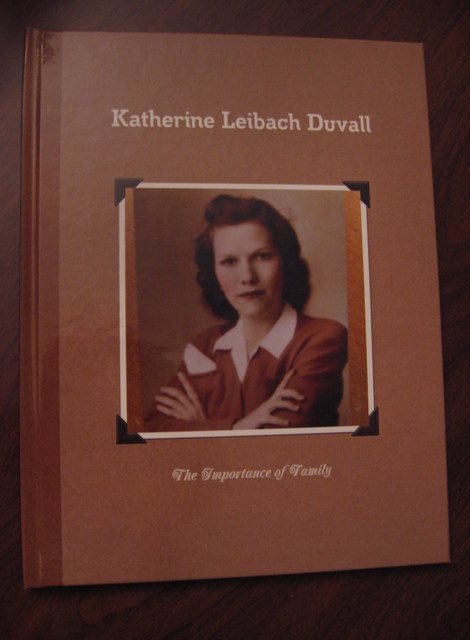
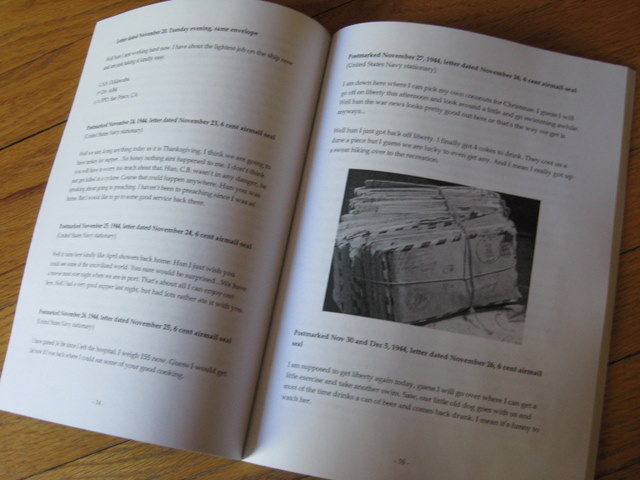
A couple mothers I know received beautiful gifts of memories for Mothers Day. The memoir books I’ve been working on arrived in the mail this week from Lulu.com. Kate’s bittersweet memories from childhood, including being orphaned at age 13 and caring for her little brothers, became a 24-page hardcover with her photo on the front. She was amazed at how nice it looked, pleased and honored that someone thought her stories were worth that kind of effort. Her daughter was very excited and asked me to order another ten copies. My mother-in-law was also very happy to receive an 84-page soft cover book of the highlights of her father’s stack of letters to home during his WWII service. She called to thank me and tell me she had tears in her eyes as she read the first section.

To get the manuscripts printed and bound, I opened an account with Lulu.com, a popular “self-publishing” company which actually serves as a publishing services company too expensive to use for those intending to sell their books to the public. However, for private family memoirs needing small quantities, Lulu is a good deal. It would have cost me almost as much at Kinkos to have the pages coil bound with frosted plastic cover as it did to make real-book copies at Lulu. Lulu has a number of format styles for book covers, or you can upload your own design at extra cost. You can choose the exact color shade(s) for your front and back covers, add photos and text. My advice is to choose standard paper vs the ultra thin “publisher” grade paper. A Word file can then be uploaded to the site, but I created a pdf file (using the free PrimoPdf download) since there were photos set into the text that I wanted to make sure would stay in place when converted to book. Be sure to double-check cover and manuscript to ensure all is well, and this was a little awkward as there was no way to “back up” from view mode so I had to just close out the window and then get back into Lulu. Once “published,” copies can be ordered and will arrive in about a week. I chose trackable shipping which is a little more expensive than regular. The FedEx man delivered the books well-packed within cardboard boxes.

The minimum page number for hard cover is 24 total (counting fronts and backs), the minimum for soft cover is 84. Both books were at the bare minimum, which can make binding more difficult. The hard cover appears to be of high quality binding, the soft cover is good and held up to reading. There was some tiny “chipping” at the tops and bottoms of the narrow spines, this from cutting the covers to size—not much to complain about, and should not occur with thicker books. All in all, they look very nice and are impressive for the family. The 84-page 8 ½” x11” book is $6.84 each, the same size 24-page hardcover is $15.63 each. There is a discount if ordering 50 or more copies. Lulu conveniently prices everything out for you immediately as you choose your options of size, binding, number, shipping method.

No excuses now, it is easier than ever and not too expensive to create your own real book of memories.

Posted in memory books, publishing | Tagged , | 4 Comments

Is history out of fashion?

I am relaxing a bit after organizing a wonderful two days with what I consider a rock star of WWII Japan-America history. Beate Sirota-Gordon came from New York to speak in Chicago and then St. Louis to discuss her role as a 22-year-old girl on the committee to draft the new post-WWII Japan constitution. Daughter of an internationally famous Russian-Jewish pianist teaching and performing through the Imperial Academy of Music in Tokyo, Beate was raised in Japan and separated from her parents during WWII while attending university in California. Working as one of the few Japanese translators in the U.S., she was able to support herself and, after the War, was eagerly accepted by the State Department to work overseas, which enabled her to be the first female civilian allowed into Japan following the War – and she was then able to find her starving parents and sneak food to them. She became involved in General MacArthur’s committee to draft the new Japan constitution and was instrumental in giving Japanese women equal rights – not a small accomplishment in that male-dominated time.

Mrs. Gordon’s stories are absolutely fascinating glimpses into pre-WWII Tokyo and, of course, she has the inside scoop of the proceedings of that frantic seven days in which the committee had to produce a final draft – why seven days is a mystery she reveals in her presentation. Mrs. Gordon is a gifted and fun story-teller who held everyone in wide-eyed trance. She is a living artifact of history, and yet her presence was snubbed by all the local papers even though her famous parents lived here for many years and her father performed live over local radio. Why?

Is living history not of interest anymore? None of the papers printed even two sentences about this event, and the St. Louis Post Dispatch choose instead to print something about fashion in media in its Events Today section. No thanks to St. Louis media and its fashions, Mrs. Gordon’s event was attended by over 100 people due mostly to in-house publicity by several of the area’s universities, the Japan America Society and the JAS Womens Association. I was relieved that the auditorium was filled and many surrounded her to chat, have their photos taken with her, and ask for her autograph, as I would have been greatly embarrassed by our town’s disinterest if we did not have a good crowd. Mrs. Gordon is known even by taxi-drivers in Japan and has traveled the world giving talks. It is sad, indeed, that our town’s papers chose not to inform the public. Let us hope that death and destruction – and fashion – are not the only things of interest to the media anymore.

Posted in history | 3 Comments

WWII letters home

I am currently working on creating a booklet out of two year’s worth of WWII letters to home. My husband’s grandfather was drafted and entered the military the day before his wedding anniversary. He wrote home almost every day. Fortunately the family had saved the letters, but no one had really looked at them.
I never got to know PawPaw very well. He was a rangy, rather quiet fellow, a retired farmer, a Tennessee country boy. Whenever we visited the few times a year, he liked to repeat the same silly jokes, with such a twinkle in his eyes that I couldn’t help but laugh. Reading his letters, I came to know a devoted family man who dearly missed the “honey and babies” he was forced to leave. Even though his writing is simple, with almost nonexistent punctuation, he wrote of the “flying fish like grasshoppers over the blue sea.” His story is neither full of action nor of much historical fact, but it is a picture of life on a supply ship: the boredom of an endless ocean interrupted by rough storms and even a typhoon or two, liberty on islands of sea shells and brown natives, never knowing the future, worrying about the family and the farm back home.
A friend working on recreating her father’s WWII story had only ship newsletters and official paperwork to go by. After her mother’s death, her father threw out his letters to home, thinking they were of no interest to anyone. Though he had stories, he didn’t want them written down, saying they were not worth anything. So many people say that about their stories, thinking that since they were nobody special their stories are not important. Yet history is also made up of everyday lives, the kind that tend to be left out of the pages of books. Yes, we like to read about decisive events and famous people, but we’re also curious about how ordinary people lived – in those days, and under those circumstances, which may not be so long ago. The world changes so quickly these days.
The PacificThis Sunday, March 14, 8pm Central time, HBO presents the first of a ten-episode series entitled “The Pacific.” Produced by Tom Hanks, Steven Spielberg, and Gary Goetzman, the miniseries is based on the memoirs of Marines Robert Leckie and Eugene Sledge, the story of war hero John Basilone, and interviews with other veterans who fought in the Pacific arena of WWII. The series depicts on a personal level the battles of Guadalcanal, Iwo Jima, Peleliu, and Okinawa and ends with the mens’ wary homecoming. Warning: Episode 9 is said to be disturbing to watch. The Pacific website offers a place to submit stories of military service or to pay tribute to today’s (or yesterday’s) soldiers. A companion book, with additional personal stories, was released earlier this month.

Helmet for My Pillow: From Parris Island to the Pacific by Robert Leckie

With the Old Breed by E.B. Sledge

Hero of the Pacific: The Life of Marine Legend John Basilone by James Brady

Posted in capturing memories | 1 Comment