
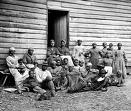
 Lately I’ve been reading interviews of ex-slaves and other “negroes” who remembered the Civil War and the freedom afterwards. Lisa Yannucci of Mama Lisa’s World, a site devoted to cultures and languages of the world, tipped me off to a section of the Project Gutenberg e-book site which contains Slave Narratives – A Folk History of Slavery in the United States, a government project of the 1930’s. Quite a number of these narratives are available to read online and are well worth the time. Lisa was most interested in the songs. Although spirituals were common, she found a couple fun ones including a celebration of freedom, so check out Mama Lisa’s World Blog post.
There’s nothing like learning history from those who lived it. Since there are so many interviews, below I’ve listed just a few of the particularly interesting ones – note I’ve only skimmed through the Arkansas narratives, part 1 of 7! You can download this particular section free in your choice of format at Project Gutenberg Work Projects Administration or choose another section.
– Uncle William Baltimore, Age 103, was a colorful character who, though blind in old age, could still thread a needle like nobody’s business and patch his own clothes.
– Henry Banner, born in 1849, states, “The last time I was sold, I sold for $2,300 – more than I’m worth now.” He explains the difference between police and “pateroles” and the saleability factors of slaves.
– Lizzie Barnette, approx age 100, wanted everyone to know she was from Tennessee, not Arkansas where she lived then. She had horror stories of the Yellow Fever plague in Memphis and saw many “ha’nts” (ghosts) on the streets and in houses.
– Boston Blackwell, age 98, escaped a beating by running away to a Yankee camp, worked for the government and was still waiting for his pension. He was so surprised someone wanted to hear his stories – “I ain’t never been axed about myself in my whole life!”
– Miss Adeline Blakely, age 87, was treated like a pet by her white owners and said she was spoiled rotten as a child. Her town was right in the middle of the Civil War and she has stories of southerner and northerner neighbors working together to keep their homes from being burned.
– Rev. Frank T. Boone, age 80, was born in the Free Colonies of Virginia to a white/Indian father and a black mother raised by Quakers. His is a detailed story that reminds us that the everyday aspects of life will someday be fascinating.
To me these interviews are as valuable as gold. Those I’ve read so far tell of being well treated by most of the masters during slavery, although they for sure worked hard and had to be wary of “pateroles,” jayhawkers, and Ku Klux (precursor to the Klan). Many slaves were happy to stay on with their masters after freedom or worked sharecropping nearby. Indeed, some thought times were harder after freedom when their living was less secure. Henry Banner claims, “Before the war you belonged to somebody. After the war you weren’t nothin’ but a nigger.” So far, I’m reading stories of the relatively lucky. Tales of beatings if a man didn’t pick 300 pounds of cotton a day, slaves being “sold at the block” and separated from families, and the hard work of all are told as a matter of fact – that’s just the way it was. Surprisingly the men felt quite free to vote after freedom and only later, after Jim Crow, were they intimidated and threatened. Funny thing, almost all of the interviewees felt the younger generation was “on the road to ruin,” … “God only knows what some of these young folks is comin’ to.” Now that’s a familiar line all through history!
In the news: The Senate passed a resolution Thursday calling for the U.S. to officially apologize for slavery and segregation. The Congressional Black Caucus, however, is up in arms about a disclaimer attached which basically states the apology has no connection with any claims of reparation. The CBC is hoping the U.S. will eventually provide some type of reparation to descendants of slaves and believes the disclaimer is an attempt to “stave off claims.” Reading the Gutenberg interviews, you will note that slaves heard they would get 40 acres and a mule, but very few received anything from the government. Most lived their last years at the mercy of family and white friends and neighbors. Whether modern descendants deserve reparations for their great great grandparents’ slavery is arguable and shall be left to political blogs.





 moonbridgebooks