War Cake

Jean Larson Steck of St. Louis was watching “The War” on PBS and remembered a certain cake recipe of her grandmother’s. Finally, Jean understood how this “War Cake” got its name – it was made without eggs, which were a scarce commodity during the time of rationing. She planned to bake it for her own children and explain its history. Lucky woman, she has the recipe written in her grandmother’s handwriting! Here is the recipe below for this spice cake, taken from the St. Louis Post-Dispatch:

War Cake

1 ½ c brown sugar packed
2 c water
3 tbsp shortening
2 c raisins
2 tsp ground cinnamon
1 tsp ground allspice
½ tsp ground cloves
½ tsp ground nutmeg
1 tsp salt
3 c all—purpose flour
2 tsp baking soda
½ c chopped nuts (optional)
¼ c candied citrus peel (optional)

Combine sugar, water, shortening, raisins, spices and salt in a saucepan, bring to boil for 5 minutes. Remove from heat and let cool. Stir in flour and baking soda. May add optional nuts and/or peel. Transfer to a greased 9”x9” pan, bake at 325 degrees for 40 minutes or until toothpick inserted in center comes out clean.
Posted in recipe, war stories | Comments Off on War Cake

The War Stories

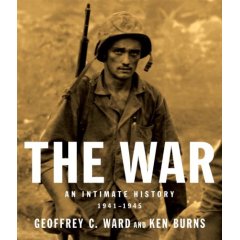
Did you watch Ken Burns’ documentary “The War” on PBS the other week? Our “greatest generation” is leaving us by the hundreds each day, taking with them treasure-troves of stories that tell us what it was like in the “old days,” and I mean what it was REALLY like to live those old days, not just that fact stuff you read in history books. The documentary relayed the terrible stories of individual men surviving horrifying destruction, and left me with a feeling of intense sadness and disgust at the thought of the huge waste of humanity and human potential. What I loved, though, were the stories of civilian people and how they coped back home. Tears, grief, fear, yet men and women and boys and girls all pitched in to help how ever they could with the war effort. It must have been an amazing time of bonding together not just to comfort each other but to work towards the common goal of ending the War and bringing loved ones back home where they belonged. War is such a shameful disgrace, a last resort when all else fails, but sometimes necessary when nations will not work together to help thwart an evil when it is still small. But, I digress from my family-friendly theme!

We in the U.S. are lucky that geography has kept us far away from the everyday reality of war. Lucky, but it leaves us in danger of forgetting, of not taking war seriously. It’s so easy to turn away from the T.V. or ignore the news articles. Many veterans who never wanted to speak of their experiences are finding it easier to talk about the war in their older age, perhaps because enough time has passed to dull the pain a bit, but perhaps they are seeing in today’s world how important it is to teach the younger generations about the terrible realities of war.

Ask your grandparents or parents of The War generation to tell you some stories of that time. What was it like to hear the announcement of war, what did they think about their country joining the war, what specific things were they afraid of, as civilians did they have to change their lifestyle any… so many questions, so many interesting answers, so much we must not forget.

Posted in war stories | Comments Off on The War Stories

Legends, Leaders, and Legacies

Recently I came across a new book for kids that should be in every school library. Legends, Leaders, and Legacies, by Susan Vollmer, is a compilation of short biographies of people around the world who lost their lives for important causes. It is written fairly simply so that children of upper elementary level and older can understand how one person can make a big difference because they felt a need to stand up for something they believed in. These personal biographies remind me of the books I devoured when I was a child, learning about the lives of those such as Abraham Lincoln, Florence Nightingale and Clara Barton, but Legends, Leaders, and Legacies covers important international figures such as Steven Biko (South Africa), Anwar Sadat (Egypt) and Ahmad Shah Masood (Afghanistan) as well as others less well known.

Ms. Vollmer includes a thoughtful and inspiring introduction, and at the end of the book is a wonderful author’s note that summarizes what is has meant for these people to be leaders-the qualities they needed, the sacrifices they made-but most importantly Ms. Vollmer states that one does not have to be a certain age or be perfect or rich to be a leader. One only has to make a choice to lead a meaningful life. I love the message of this book, “No matter what your age is, no matter where you came from or where you will go, you have something to contribute, just like those who came before us.”

Not everyone will have it in them to change society, but each of us has the power to change the lives around us.
Posted in history | 1 Comment