Veterans Day – honoring service and memories

Veterans Day is coming up – this Friday, November 11. The Battlefield Doc and I will be at a VFW post for breakfast and book signing. Doc loves to chat with other veterans, sharing where they were and what they did in the military and swapping stories. I watched the PBS documentary “Battle of Chosin” last week and was astonished to see all the combat video they had of the Korean War. Video that let me hear the horns and bugles of the Chinese attacking in the night, and the winter wind blowing down from Manchuria – brrr. Video and still photos that showed the horrors of what Americans and Chinese and Koreans lived and died through. Some of the survivors were interviewed, and many began to cry, even after all these years.

We need to see and to read about what our military men and women in combat areas go through. Six of our military men died last week, one in training stateside and the others in dangerous places overseas. We in our heated and cooled homes, sitting well-fed in our comfy chairs, need to be reminded now and then that we have survivors in our midst, many suffering PTSD, who deserve our respect and good medical care. Whether our veterans were in combat or not, they gave of themselves to our country, and the lucky ones lived to tell about it.

Doc said that often when he and his friend go out to eat, someone in the restaurant will buy their meal, sometimes anonymously. Doc wears his Korean War cap and his buddy is an elder veteran, too. Doc did not get any medals, but I’m glad he gets respect for all he did saving lives during that awful war.

On Veterans Day, set out your flag and listen to the stories.
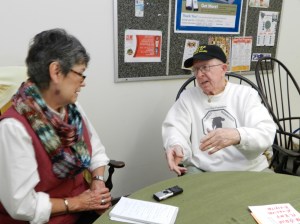
dscn8180

Doc talking to a reporter at his author event at the Kirkwood Public Library


Posted in honoring veterans, war stories | Tagged | Leave a comment

The art of memoir and writing about history

Mary Karr came to St. Louis again, this time to talk about The Art of Memoir, her latest popular book. She’s had quite a life and lived to tell about it: The Liars’ Club, Cherry, Lit. She said, “Writing is a way of connecting.” Connecting with yourself and with others. Her goal in writing is to “make the reader feel something.” Let them feel what it was like to be there.

More recently, I went to hear H.W. Brands talk about his book about the butting heads relationship between Harry Truman and General MacArthur during the Cold War, because I thought I might learn something new about the Korean War, beyond the research for Battlefield Doc. While Dr. Brands did have interesting things to say about “The General vs. the President: MacArthur and Truman at the Brink of Nuclear War,” I was surprised to hear him talk about the art of writing. The audience was mostly older than me—men and women old enough to remember this forgotten war—and I was not sure they were there to hear about writing skills.

Turns out, Dr. Brands, a historian, teaches writing, too. He knows that he needs to identify who he is writing for. He said his model reader wants to learn about the real world. Not everyone does. (Note: the reader audience for your memoir is not “everybody,” as many new authors believe.) Brands asked his writing students if they thought reading true stories was better than reading fiction. Some said no, because they read to escape from real life. And if they read anything historical with dates, that made them feel they were supposed to learn and remember—work! So Brands decided to write history as biographies that read more like novels. “History is boring, but biographies are interesting because they are about people” and not a bunch of dates and places. His wife reminded him of Elmore Leonard’s famous advice, “Take out the boring stuff.”

So, as you write your memoir, or a memoir/biography of a parent or grandparent, remember to take out the boring stuff and make the reader feel what it was like to be there. Many memoirs can use a sprinkling of history to help readers understand what is affecting the life of the author-subject, but don’t let the story get bogged down in the nitty-gritty. Battlefield Doc, although a war memoir, does not include many dates or place names because they are not important to the actual stories, and since it is not a (boring) history book. When you write, “talk” to your readers as though they are your new friends. I hope the older audience did pay a little attention to Dr. Brand’s writing advice, in case any of them decides to write a memoir.

IMAG2479.jpg

Posted in history, memoir writing, writing, writing skills | Tagged | Leave a comment

War brides: the untold story

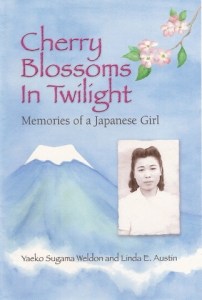
War brides. They were out there, often alone in a world of white, figuring out how to fit in. In my Japanese mother’s case, she was in the midst of Midwestern cornfields raising children who were the only non-white bread in their school system. In the last few years of putting together her life story, I realized that almost no one in the US knew much about civilian life in Japan during WWII and few knew much about the Japanese women who married Occupation-era soldiers and immigrated to new and very foreign lands. I did know that wrong and unpleasant ideas about them existed. This is when I decided to formally publish Cherry Blossoms in Twilight, which happened in 2005. Two years later (and after I had learned a thing or two more about writing and publishing), I published a more polished second edition to include more information and photos. Cherry Blossoms can be found in the libraries of some major US universities and even one in the UK, I’m sure not because my writing is so awesome,* but because the story is so rare.

I was happy to see a big article recently in the Washington Post on Japanese war brides. Quite a few people sent me the link. The article publicizes the newly released short documentary Fall Seven Times, Get Up Eight featuring the “largely untold story” of Japanese war brides, or at least three of them; their stories, however, are familiar to me and likely to many children of war brides. These women are in their eighties now, so it’s taken all these years since the end of WWII in 1945 for their stories to come to light to the general public. Some war brides have never told their stories to their own families.

More than Japanese war brides are out there in the world. Some of my mother’s friends included a British war bride and a Vietnamese war bride. I wonder if their children know their mothers’ stories of surviving a war that devastated their country, marrying a foreign man and starting a completely new life far away. If your mother or grandmother is a war bride, ask the questions that will start your own family memoir.

Cherry Blossoms Twilight

*It is more important when writing other peoples’stories from their first-person perspective to be true to their words and stories rather than polishing them up so much that their family and friends don’t recognize them speaking. If you’ve read Cherry Blossoms or any of my other books, please leave a review on Amazon and/or Goodreads as they are valuable to us little publishers. Well, terrible reviews aren’t, but 3-stars or better we appreciate – thanks!


Posted in capturing memories, history | Tagged , | 1 Comment