National Life Writing Month: Turning Memories into Memoirs

Yes, November is National Life Writing Month. That gets short shrift compared to NaNoWriMo. During this National Novel Writing Month, so you’ll find writers around the world sequestering themselves or hanging out at libraries or coffee shops, typing away at their novels, trying to make the 50,000 word count by the end of the month. That’s only about 200 draft book-pages, but that’s a good start. Life writers can do their version of NaNoWriMo by focusing hard on writing their nonfiction stories.

The Thanksgiving holiday can interfere with NaNoWriMo people, but it is a boon to life writers who can interview family at gatherings and enjoy looking at photos and sharing and comparing stories. Our stories capture history and culture, but also important life lessons. How did we cope with problems or bad experiences? Writing our stories can give us insight into our own selves. What do our life experiences teach us about ourselves? Denis Ledoux, in his book Turning Memories into Memoirs, says our stories have power. “If they are preserved, they can offer meaning and direction for your children and grandchildren—just as they can for you.”

Turning-Memories-Into-MemoirsI find plenty of people who know they have great family stories but are intimidated at the thought of writing them down. They aren’t writers, they don’t know how to start, they feel the project is too big, they don’t have time to figure it all out. Turning Memories into Memoirs is an overview that encourages those on the edge who feel inadequate in their writing skills. It breaks down the process of life story writing so it is not so overwhelming. Denis’s book is based on his years of leading workshops and will help any new writer gather and organize information and learn how to put it all together. Memoir does not have to be one giant story, but can be a series of short stories—much more manageable.

Denis managed to cover all the bases, distilling the whole process down to its bones, leaving room in his short book for plenty of valuable tips, anecdotes, and examples of stories and writing technique. Of course he discusses the standard memoir issues of writing around and about painful memories and of what is the truth, whose truth is it, how much do you put in, and what if you don’t know the truth. He mentions a little about publishing, both for private use and public sales, then ends with a list of resources and an index.

I highly recommend Turning Memories into Memoirs to anyone wanting to cut through the fluff and learn more about the actual process of writing and writing well. Denis makes it easy. Brand new writers can feel success just getting their stories down on paper or can be inspired to polish them as brightly as they can with Denis’s explanations.

Do you have a family storyteller? What happens to the stories when he or she is gone? Don’t let them disappear! If no one has been telling stories, it’s time to start. Give your family a past to enjoy, let them feel a connection to history and their ancestors. Who are you, and where did you come from? The personalities and life journeys of one generation affect the next. Think about it. The day after Thanksgiving is the National Day of Listening. Especially if you’ve got a family gathering for the holiday, take the time to ask for stories, because if you don’t, you may never hear them.

I leave you with another comment from Denis’s book:

“Lifewriting is important. Believe in your stories enough to commit yourself—today, tomorrow, and the day after—to write them down for yourself, your family, and possibly the world.”

* * * * *

Denis Ledoux helps people write their memories. Take a look at his Memoir Writer’s Network website to find see the other books he’s written or to see the writing and publishing services he offers. Find helpful articles on his Memoir Writer’s Blog
Posted in book reviews, book talk, capturing memories, lifewriting, memoir writing, storytelling, writing, writing skills | Tagged , , | 2 Comments

Remembering Pain: Bosnia memories

“Never forget. If we forget, it’s as though it never happened.” Unfortunately the words fit more than the Holocaust, the genocide of Jews in WWII. Humans continue to commit genocide without apology. Recently, I attended a screening of the new documentary Pretty Village by Kemal Pervanic, a survivor of the Omarska death camp in the Bosnian War of the 1990s. What a story he told at an event sponsored by the Bosnia Memory Project.

St. Louis has the largest Bosnian population outside of Bosnia, thanks to the influx of refugees from the Bosnian War where many thousands of Bosnians were abused, tortured, and massacred. Mr. Pervanic, who has gone back to his home village to visit what is left, says his Serbian former neighbors, friends, and school teachers have their reasons for participating in the atrocities and are tight-lipped and unrepentant. Some say, “We were the good guys, at least we didn’t kill you.” Only 50 of 800 villagers were left.

Sadly, history does repeat itself as too many people only look to their own future and could care less about others. There are many ways to justify the evil we do and many ways to twist a story. Still, the victims know the hope for the future lies in remembering. Someday, caring and peace-loving people may point and say, “Look what happened before when we turned away and did nothing.” Turn away and lose a bit of your own humanity. Interestingly, there is little physical difference between the Bosnian Muslims, Orthodox Serbs, and Catholic Croats; the Bosnians tended to be rather secular in their beliefs; and all three groups co-mingled well before the trouble started. What happened?

The stories behind the Bosnian War are complex, but can genocide ever be justified? Some of the Bosnians who fled during the war have returned to live among their former guards and torturers. Mr. Pervanic, who escaped to the UK and still lives there, says another war is in the wings because it was never over. However, he has started a program called “Most Mira,” or “Bridge of Peace,” a British and Bosnian nonprofit working with children in the Prijedor area of Bosnia “to encourage understanding and tolerance between young Bosnians of all ethnic backgrounds.” He also works to encourage fellow survivors of the war to speak up and tell their stories, to “take ownership of their pasts, because without history, you don’t exist. You were a part of the genocide story and need to keep the memory alive.” The Bosnian Memory Project, based in St. Louis, also encourages the telling of stories for the sake of history, to help in healing and reconciliation, and to share the culture and experiences of Bosnians.

A few published first-hand stories of the Bosnian War exist:

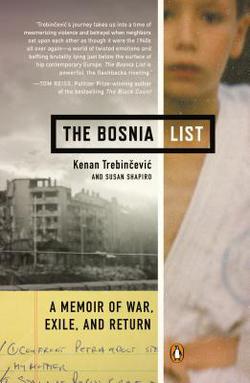
The Bosnia List by Kenan Trebincevic and Susan Shapiro

Bosnia List


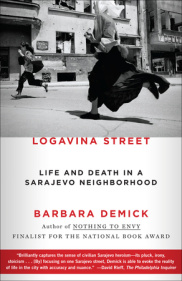
Logavina Street by Barbara Demick

Logavina Street

Posted in heritage, history, war stories | Tagged , , | 1 Comment

The Pruitt-Igoe Myth: history and truth through personal stories

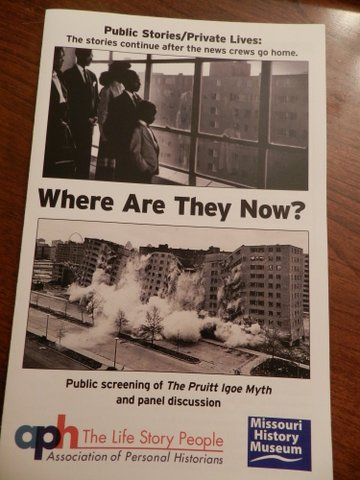
Pruitt-IgoeI love historical documentaries, partly because they usually include personal stories. The other day I saw The Pruitt-Igoe Myth, an independent film documenting the rise and fall of the infamous Pruitt-Igoe public housing project in downtown St. Louis. All I knew of the project was that it was a controversial symbol generally interpreted as either a failure of public housing or a failure of the poor (especially black poor) to behave civilly, or both. I learned so much from the film and the discussion after with the film producer, a representative of our local history museum, and several former inhabitants of the project. There’s a huge story there, about as huge as the project, which I did not know occupied 57 acres! Apparently the media had its own big failure then by neglecting to explain all the complexities and instead focusing on a simple, negative agenda that became known worldwide. Most of the photos that exist of the project are of it being destroyed.

Much of the details of Pruitt Igoe can now be found online, but not everything. The documentary can’t say everything either in its limited time. That’s where the personal stories come in. Some are in the film, but there’s more to it. Three siblings of a family of fourteen were on stage following the film to answer questions. We learned that able-bodied men, including fathers, were not allowed to live in the development. They could go out and support themselves and let the government provide for their families. Fathers were not to be anywhere near the area, I guess lest some of that free government money ended up in their able hands.

While the siblings missed their father dearly and were resentful of the social workers and rules that kept him away, they said they and others had wonderful memories of the projects—the sense of community and the strong bonds among family, how every child had his or her own bed and a nice place to live – for a while. The cost and difficulties of maintaining thirty-three eleven-story buildings and the grounds were not realistically considered and the buildings began to deteriorate.

White people of the Igoe section of the segregated project began to leave, along with businesses and the rest of the city population, to new suburbs where the cost of land and houses was cheaper than land and renting in the city. Telling is that there are few stories of white people living in the project because they could find jobs more easily and afford to escape, particularly into the new suburban whites-only areas. The projects were but a temporary housing situation for them. As the buildings emptied, crime moved in. When the projects were finally destroyed—only twenty years after they were built—many residents cried. That had been their home, and they had good memories. Every spring a reunion is held with several hundred people who laugh and tell stories of good times and bad.

It wasn’t all bad. The drugs and crime came in later years and was bad outside the projects, too, but these are not the stories we’ve been told. The real stories include strong mothers holding together strong families, kids having a place to sleep and play safely, good schools nearby for them, adult education classes offered in a nearby church – hundreds attended those classes. The representative from our history museum said the public memory of Pruitt-Igoe is fading as time goes along and former inhabitants pass away. That’s why capturing the stories is important. To capture the side the news didn’t tell. To destroy the myth and acknowledge a perfect storm of factors. Public housing is not all bad, modern architecture is not all bad, and poor black people are not all bad.

*Interesting to note, the main architect of Pruitt-Igoe was Minoru Yamasaki, working within the confines of federal government rules and opinions. He was also the architect of the World Trade Center, which was being built as Pruitt-Igoe was being torn down and which in turn was later destroyed, but by terrorists. Yamasaki is also the architect of the original portion of Lambert St. Louis Airport.

Posted in history, memories | Tagged , | 3 Comments