Publishing Your Book, and NaNoWriMo for nonfiction

November is National Novel Writing Month, when writers around the world frantically try to write 50,000 words by the end of the month to finish a first draft of their novel. NaNoWriMo, as it’s nicknamed, is a great way to put a fire under the seat of any writer. I can always use a fire under my seat when it comes to writing, but I don’t write fiction and November is a lousy month for me to meet any big writerly deadlines. I’m busy doing yardwork and then there’s Thanksgiving when we sometimes have visiting family. This year, though, I am taking on a writing challenge–to finish off a short book of my mother-in-law’s childhood, including some of her recipes with color photos. I’m mulling over how to get a few copies of a family-only book with color interior. Color interiors cost a lot, but then won’t this book be priceless anyway? What a great Christmas present.

Those of you narrative nonfiction (memoir) writers might want to sign up for Nina Amir’s 2013 National Nonfiction Writing Month (NaNonFicWriMo) challenge. It’s not too late! You can write your first draft, polish up a second, or aim to finish a project. I didn’t sign up, but I will try to get my project to the printer by the end of the month. If I get done early I’m in the midst of a second memoir project that needs a fire under it.

After NaNoWriMo is over, plenty of writers start wondering how to get their work published. I helped teach a class on that yesterday at the community college, with three other St. Louis Publishers Association members. The class is always a big hit because we fill everyone’s head to overflowing. There’s a lot to learn, and a four-hour class is really just a teaser. But, that’s what attending SLPA monthly meetings is for. Since the publishing world changes so fast, I had to update my presentation from last April’s class. Today, I tackled updating the publishing articles on this website. So, for those of you interested in publishing for the public, click on the Resources tab above and look at the articles on Methods of Publishing, Amazon CreateSpace, and Lightning Source. There’s even a new article on e-book publishing. Enjoy!
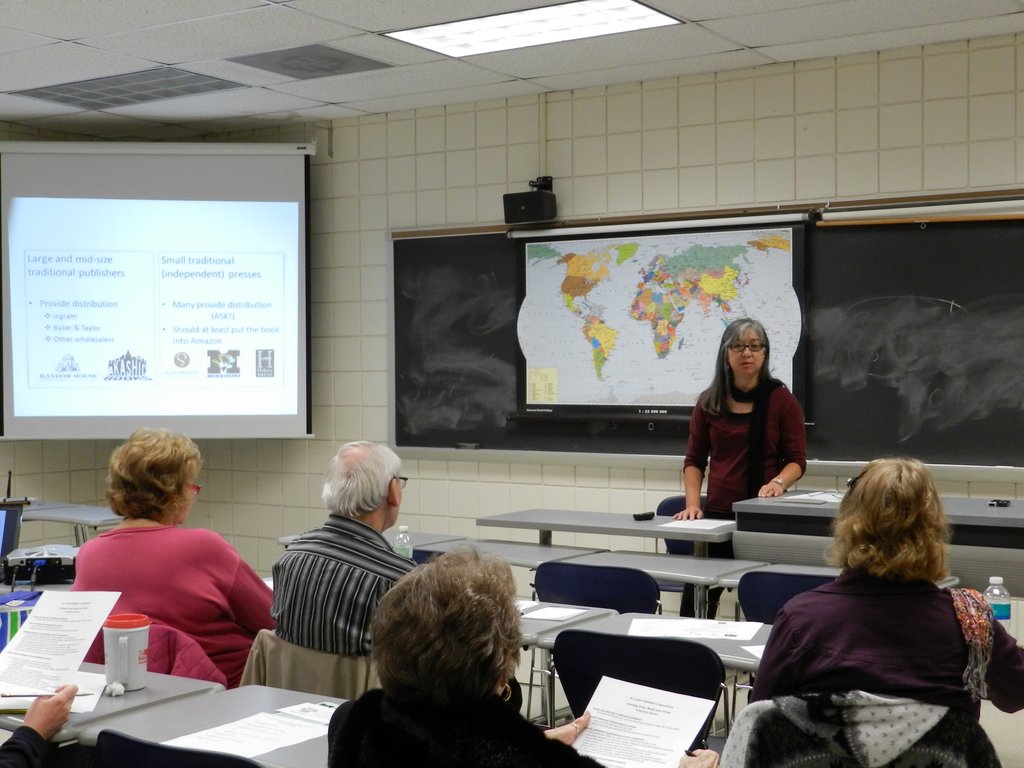
A world map is an appropriate backdrop when talking about distribution

A world map is an appropriate backdrop when talking about distribution

Posted in publishing, writing | Tagged , | Leave a comment

Eighty Days, a race around the world: Bringing someone else’s history to life

Wouldn’t that be exciting to find a stranger has discovered a stack of letters written by one of your ancestors and wants to write a book about her? Matthew Goodman wrote Eighty Days about a historic race around the world that caused great excitement in the late 1800s. Pioneering women journalists Nellie Bly and Elizabeth Bisland both aimed to be the first person to travel around the world in less than eighty days, to break the fictional record of Phileas Fogg from Jules Verne’s novel Around the World in Eighty Days. Feisty investigative news reporter Bly had the idea in the first place, and Bisland’s magazine editor persuaded her to race against Bly going in the opposite direction. Bly didn’t even know she had a competitor until she reached Hong Kong, and boy did she get mad about that.

Matthew Goodman did two years of research before he felt ready to begin putting together the story of these two very different women. Bly worked for Joseph Pulitzer’s The World, the most influential newspaper of the time, and boldly chased after sensational stories, particularly those that exposed social injustice. Bisland was a refined and quiet woman, a poet and essayist, who was literary editor for The Cosmopolitan, an upscale magazine (now known as Cosmo, a very, very different sort of read). Like Bly, though, she was also an advocate for social justice and women’s rights.

While a lot has been written by and about the outgoing Nelly Bly, Bisland shunned the spotlight and after the race went to live in England for a year to escape the height of her fame in the United States. I asked Mr. Goodman how he found enough material to write about Bisland. Besides reading whatever he could find, including a few books she wrote, he discovered Tulane University held a stash of letters she had written, letters Bisland’s own family didn’t know about. Some of Bisland’s descendants are avid genealogists who shared their information and an unpublished family history with Goodman. A great-grandniece let him see other letters by Elizabeth written about subsequent travels. The family is pleased that someone has written all about their amazing but almost unknown relative, to share her historic achievements and open-minded perspectives. My advice, though, is to not hope for a stranger to come along to write about you or your ancestor. Get busy and write, and get it published, too, even if it’s just for your own family.

Anyone who enjoys reading about history, adventure, world cultures, bold women forging their way through male-dominated society, and the complexities of personality (listening to Goodman talk, I thought Nellie Bly a particularly interesting person) should pick up a copy of Eighty Days: Nellie Bly and Elizabeth Bisland’s History-Making Race Around the World. While Goodman writes about these women as for a history book, he skillfully intersperses dialog and third-person storytelling to make the book much more pleasant to read than straight history. In his hands, this works. Many details of daily life in the times and the intimate storytelling tell us he had a wealth of letters and historic information to work with. I opened the book to find Elizabeth in Japan so of course I had to buy a copy. Goodman said she loved Japan and returned there in later years. I need to save up for my own visit.

Photo325

Posted in book talk, history | Tagged , | Leave a comment

“The Boy at the Gate” memoir is a poignant song

DSCN3993At the age of eight, Danny Ellis was separated from his siblings and dropped off at the most notorious orphanage in Ireland. The Artane Industrial School housed 800 orphans and delinquents that nobody wanted—a noisy, ragtag bunch of “humanity’s lost children.” His ma said, “I’ll be back for you at Christmas.” He saw her briefly one more time, and then never again.

I saw Danny Ellis perform part of his memoir the other night. He’s a singer-songwriter, invited to open for Bonnie Raitt last spring. He’s got a gently scuffed voice that goes well with the sweetness of his guitar playing. Ah, and that Irish brogue is the cream on top. Danny has been touring the country telling a touching story of his rough upbringing, singing his way to healing. If he comes to your area, be sure to see him.

Danny came out of the orphanage at age 16 trained to be a cobbler, but music was his calling and soon he was happily making a career of it. He pushed his childhood to the side, “focusing on other things rather than on why my ma left me.” His younger sisters later found him and had to “insert themselves” into his life because he didn’t want be reminded of his abandonment. Late one night many years later, while unwinding at home after a gig, the notes of his past began to flow through his guitar and he realized “there was a part of me still left in the orphanage.” His CD 800 Voices is the tuneful poetry of that part. His memoir, The Boy at the Gate, is the poetic prose. The beautiful, sensitive writing in an online excerpt of the book drove me to go to Danny’s event, which turned out to be well worth the fight against Cardinal Nation traffic heading home after a game 2 NLCS win.

The Boy at the Gate is not all sad sack. Reading to page 44 and skimming through the rest, it is mostly an introspective and often amusing look at bad times and colorful characters. Ellis was born in Dublin, a city he says was full of interesting and humorous people. “Poverty creates characters … Everyone in Dublin was a thespian. Nothing was ever what it seemed.” Of his rough childhood Ellis said, “A kid thinks his life is like other people’s. Even if bad things happen in the morning, something good can happen in the evening. You make the best of it.” He said he never had the energy needed to be hateful or vindictive. “Life is very beautiful despite how bad it can be. We would look for beauty anywhere—in friendships, little animals, bugs.” He writes about a tough boxer who would “sing as if to save his life while saving my life, too.” When Tommy, the fighter, turned 16 and left the orphanage, Ellis knew it was his turn to sing to save his own life. And he did.

The book is written in present tense, transporting us to the rough city streets of 1950s Ireland and refusing to let us go. The prologue alone is gripping, the writing evocative. A soul-satisfying epilogue and an overview of the orphanage’s history end the book. I asked Danny about his beautiful writing style and he explained that the brevity and emotion involved in songwriting lent itself well to writing his memoir. A well-known ghostwriter actually refused the job of writing for him after reading draft pages because they were so well-written. Danny is thinking of writing a second memoir about exploring who he really is. He knows his persona has been shaped by what’s happened to him, so who is he underneath all that? I don’t know, but he sure seemed like a nice guy to me.

DSCN3940

Posted in bad memories, book reviews, book talk, multicultural | Tagged , | 4 Comments