Drifting away from your roots

Fall is in the air, my favorite time of year! Except I’m not so happy. Today is my mother’s birthday and she’s no longer with us. As the leaves begin to turn my thoughts turn to my mother’s last days. She became ill a few weeks after her birthday last year and did not recover, passing into another existence days before Thanksgiving. With her passed a big piece of my life and a piece of my heritage.

I have enjoyed celebrating my Japanese roots ever since we moved to this area and found a good-sized group of Japanese-heritage people. There’s even a big festival and a big Japanese garden! I’d be happy to celebrate my Dutch heritage, too, but I don’t know anything about it. My dad’s family didn’t do anything particularly Dutch – except go to a strict Dutch church – even though they were immigrants. The Dutch heritage was absorbed into American-ness by the first generation.

Since I’m being melancholy missing my mom, I have been wondering how fast our Japanese heritage will disappear. One daughter looks entirely Caucasian and will probably marry a Caucasian man. She has some interest in things Japanese, particularly in Hello Kitty and Totoro and certain foods (she can make tempura). Will her children (if she has any) be interested in the one-eighth Japanese heritage hiding inside them? Will my daughter sing the Shojoji song to her kids? Will she take pictures of her white toddlers in hand-me-down kimonos and feed them rice with seaweed sprinkles? We’ll see. This daughter may relate more to her daddy’s Southern family in the Tennessee countryside, but she is very much an American Midwestern city girl.

My other daughter does look like she has Asian heritage and has some interest in things Japanese, but about as much as her sister. She did try to learn Japanese with me one summer with a private tutor, but quit in frustration (I didn’t last much longer). Recently, though, she surprised me by saying she wanted to teach English in Japan and maybe live there for a while because “It’s not that interesting here.” We’ll see. She was referring to culture in her statement. American culture can seem rather bland compared to old cultures with colorful customs and traditions and thousand-year-old buildings.

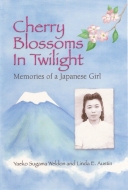
If my younger daughter follows through with her plans (she’s only in high school), then the Japanese heritage might live on. I’m not holding my breath. I will be sad to see the richness of that heritage wash away, but I may not be around long enough to see. No matter what, my mother and I will smile down upon our future generations from behind a veil, our whispers blending in with the wind, knowing there is a book that tells our story.

A few yellow leaves
Drifting from the locust tree
Reminding me
My mother left this earth
When the maples burned red

Posted in death, heritage, relationship | Tagged , | 5 Comments

Canton Elegy: Astonishing memoir of Chinese history and a father’s love

Canton ElegyRecently I finished reading an advance copy of Canton Elegy by Stephen Jin Nom Lee. It is one of the most beautiful memoirs I’ve ever read, and I’ve read a LOT of memoirs. I wrote about Canton Elegy in April 2012 when I saw an article about how the handwritten, English-second-language pages were kept in an attic, waiting long after Lee’s death until . . . a grand-daughter and her writer-husband from overseas came to visit. Howard Webster was enthralled with what he read and the resulting book will be released this week.

Well, I was enthralled, too. Stephen Lee wrote a long letter for his children—the story of his life until his firstborn child graduated high school and left for the U.S., the rest of the family soon to follow. He wanted them to know what he and his wife had gone through and to “speak to, comfort and inspire my children, grandchildren and their children in a time when my name is just a memory carved in a tablet of stone on a grassy hillside.” Mostly he wanted his children to know how much he loved them, and his love shines through like a star in the night of his story. He died in 1970, Howard Webster was given the manuscript to read in early 2012.

Jin Nom Lee was born in China in 1902 and his father died soon after. At age six, Lee’s grandfather took him away from his mother to be educated in the U.S. Despite a college degree from Berkeley, Stephen Lee could find no job but menial work and so returned to China. Racism was rampant in the U.S. then. In China he was a successful banker with a civilian job with the Cantonese Air Force, a dangerous association as communist forces sought to overthrow the government. Civil wars were interrupted by WWII and the Japanese invasion and continued afterwards until Chinese communists took over. So much danger in this book! Lee’s wife fled the Japanese army in a harrowing 300-mile journey on foot with four young children to reach her husband sent to open a new bank branch in a safer location. Enemy soldiers, starvation, killing floods, and vicious Red Guards keep the story riveting, but the prose is eloquent and often poetic, sincere and hopeful. Many times I paused to take in what had happened, or paused to soak in the beauty of the words and the wisdom for the generations.

Every child should be so lucky to receive a gift of story and life learnings from a parent! Stephen Lee speaks to his children from the beyond. How wonderful for them to know their father, though he worked long hours and may not have been forthcoming with words, loved them deeply . . .

“That’s why this manuscript is important. I want it to be a gentle golden thread of memory to connect us, to remind you that you, my children, were, and always will be, loved. The love I have for you is a single thread of shimmering, unbreakable certainty.”

I am thankful that Howard Webster knew how to get Stephen Lee’s words published. Read this book! Its words will pierce your heart and live in your mind.

Posted in book reviews, book talk, grandparents, history, inspiration, letters, multicultural, war stories, WWII | Tagged , , , , , | 1 Comment

Visiting your family roots far away

Kathy Pooler, a fellow memoir-writer who also encourages others to write their stories, just posted in her Memoir Writer’s Journey blog about a recent visit to Italy where she met her overseas family for the first time. See Back to My Roots:  A Memoir Moment. What a meaningful vacation! Her post made me sad, though, as I have never seen my Japanese relatives. I would need a translator and lots of money because Japan is an expensive place to visit–and I would want to visit all over the country. Then there is that omiyage thing. Omiyage is “the gift you keep on giving.” In the land of respect and politeness, visitors must bring gifts and they in turn will be given gifts. Heaven help the person who brings over a tray of cookies – the return of the tray (never a throwaway) involves gifting something back, and then back and forth the tray goes forever, so goes the  joke.

My parents could not afford trips to Japan, and omiyage was intimidating to my mother on a budget. My dad finally insisted on taking my mom back ten years after he brought her to the US, and us kids had to stay home “because you won’t like the food.” It’s true we cried for McDonald’s whenever Dad took us to Japantown in Chicago so Mom could buy food stuffs at Star Market and they could eat at Kamehachi sushi restaurant. I’m sure the real reason we kids had to stay home was cost.

The visit was just in time. Mom was able to reconcile some issues with her mother before her mother died. It was a sweet homecoming. After that, she saw her two sisters and their families only once every 10-20 years, and my sister and I were never able to go with her for financial, work, or our own family reasons. I rarely see my own sister, but I couldn’t imagine being away from her that long!

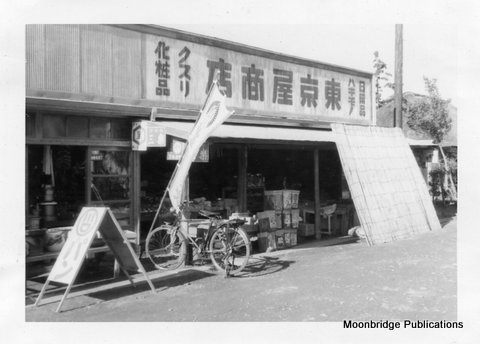
Kathy Pooler had the joy of seeing the house where her grandfather was born and of meeting his nieces and nephews. And eating Italian home cooking! Apparently in Italy they practice omiyage, too, as Kathy was laden with gifts by delighted relatives. If I went to Japan, I would find nothing left of where my mother lived. She remarked on all the changes after her first visit back. Her old home was gone. Her small town in the tea fields, with its dirt roads and wooden shop fronts, was quickly becoming a bustling bedroom community of Tokyo. She had only the memories – and her sisters. Johnson Air Base where she worked was turned back over to the Japanese around 1970, then abandoned. The remains of a few base houses are engulfed in overgrown brush, viewed behind barbed wire.

Someday I hope to go to Japan. Someday I hope to go to Holland to see where my dad’s ancestors came from. Until then, I live vicariously through people like Kathy and Kim Wolterman, another memoir-writer and history-loving friend, who has just travelled to Germany and Switzerland to discover her faraway family. I’m so excited for them!

Tokorozawa, 1950s

Tokorozawa, 1950s

Posted in family gathering, heritage, relationship | Tagged | 4 Comments