Denis Ledoux on writing your memoir: What if I can’t remember?

A few weeks ago, Denis Ledoux of The Memoir Network posted an article on the LinkedIn Memoir Writers Society group that gave some good tips for capturing memories. He’s basically advocating a brain dump, the writing down of snippets of memories as they come. A writer’s notebook would come in handy for this – carry it around with you. I keep a small notebook in my handbag (which comes in handy for all sorts of spontaneous note-taking). After publishing his own collection of autobiographical fiction, Denis began presenting workshops on memoir writing. He and his team work to help others write and publish their memoirs. With his permission, here is his post:

What if I can’t remember?

People who are writing a memoir will sometimes say, “I want to write my stories but I have forgotten so many details. Is there any way I can get them back?”

There is one tool above all others that makes the experience of life writing successful. That tool is the Memory List. No other exercise opens up the process of life writing as quickly and as surely as the thoughtful and thorough compilation of such a List. It’s simple, and as a first step, it’s crucial.

In this article, I will talk about the Memory List (a general term for your list of memories) and the Extended Memory List (its widest, most all-inclusive version). The Core Memory List (the list refined to the ten most important memories) is covered in a separate article.

Your Memory List is always a work in process because the more you remember and jot down, the more you’ll recall. You will return to and rework your list again and again as you write your life stories.

1.) The Extended Memory List consists of short memory notes (three to five words is sufficient) of people, events, relationships, thoughts, feelings, things-anything-from your past. The list is usually random and always uncensored. Each line lists a different memory. When you write a different memory, start a new line. Do not feel compelled to write in full sentences. (In fact, I urge you not to write in full sentences!)

2.) Let the logic of creating a Memory List be internal. Do not force yourself to be chronological (“everything I did when I was sixteen”) or thematic (“my father”), and do not strive for cause-and-effect relationships (“because this happened, that followed…”) unless the memories come that way spontaneously.

3.) Do not censor your memories. As soon as you find yourself thinking something like “Is this really important enough?” you are censoring your memory and compromising your Memory List. Censoring can result in a list that is less comprehensive-and therefore, less useful to you as a lifewriter-than it would be if you allowed yourself to be free-flowing and uncensoring. Let yourself go where your imagination takes you.

4.) A Memory List includes both big items and small ones. Any of the following are “on target” such a list:

– Brother Stan died.
– Green wallpaper-stage coaches and buttes.
– Sister Marie Gertrude fell on stairs.
– My parents divorced.
– Blue Schwinn bicycle.

The list is for you, and you’re the only one for whom it needs to have meaning. No one else will see it unless you share it. Include enough data to make the notes understandable to you at some future time. Don’t fall into the trap of writing something cryptic like “cap.” In a month’s time, you may not remember which “cap,” or whose, you were remembering. But, if you wrote “Bob’s Red Sox cap/1970,” it is likely you will have enough of a cue to recall what you meant.

5.) The Extended Memory List ought to be fairly long. It is not unusual for a writer to spend two or three weeks or even months compiling it. You will find yourself adding to it regularly in the months ahead as more and more memories come to you.

This Extended Memory List will go in your three-ring binder. It will serve as your source of writing inspiration and be a tremendous time saver. Whenever you sit down to write, you won’t need to spend time coming up with a topic. All you have to do is pick an item on the list and write about it. (Write everything you remember about the “blue Schwinn bicycle” you mentioned on your list.) With your Memory List, you need never again have writer’s block. With an extensive list of memories to pick from, you will always have a ready prompt.

What tools do you have to remember life stories?

* * * * *

Denis LedouxEvery November, Denis offers “November is Lifewriting Month.” NILM provides writing prompts via e-mail, free tele-classes on memoir-writing techniques and many surprise memoir gifts. Denis is the author of the classic Turning Memories Into Memoirs/ A Handbook for Writing Lifestories. Most recently, he completed his mother’s memoir, We Were Not Spoiled, and his uncle’s memoir, Business Boy to Business Man. Denis is currently working on a book about “writing with passion.” Jumpstart materials are also available for writers wishing to be memoir professionals in their communities.
Posted in capturing memories | Tagged | 11 Comments

Patricia Polacco: Family stories for children

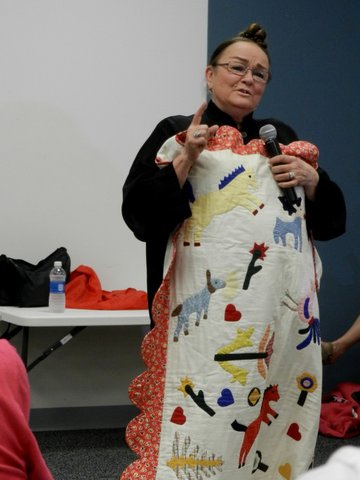
Author Patricia Polacco spoke at the St. Louis County Library the other night. She is the writer and illustrator of about 57 children’s books so far, more in the works. Her books are well loved. The Keeping Quilt celebrates its 25th birthday this year with a republished version of 15 more pages explaining what has happened since to the quilt. The story’s prequel, The Blessing Cup, has just been released. These are family stories she has heard “a thousand times, and each time they got more majestic.”

Patricia’s great-grandmother’s family emigrated from Russia, her father’s side from Ireland. She grew up “watching” her Russian grandmother telling stories, not watching TV since there was none in the house. Sometimes she would ask her babushka if a story was really true. “Of course, it’s true—but it may not have happened.” Patricia said, “Truth is the journey one takes through the story. Did it make you laugh? Cry? Seek justice?” She is working on an Irish story of her father’s family emigrating to Chicago and experiencing the Great Chicago Fire of 1871.

Patricia Polacco did not learn to read until she was about 14 years old. Her learning disability is documented in poignant books: Thank you, Mr. Falker and The Art of Miss Chew. Her story of embarrassment and shame, of being bullied mercilessly, and of finally overcoming the dyslexia she tried to hide brought tears to many eyes. She had teachers who were her heroes. She did not become an author until the age of 41, a fact she says draws gasps from children at school presentations. How old!

Patricia grew up in a family of “amazing” storytellers, and her best friend since childhood is an African-American man whose family of storytellers is from the bayous of Louisiana. Patricia has lots of stories, from her family as well as her own real-life experiences, some with her Rotten, Red-headed Brother and with her friend Stewart. She says almost all her books have a red-headed character in them–“red-heads are magic!” And almost all have both young children and elderly in them because of the wonderful experience she had growing up with her grandparents.

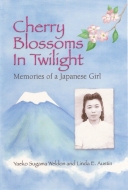
Maybe you have some fun or poignant short stories of your own that can be turned into children’s stories to pass along the branches of your family tree. My mother’s memoir, Cherry Blossoms in Twilight, was written with her future great-grandchildren in mind. She has passed on her stories of catching tadpoles in rice paddies and hearing spooky tales of the Old Fox, and she has even left us songs she used to sing as a little girl. Our life stories don’t have to be long memoirs for grown-ups. Think of the young children, too.

Patricia Polacco The Keeping Quilt

The Keeping Quilt

The original “Keeping Quilt” is now in a museum,
but Patricia says when she touches this reproduction
she can still feel her grandmother.
(The yellow horse is her favorite piece)

Posted in book talk, capturing memories, grandparents, heritage, raising kids, storytelling | Tagged , , | Leave a comment

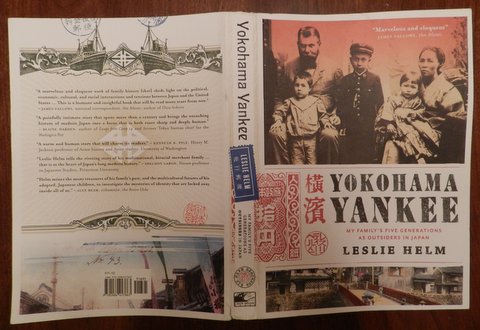
More on making family stories and genealogy come alive: “Yokohama Yankee”

The story begins at a funeral marking the “fading presence in Yokohama of a family that witnessed Japan’s transformation from a feudal nation ruled by samurai into one of the world’s greatest industrial powers.” Yokohama Yankee: My Family’s Five Generations as Outsiders in Japan is a very readable quest of journalist Leslie Helm to learn more about his famous German-Japanese family. Helm is a quarter Japanese. He was born and raised in Yokohama, where his family’s roots go back to 1869. The funeral that begins the book is for Helms’ father, the last (and reluctant) heir of the illustrious Helms Brothers company that provided stevedoring and other transporation-related services to the ships loading and unloading in Yokohama harbor, later in Kobe and other major Japanese ports. Leslie Helms was not close to his half-Japanese father, although both were similar in that they were uncomfortable being part-Japanese. Most of the Helms “felt insecure in the country of their birth.”

Leslie Helm added fascinating tidbits of historical information beginning with his great-grandfather Julius leaving farm work in Germany (and, as the family joke goes, escaping an arranged marriage) to try his luck in Minnesota where he was soon disheartened, then he missed a boat to China and took the next ship out—to Japan. Leslie had Julius Helms’s autobiography to work from, but did plenty of research and interviews with remaining family and friends to weave facts and imaginings of how it was for a burly German man to break cultural barriers by marrying a Japanese woman and raising “mixed bloods” in insular Japan. The story reminds me of Lisa See’s On Gold Mountain epic of her Chinese and American family.

Helms brings to life history and the delicate dance of living through WWI (Julius Helm had taught samurai the German fighting techniques) and WWII and the Occupation as German/Japanese with the American enemy mixed in. He takes us through the flames of hell rising from the Great Kanto Earthquake of 1923. He muses about the complexities of father-son relationships through generations. Those interested in genealogy will thrill to walk beside him as he discovers and follows clues that solve mysteries of family heritage. With all this to hold readers fast, Helms really drives deep with the main storyline—his and American wife Marie’s adoption of two Japanese orphans. I found this international adoption journey to be startling, painful, and raw as Leslie opens his heart to readers with his own misgivings, confusion, pain, and discovery. Adoption in Japan is no easy thing, both legally and emotionally, and add to that parents who do not look or act Japanese.

I advise those who want to write their life stories to read plenty of memoirs, particularly those that hold similar stories. I bring up Yokohama Yankee and On Gold Mountain because adding genealogy and history can be a daunting task with so many different stories that need to be integrated into one. Reading other memoirs will give you ideas of how to organize and write your own, what to include—or not. Farewell to Manzanar helped me write Cherry Blossoms in Twilight. I liked the simplicity and the added historical details and that it was about the memories of being a little girl living a WWII experience few outsiders knew about. Other than that, these memoirs are not very similar.

Yokohama Yankee is a 5-star book for me. Not only was it exciting to follow Leslie Helm’s discoveries of his family history and learn about Japanese and world history at the same time, the physical book itself is a work of art. Book designer Joshua Powell is a JET (Japan Exchange & Teaching program) alum and his time in Japan probably influenced his sense of aesthetics. He used Helms’s collection of old photos, postcards, and ephemera to turn the book into a visual delight.

Yokohama Yankee


Posted in adoption, book reviews, book talk, heritage, history, memoir writing, multicultural | Tagged , , | Leave a comment