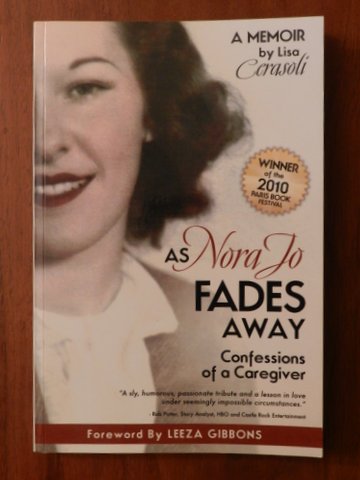
 I read Nora Jo Fades Away: Confessions of a Caregiver several months after my mother died of Alzheimer’s, but I’m just now getting around to writing about it. I was shocked, shocked I tell you by the first few pages. Author Lisa Cerasoli has an outrageous memoir of caring for her feisty grandmother, Nora Jo, who had Alzheimer’s. Lisa left her career in acting and writing, and—with a new marriage and stepson and a toddler daughter—she took in her brandy-loving, swearing, blunt-speaking Gram. Friends said, “Are you crazy? Are you looking to get divorced?” She did survive, she only went crazy a lot, and she did not get divorced because of it, thanks to an easy-going and patient husband. The kids were troopers.
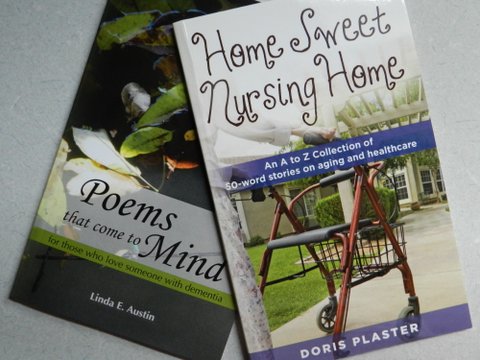
Taking care of an Alzheimer patient is no piece of cake—especially if you’ve got kids to look after, too. Lisa is very open and tells it like it is, colorful language (both hers and Gram’s because that’s just how they talk) included. She says, “A memoir is taking your story and laying it ALL out there. The only way to write a book on Alzheimer’s is to get downright personal.” The kinds of things our loved ones can say and do when the disease gets a good grip on their minds are important for caregivers to know. “The Iraqis have poisoned my lettuce.” “Leave me in here to die, goddamnit!” If caregivers are armed with knowledge, they are better equipped to deal with the disease, and this disease can drop your jaw daily. There is also a cold comfort knowing that others are going through the same astonishing horror and feeling the same draining emotions and exhaustion. And there is hope in hearing there are beautiful moments of incredible sweetness (see also my Poems That Come to Mind).
Lisa walks us through life with Alzheimer’s with wit and learned wisdom. We’re right there experiencing and learning with her. She waters down Nora Jo’s brandy on the sly, then at least succeeds in getting her to switch to beer, which Nora Jo likes warm. Lisa has to figure out how to get Gram to stop putting her beer cans in the microwave. How will she get her out of the bathroom? How will she get her through Christmas?
Being feisty herself, Lisa is blunt and she laughs at and teases her Gram. Some readers (me) may find this shocking at first, but I quickly saw how Lisa was mostly laughing at the situation, that her teasing made her Gram feel better, and that Lisa loved her Gram dearly. Nora Jo is quite the character herself and gives as good as she gets. Laughter releases stress in both the dementia patient and the caregiver, and believe me that stress level regularly gets very high for all involved! Laughter is a way to feel close and loving even if a minute ago both were angry and frustrated. Lisa and her family became very good at calming Nora Jo and making her feel good about herself. Once it involved ravioli.
Those who are fairly conservative may not appreciate this book (language [sh*t, hell, damn], drinking, a past secret exposed). I found an instance of political incorrectness. The book is brash and funny, but also sensitive and heart-breaking. It gives facts about Alzheimer’s and puts the reader into the Alzheimer’s experience with total candor. The memoir itself is a fast read at 116 pages, the sections that follow are of family photos and of other peoples’ memories of their loved ones with dementia. I fell in love with Nora Jo, and I want to tell Lisa, “Well done.”
From Lisa:
My Gram got “interviewed” for the book a bunch, so she felt like she was a part of the process, even if she couldn’t remember it. It kept us both busy. When the book got published, she absolutely adored the photo I put on the cover, which was a shot of her when she was twenty-five. She looked like a Hollywood starlet, truly. She’d walk by the book and say, “Who is that gorgeous girl on the cover of that book? Oh, for God’s sake, it’s me!” She was so proud. And I felt like I had figured out how to build a bridge between the life I had left behind and the one I had now as a caregiver. I guess you could call that “purpose.”
Lisa is also author of the novel On the Brink of Bliss and Insanity and produced the short documentary 14 Days With Alzheimer’s





 moonbridgebooks