Mrs. Lincoln’s Dressmaker wrote a memoir

A few weeks ago I listened to Jennifer Chiaverini talk about Mrs. Lincoln’s Dressmaker. Her name was Elizabeth Keckley, and she was a slave who had scrimped to buy freedom for herself and her son from her half sister and husband ( Keckley was daughter of a white slave owner and a slave woman). Keckley was well-known in St. Louis in the mid 1800s for her dressmaking skills, and was obviously held in high regard as some of her patrons offered to loan her the $1200 to buy her freedom, knowing she would leave immediately to find her fortune on the East Coast.

Mrs. Lincoln's DressmakerKeckley became dressmaker to the leading families in Washington, D.C., including to Mary Todd Lincoln, the president’s intelligent and vivacious but troubled wife who had many detractors. After Lincoln was assassinated, Keckley remained close to Mary until Keckley published her tell-all memoir of life in the capitol. Chiaverini took this memoir and built it into a novel, imagining between the lines of Behind the Scenes: Thirty Years as a Slave and Four Years in the White House. She said the memoir is short and did not even mention Emancipation Day.

Slave narratives were being published by that time, mostly by white abolitionists writing the stories of slavery for illiterate former slaves. The brilliant orator Fredrick Douglass himself wrote three autobiographies covering his slavery, those published from 1845-1881. Keckley’s memoir, however, was something else. It only briefly describes her life as a slave, but it exposed the personal relationship she had with Mary Todd Lincoln. Imagine in 1868 a former slave giving the inside scoop about the daily life and marriage of the President of the United States!

No one really knows if Keckley wrote her own memoir. She may have been literate—she was half white and the main wage-earner in her owner’s 17-person family, and the slave man she thought was her father had encouraged her to educate herself. Many believe her memoir was ghost-written, though (the writer misspelled “Keckly” as “Keckley”). In an interview late in life, she said she was “tricked” into telling her stories, and the publisher betrayed her by including her personal letters from Mrs. Lincoln.

Lizzie Keckley did mean to show Mary Lincoln in a good light, albeit not without blemish. The East Coast public, however, happily pounced on verification of that “Western” Mrs. Lincoln’s faults since they didn’t like her anyway. At the same time, they were appalled a black woman would dare publicly expose a white family’s personal lives, and many refused to patronize Lizzie again. Her memoir did not sell well. Mary, understandably, did not appreciate the invasion of her and the President’s privacy and severed the relationship with Lizzie. Lizzie died in poverty.

I haven’t read Mrs. Lincoln’s Dressmaker, but I own a signed copy now and am looking forward to Chiaverini’s imaginings and research. I haven’t seen the movie Lincoln yet either, but I do know the black woman accompanying Mary Lincoln in a few scenes is not her maid. She is Elizabeth Keckley, dressmaker extraordinaire, a free woman, and one whose memoir would cause irreparable damage to her reputation and to her deep friendship with Mary.

(At the time of this posting, the Behind the Scenes Kindle e-book  is free on Amazon)

Posted in book talk, history | Tagged , | 3 Comments

The Poetry of Alzheimers

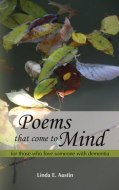
Most people wouldn’t think poetry and Alzheimer’s disease go together. Alzheimer’s is a tragedy. Poetry is beautiful. Poems That Come to Mind, however finds the beauty and the tragedy. Alzheimer victims may not know their families and friends, they may not be able to make sense of their surroundings, but they still enjoy friendly visitors, holding hands, a warm breeze. I wrote this book in honor of my mother and the other residents of the nursing home she was in. I hope it helps other caregivers find comfort in knowing they are not alone, and that it brings a sense of respect and understanding towards those who suffer dementia.

Poems for AlzheimersThe e-book version of Poems That Come to Mind is free through Valentine’s Day to spread love and understanding. Please share this message with anyone you know who cares for someone with Alzheimer’s or other dementia-causing disease.

Free Poems That Come to Mind on Amazon (downloads to Kindle, PC, and other readers except Nook)


Posted in aging, poems | Tagged | 3 Comments

That’s The Way It Was black history stories of segregation in St. Louis

That's The Way It Was Vida Goldman PrinceFebruary is Black History Month, so seeing Vida Goldman Prince the other night was especially fitting. She introduced her brand new book, That’s The Way It Was: Stories of Struggles, Survival and Self-Respect in Twentieth-Century Black St. Louis. She was proud of her 30-year undertaking, but more proud of the black interviewees who opened their hearts to her, a white Jewish stranger, and told her what it was like to live in segregated St. Louis in the first half of the 1900s. Each chapter of the book is a different person’s stories.

In 1987, Vita Prince interviewed Marian O’Fallon Oldham, a civil rights activist, who attended a Missouri Historical Society exhibit called “I, Too, Sing America: Black St. Louisans in the 1940s.” Prince wanted to dig deeper into Oldham’s statement of how “our parents went ahead with life and made something out of themselves and their children…despite the real outside world.” She wanted to know what was it like for black people to live in this real outside world, what did the children think and what did their parents have to say about this world.

Ms. Prince interviewed 24 people and then struggled for years to find a publisher interested in capturing these historical, personal perspectives of segregation in St. Louis, the “most southern city in the north.” Finally, The History Press came to the rescue.

Stella Bouie, who as a child had banana curls and wanted to be Shirley Temple, stood up to introduce herself at the book event. Bouie had worked as an elevator girl for a local department store and was promoted to display coordinator. She still remembers all the places she wasn’t allowed to eat at. She said she enjoyed every moment of the interviews and that Vida asked questions nobody else ever asked. Ms. Prince said the time must have been right to tell the stories, and no one she interviewed ever asked why she was doing the project.

DSCN2336-001

Vida Goldman Prince is delighted to see Stella in the audience

The book includes stories by Richard A. Martin, Jr., a nephew of Josephine Baker. By age eight, he was tap dancing to attract customers to his shoeshine at Union Station. Clifton Fitzpatrick remembered blacks finally being allowed to work skilled factory jobs, and how even though they didn’t like the coloreds-only roped off cafeteria seating or the toilet sign, they “tried to work with the system…and get a piece of the pie.”

Edna McKinney said Grand Avenue was a dividing line in the city then between poor blacks and the professional blacks allowed to live in a pocket to the west. Blacks coming up from the South were another class of people, and their cooking was different and their stories were fearful. She said there was prejudice even amongst the black people based on where they lived, where they were from, how much money they made. St. Louis blacks resented the southern blacks coming in and competing for jobs. This sounds like the way white people can behave, too.

The interviews are edited but seem barely so because the voices shine through. In the introduction, Ms. Prince says Salimah Jones told her in an interview that her father talked about black history but “the last thing he wanted was for somebody white to write his history.” Prince replied, “You mean like I’m trying to do? But this history is going to be in your words.” Yes, I can hear Stella, Richard, Edna, and others talking. I hear them telling me their stories, and I’m listening. Ms. Prince hopes high school and university libraries will be interested, and I hope so, too.

See the post on Sugar Hill: Where the Sun Rose Over Harlem for a personal perspective on growing up in Harlem in the 1950s-60s.

Posted in book talk, heritage, history, multicultural | Tagged , , | 1 Comment