
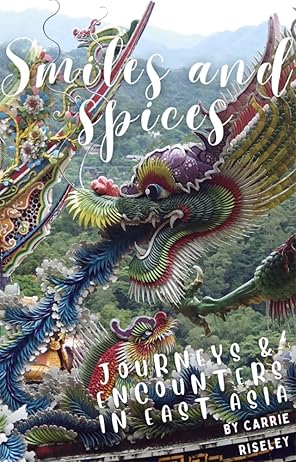
The other month I read Smiles and Spices: Journeys and Encounters in East Asia by Carrie Riseley of Tasmania. She’s also lived in Australia, Japan, and England. Carrie is way braver than me. She goes off wandering in strange countries by herself. My young niece does this, too, and she usually finds herself the only American. Apparently, world wandering is a thing mostly among younger people of other countries.
In Smiles and Spices, Carrie documents her mostly solo travels to South Korea (and the DMZ), China, Tibet, Hong Kong, Macau, Vietnam, Cambodia, Thailand a bit, and Taiwan and incorporates interesting bits of culture and history. Her tales are scary but fascinating to me, as she navigates various methods of transportation with the accompanying issues, going to very rural areas with “toilet adventures,” getting lost, driving narrow roads along cliff sides. She stayed mostly in hostels, which I learned are a great place to make friends you might then see elsewhere along your journey, and you might even travel along with some of them a bit.
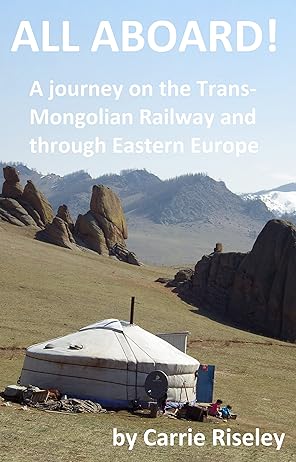
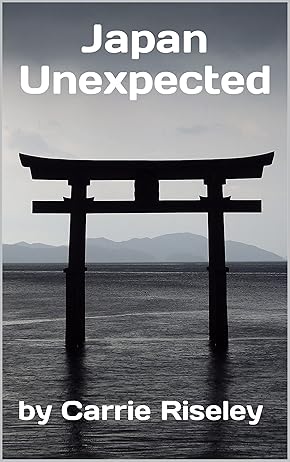
Carrie’s previous travel memoirs are All Aboard!: A Journey on the Trans-Mongolian Railway and Through Eastern Europe, and then Japan Unexpected. I very much enjoyed reading and learning from Smiles and Spices and highly recommend that book, and I’m sure her others are equally fascinating.
I asked Carrie how she went from journal to book:
* * * * *
Yes, I had to do some editing. My travel journals are very, very extensive. For my first book, All Aboard!, my first draft was I think 169,000 words! That’s far too long for a book—80-90,000 is considered a good length for a book, 100,000 max. So, I edited all three of my books down to 100,000 words. Sometimes that meant cutting out any boring bits and sometimes it meant reducing the number of words in a sentence, e.g. “The next day I went to Riga, the capital of Latvia, and I was amazed at how diverse the architecture was” can be cut down to, “My next destination was Riga, Latvia’s capital, which has surprisingly diverse architecture.” The latter option also reads better, which is another thing I think about when I’m editing, e.g. make sure I haven’t said too many “verys” or “wows” and make sure it sounds good to read. But overall, I haven’t changed all that much of my original journal text.
For Smiles and Spices, in addition to doing the above I had to stitch my multiple journeys to Asia together because unlike All Aboard!, I didn’t undertake the whole journey in one go. But stitching those together wasn’t so difficult because I elected to just put different sections into the book with a map of the relevant region at the start of each section.
For Japan Unexpected I used the same process, again publishing mostly just what I’d written when I was in Japan . . . The original journal was written just for me to read, and I have a lot of prior knowledge of Japan. So, I added some cultural explanations during the editing process so that the book could also be enjoyed by people with no prior knowledge.
The advice I would give to anyone else wanting to do it is: make sure you read over the entire draft—whilst editing—at least seven times, preferably more. That’s the only way to catch typos, too, which hide in plain sight. You can also do a Ctrl F search for words like “very” and take them out, but not all of them. I’m keen to preserve the original tone of my writing because therein lies my excitement at what I was seeing and experiencing while travelling. So, I leave some of the “verys” and “wows” in. I wrote the journals for me to read myself, so luckily I enjoy reading them and didn’t mind going through the entire manuscript seven times!
* * * * *
Below is Carrie’s travel advice from Smiles and Spices:
The best thing, always, when seeking to understand and really experience being in another place, is to get to know the people . . . it’s not always possible, but every interaction pushes you closer. . . . the only way to truly learn what a country is like is to navigate it yourself. To buy your own food and bus tickets; to smile at locals on the street; to watch them eating, praying, shopping, and driving; to learn how to say “thank you,” to get lost and found.
Learn more about Carrie and her books and see her photos and blog at Carrie’s Travel Books. She is on Facebook, Twitter (@CazTravelBooks), Instagram and LinkedIn.



 moonbridgebooks