Stop picking at 9/11?

It came up on Facebook that some think we fuss way too much about the anniversary of 9/11 when it happened so long ago. I mean, it’s been over ten years, so we should be past it. The reference was to “picking a scab.”

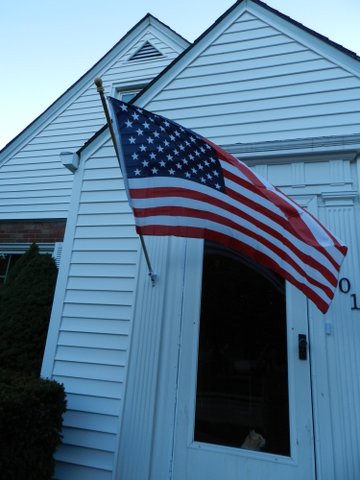
I put a brand new flag up on our pole this morning. It’s really a lightweight banner; so light, in fact, it floated in the wispy breeze like a kite. As I attached it to the pole and watched it billow so beautifully, I thought back to that morning when my whole body reacted to the traumatic shock of watching this unimaginable horror unfold on TV. Heart squeezed by an unknown fist, body tensed as from a chill in the air, the tears that just fell out. And how I wanted to DO something to show my support for my country and the people suffering at the sites. Standing there watching with my mouth open was not enough. And so I put up our flag. It was all I could think to do.

Then there was the post-traumatic stress that came from reading and watching too much news, reliving too much over and over through the scenes on television. Maybe that’s what people mean when they say “picking the scab.” Now, eleven years after it’s over, we’re supposed to be healed by now, leave it alone, why relive such a terrible event, why make yourself hurt again?

I would argue that history is worth remembering, good or bad, and this is BIG history in the U.S. America was attacked in a spectacular way on its own soil. It was an affront to the entire country and taught us an ocean is not enough to keep our enemies away. But memories and intense feelings fade, just as they have for the bombing of Pearl Harbor. A generation passes and dust settles into corners. Thank goodness for the newspapers on file and the memoirs written since that will keep the full intensity of the event from disappearing into complacent forgetfulness.

This eleventh year after, the 9/11 ceremonies were toned way down, if they happened at all. Politicians were not welcome at the official New York remembrance to allow the focus to be on the families who will never stop grieving. I didn’t see anything in our local news about official ceremonies in our city or its close suburbs even though a few families did lose someone in the destruction. A few small gatherings were across the river in Illinois. News media stepped in to help us all remember.

I want to remember because I think we owe it to the people who died and the survivors still affected. The number of people who died might be small compared to genocides and current mass atrocities overseas, but they are ours and 9/11 is ours. Our people and our land. The least we can do is give a moment of silence, a thought in our day. Remembering the scab and what it means, not picking at it.
Posted in bad memories, history | Tagged | 3 Comments

Basking in culture and heritage at the St. Louis Japanese Festival

Yes, I’ve ignored my blog lately because I was busy preparing for the annual St. Louis Japanese Festival, the largest Japanese festival in the nation, at the Missouri Botanical Garden which has the largest Japanese garden in the nation. I’m so lucky to live in this city!

Every Labor Day weekend, 40,000-plus people become Japanese, many carrying the sturdy paper parasols or folding fans sold by our Japan America Society Women’s Association booth I organize. Some – men and women – wear the cotton yukata summer kimonos or the short happi coats, although a few women bravely don real silk kimonos to stroll in the usual oppressive heat of late summers here. There are the kawaii (cute) anime teens who are walking photo ops. Then there are those who must have missed the Chinese festival in June and come wearing their slim and silky Chinese cheongsam dresses.

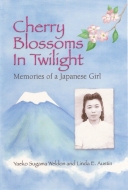
The Japanese community in St. Louis is not all that large, but we know how to come together to make a fabulous festival. It includes the kimono show with models elegant in stunning silks and elaborately-tied obi sashes, a sumo demonstration by still-large retired wrestlers, taiko drumming, traditional dance shows, omikoshi shrine parade, and, my favorite, the obon dancing where everyone is invited to follow simple dance moves in a circle around a decorated raised platform where the drummers pound out the rhythm. What fun, and what a nice way to remember and share our heritage. I usually sell some copies of our Cherry Blossoms in Twilight memoir, too.

Sadly my mother can’t go anymore – she can’t go anywhere, actually. She loved this taste of her home country, always saying, “It’s just like Japan!” with her eyes bright and happy. The day after the festival I went to see her in the nursing home and sang the first line of “Tanko Bushi,” the “Coal-Miners’ Song,” that’s always played at the obon dancing. I only know the first line and have to da-da-da the rest of the song, ending in the funny “sa no yoi yoi” clap-clap. She joined in! I couldn’t understand her words, she speaks so softly now and not clearly, but her eyes grew distant and her face brightened. I thought I might cry.

 2007 St. Louis Japanese Festival video clip 


Posted in heritage | Tagged , | 2 Comments

Are you afraid to write your memoir? It’s scary out there!

Last week I talked about the ferocious world of extremist views out there lately and how people are getting very emotional, jumping to conclusions and verbally attacking each other. Might make you a little afraid to write your memoir. What if you say the “wrong” thing and your family thinks you are an ignoramus worth forgetting?

For one thing, you probably won’t be writing many extremist views in your memoir because a memoir is not a bunch of political or philosophical essays. That would be like writing your own version of The Federalist Papers or Plato’s Republic. Fine, but not a memoir.

A memoir is a written record of a period of your life and what you thought about it. It’s okay to have opinions unpopular with your family. The point is not the opinions but the story behind those opinions. What makes you think that way? Opinions generally flow out of the stories you tell; it’s more rare to tell stories just to talk about an opinion.

My husband’s side of our family is from the South. His grandparents lived in a time of prejudice against black people. It was The Way of Thinking.  They were nice to black people yet seemed to think of them as large children, even though they were experts at butchering hogs. They had been brought up to think of their black friends and farm helpers a certain way, and their black friends were probably brought up to think that’s just the way these white people were. I did not try to teach my husband’s elders a lesson with my pointer finger, nor did I disown or belittle them. If they had actually mistreated someone, I know I’d feel differently.

Do we whitewash politically incorrect views out of our stories, out of our history? Will we disown our family members who think differently than we do? Not usually. They are family, and we usually love them enough not to disown them over mere opinions. Usually we put up with really bad behavior, too!

Our opinions and behaviors are a part of who we are and usually a result of the social culture and history of the time. In times of sociocultural transition, big differences of opinion are common. When there are polar opposites in the family, it’s best to agree to disagree and avoid discussion. On my own side of the family, I’m not sure we can talk about anything important when we’re all together!

The best part of memoir is that it is the written word, so nobody’s going to stop you in the middle and have a verbal argument about your political or religious beliefs or why you shouldn’t be a vegetarian.  I don’t believe in removing traditional Christian thoughts or leaving out the part where you were excited to vote for Barack Obama. Do you delete the paragraph explaining you think NASA faked the Apollo moon landings? Why bother; it makes you look colorful. It’s not the opinion that matters, it’s the story behind it, what we can learn from it, and how we can appreciate you as a three-dimensional person. We do not need to accept all of a person’s opinions before we can love them or learn from them. Most people understand this.

Here’s a related post on listening and learning and accepting:  Statements or Questions, by my online buddy, Earl. B. Russell.

Be more than a shadow

Posted in history, memoir writing | Tagged | 7 Comments