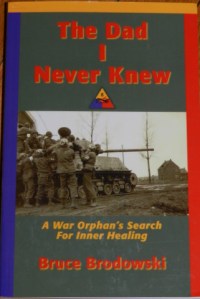
 Bruce Brodowski is author of The Dad I Never Knew: A War Orphan’s Search for Inner Healing. Ed Brodowski was killed during WWII in Germany weeks before Bruce, his first child, was born. Sadly, even now there are children being born who will never know their fathers, killed in military training or action before they could see their babies. Bruce, however, then lost his mother to cancer when he was ten years old and went to live with an aunt and uncle. He has lived with a truly “orphan heart” since.
In 1997 John H., from Ed Brodowski’s military unit, found Bruce, wanting to tell him what he could about his father. Thus began Bruce’s search to know his father and discover a sense of belonging. Fortunately, he had a pile of letters his father had written to his mother during his service and some his mother had written. Bruce used them, along with historical details of the War and his father’s 8th Armored Division movements, to tell the story of a love that actually grew stronger through letters. Wife Maryanne wrote, “I wish you had talked to me like this when we were together.”
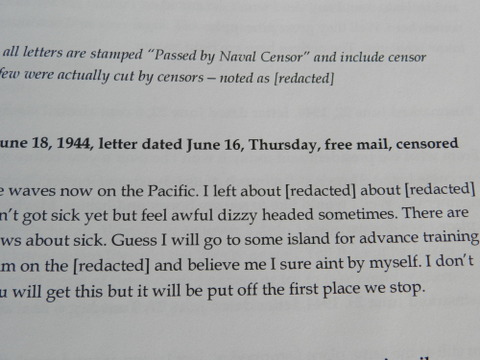
As with many war letters home, Ed’s letters are filled with longing to be back with his wife and with descriptions of days filled with everyday nothing-much and a lot of waiting – waiting for letters from home, waiting for something to happen. When Ed finally is shipped overseas, readers would never guess what was really going on from the letters; of course, the men knew censors were reading. So although I often found those interspersed military details a bit tedious, they did help to understand the big picture and know that Ed’s division was not just sitting around in Europe. War history buffs or those with relatives who were in the 8th Division would be particularly interested in those details.
The Dad I Never Knew begins with a four-page introductory preface then launches into letters and clips from historical resources, but the end is what I found most interesting. There Bruce includes some pieces of other memoirs and descriptions from other men in his father’s unit and adds his own thoughts on this “orphan heart” sense of lost loneliness that anyone can feel, real orphan or not. It is a Christian perspective, and one might suspect God had a hand in this perfect lead in to Bruce’s next book, My Father My Son: Healing the Orphan Heart with the Father’s Love. (Bruce is president of Carolinas Ecumenical Healing Ministries.) Some tear-inducing poems and other short writings help leave an overall sad sweetness mixed with a bold sense of pride in our military men and women.
I asked Bruce a few questions about his writing journey.
Your dad’s letters are interspersed with the history of what his military division was doing throughout its time overseas. Did you have any trouble deciding how to structure a book of your dad’s letters?
It took two years to learn to read Dad’s handwriting and compile the postcard-size v-mails into a manuscript. That first manuscript contained all the letters and was given out to family members. My cousin Tom suggested going back and editing out unnecessary letters to make the story interesting. I then decided to insert current events happening at the time of Dad’s letters. When I received a copy of In Tornado’s Wake – A History of the 8th Armored Division, by Capt. Charles R. Leach, with a picture in it of Dad on top of his tank, it was just logical to include the history of Dad’s travels and the battles.
Did you write this book already knowing that you wanted to do a second book about healing?
No. In 2010, I had a meeting with my pastor friend from the UK, Russ Parker. I said to him, “Well, Russ, my book is done, but from my research this healing the orphan heart issue is huge. Pieces of information are scattered everywhere. How much has been written and is out there?” “Not much, mate,” was his reply.
“Someone needs to write about this and compile all the information into one reference source,” I suggested, hinting that Russ, the author of thirteen books, should consider it. “Let me know what you come up with, mate, and I’ll review it,” he said. Six to eight months later, My Father, My Son, Healing the Orphan Heart with the Father’s Love was completed.
How did you find In Tornado’s Wake and other resources which had details of your dad’s military division?
I first made contact to the 8th Armored Division website. Dick Kemp had a complimentary copy mailed to me. In Tornado’s Wake is by Capt. Charles R. Leach, 1956, Battery Press, Inc., and is probably out of print.
John H., who served with your father, searched for you in 1997 and touched off your quest to learn more about your father and what happened to him. How did you find Dick Kemp who, along with his daughter, wrote to you about your father?
I posted on the 8th Armored Division’s website for anyone that knew my dad to contact me. Dick Kemp wrote to me and called me after seeing that post. I found out more about my dad and a better understanding of their battles through Dick Kemp. It was an amazing two years of his friendship. He called me a couple of days before he died. It was probably to say goodbye. His daughter contacted me after her dad’s funeral in Arlington Cemetery.
Did you include every letter you had from your dad? Did you include all of each letter or try to keep only parts you thought interesting to the story? How did you decide what to include?
Only letters that developed into an amazing love story were used and all of each letter was included. I can only say that the decision of what to include was inspiration from God. It became obvious to me that some war orphans may need inner healing which is why the last chapters were included and the subtitle became A War Orphans Search for Inner Healing.
You said in the preface that by the end of the book about your dad you had learned something about yourself. Do you want to talk about that?
We go through our childhood wanting to hear the same words that the Father said to Jesus, “Luke 3:22 – And a voice came from heaven which said, “You are my beloved Son (or daughter); with whom I am well pleased.” However, for many orphans, for one reason or another, their fathers are not there. There is a void in their soul that cries out “Daddy.” That void needs to be filled with knowledge of the father. Before, I could never say, “I am just like my dad.” Now I can say, “I am just like my dad because…..” I am not a misfit. I was wanted. I have some of Dad’s personality traits. I am now a complete person knowing both my father and my mother.
Is there anything else you’d like to say about the writing or publishing of this book?
It was a labor of love and a journey into understanding my dad, the relationship of Mom and Dad during the War, understanding the experiences of Dad and the 8th Armored Division, and learning how to write and publish a book. Had it not been for my conviction to the importance of writing this book, the second book would not have evolved from this. Because of the second book, two more books may be in the works. Seasons Pass – first chapter – is up on my website for review.
* * * * *
My thanks to Bruce for answering these questions for us. Each person will have to find their own way to write their parent’s story. How depends on what sources and resources are available as well as deciding from what angle the story should be told. Is there an overall message? Will it be just for family or for a wider audience? For other examples of handling a parent or grandparent’s war letters, documents, or experiences, see posts about Karen Fisher-Alaniz (Breaking the Code) and Kim Wolterman (From Buckeye to G.I.) or even Jeffrey Copeland who found someone else’s love letters (Inman’s War). See Bruce Brodowski’s website for more information about him, his books, and his healing ministry.
Does your family have a stash of old letters somewhere? If so, what have you done with them? Just don’t tell me if you threw them away!





 moonbridgebooks