Mardi Gras, and digital vs print photo memories

Mmm, Mardi Gras is… delicious! I can’t help but post about this today since Fat Tuesday is a couple days away and we’ve already dined on red beans and rice and king cake. St. Louis, where we live now, is actually thought to have the second biggest Mardi Gras celebration in the U.S., but my history with New Orleans goes way back to when I was just married, lived in Florida and watched Justin Wilson cooking his Cajun magic on TV – “I gar-on-tee” dis will be delicious wit a little wine, lak so (sip, sip). Using a basic Southern Living cookbook, I made seafood gumbo for some new friends from New Orleans and it turned out fabulous. We were hooked on Cajun. Never been to the big Mardi Gras, only the Jazz Festival, but loved our jump-up-and-go trips to the Big Easy, b.k. (before kids), where we ate our way through town.

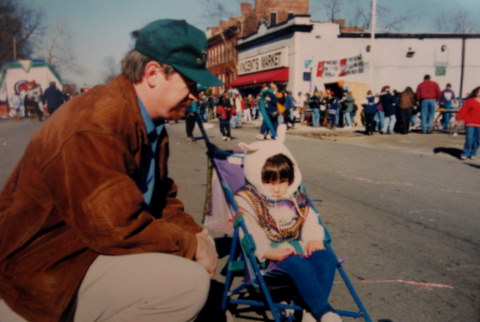
We have taken the kids to the St. Louis Mardi Gras parade a couple times, to the Krewe of Barkus pet parade and the wiener dog races once. We went to the tail end of the parade route, right by Anheuser Busch (now In-Bev) where the crowd was much smaller and the debauchery almost nonexistent (a bit of drunken swearing). Best part about having little kids at the end of the line is the colorful folks on the floats throw all the leftover beads to them – the girls were happily covered with cheap sparkling necklaces! The photos remind me of all my favorite New Orleans memories.
Linda O. commented on my last post (on important photos) that “the best pictures can evoke an essay.” While a memoir is a big story of a certain timeframe, lifewriting is much easier to do – write your short stories and include a photo that goes along with it. Some like to do this in a scrapbook, which means there is only one copy unless you do it the new digital (online) way to share, but I’d suggest collecting the stories and photos and putting them into a booklet that any copy shop can whip up for you. If you want to get serious, upload to LuLu.com for a real paperback or hardcover version. They may only be in black & white, but I gar-on-tee you will be delighted!
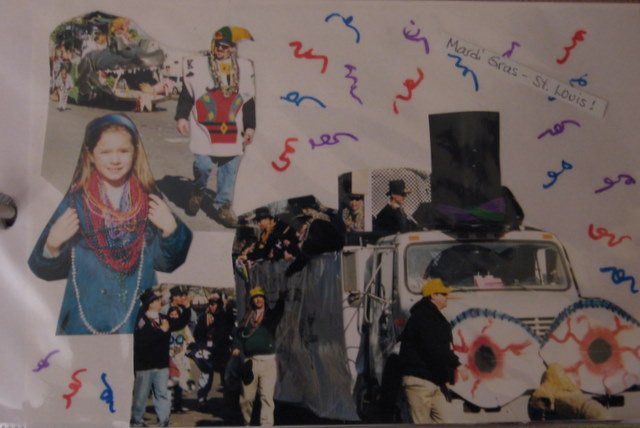
Whatever you do, don’t leave the stories stuck in your head or the photos forgotten in your computer. I love digital cameras, but I think too often the pictures get loaded onto the computer and nobody looks at them again. I have a number of photo albums, the later ones including scrapbook-style entries of 4×6 collage or cutouts, because I’m not ready to start a big scrapbooking hobby – yet. I love looking through these albums of fond memories. The girls have enjoyed looking through them with their friends and especially love seeing their baby and toddler pictures. In the albums, I write comments and dates. No, none of us scrolls through the digital files on my laptop or looks at the CDs I’ve copied photos to. And while e-books may be the latest rage, they are not the ideal medium for collections of photos with stories, at least not yet. Think print.
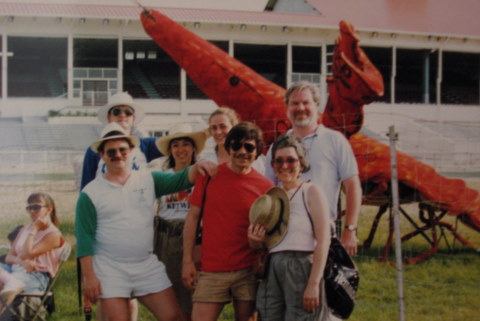
At the New Orleans Jazz Festival '88
Posted in holiday, photos | Leave a comment

The most important photos may not be what you think

Karen Fisher-Alaniz, whom I interviewed here about her memoir, Breaking the Code, had a shock recently. The diner where she and her father sat and talked each Wednesday is going to close. This was where Karen worked on getting her father to talk about his WWII past, where she worked on bonding with her dad. Memories. Memories that made it into her book. Fortunately, she has photos.

I figured out that some of the most important photos are not the family portraits where everyone pastes on a smile, not the school pictures, maybe not even the staged wedding photos (especially not these days where divorce is common). The most meaningful photos are the ones that show personalities and what is important to our lives, the pictures of our everyday lives.

What is it your family members like to do, what are they known for? I have photos of my dad working a puzzle, my mom trimming a bonsai, my mom-in-law cooking—and my dad-in-law happily holding a plate full of her comfort food. I love the pictures of one daughter asleep cuddling a cat and another fluffing the floppy ears of her dog. I love the photo of my dad-in-law working on his tractor. And there’s the pic of my mom in her beloved 15-year-old car with only 30,000 miles on it, taken just before it was sold to retire in the country. My daughter with her beloved yellow Mustang before it was totaled on Lake Shore Drive, Chicago. Don’t forget to take pictures of the front of houses you’ve lived in.

I met fine arts photographer David Coblitz at my booksigning this past Saturday and had a good time looking through his art loaded on his iPad. He doesn’t advertise he takes portraits for bios, but he should because somehow he captures personality. It’s hard, he says, because people feel awkward at photo shoots and he has to get them comfortable and into character. Most of us bawk and feel self-conscious when anyone points a camera our way.

Most portraits won’t capture personality, and we’re better off catching our beloveds right in the middle of doing what they love. Let the picture tell a story.

Posted in photos | 6 Comments

Lifestory Lessons from Luis Alberto Urrea and Thrity Umrigar

Wow, was I excited to attend author events with Thrity Umrigar and Luis Alberto Urrea one day after another the other week. Luis is author of one of my favorite novels, The Hummingbird’s Daughter, a historical fiction “dramascape” set in Mexico that imagines the life of his great aunt Teresa Urrea, “the Saint of Cabora,” who had quite the colorful life, documented in news clippings. Queen of America is the sequel, where Teresa has been exiled to the U.S. and must learn to adapt from the free range of Mexico to the confines of civilized American society of the early 1900s. Thrity Umrigar, whom I just discovered, has written a number of books set in her hometown of Bombay (Mumbai), India.

As documented in his memoir, Nobody’s Son: Notes From an American Life, Luis’s scaryNobody's Son by Luis Urrea Tia Flaca (Aunt Skinny) was the one who passed on stories of Aunt Teresita, the Mexican Indian healer and arbiter for social justice. Tia Flaca, chain-smoking and blind in one eye, squinting as she told the stories she knew. Luis didn’t really take them to heart until a professor showed him a book that mentioned the (in)famous Teresa Urrea. Off he went to do research for ten years to create the magnificent The Hummingbird’s Daughter, which brings Teresa to life the way a nonfiction biography could never do. If you are unsure whether you have enough information to create a memoir or ghostwrite one for a family member, or think you may not have a strong enough story to hold interest as a nonfiction memoir, Writer’s Digest posted Ten Ways to Tell if Your Story Should be a Memoir or a Novel.

Luis Urrea has also written nonfiction about his experiences with poverty along the Mexican-U.S. border. By the Lake of Sleeping Children documents his time helping an orphanage in Tijuana and seeing a community of poor finding food by picking through a huge dump nearby. This is a series of vignettes, and rough—one in particular that turned my stomach. Across the Wire: Life and Hard Times on the Mexican Border was written so Americans could understand the desperation that cause some to risk their lives to come here. He admits that times have changed a bit since the writing of that book as the “narcos” have taken over. The purpose of Luis Urrea’s nonfiction is to draw attention to the plight of poor Mexicans, hoping that stories of real people suffering will bring some degree of empathy to replace disgust, intolerance, and even hate for those who break immigration laws. And, of course, to tell a good story to retain interest.

First Darling of the MorningThrity Umrigar, on the other hand, means to tell good stories that just happen to involve Indian history and culture. While she has written a memoir, First Darling of the Morning, which details her rebellious childhood in a minority, middle-class, Westernized family in Mumbai, the rest of her books are novels, and she says she does not put herself into any of the characters. That said, she discovered that the “middle class all around the world has a lot in common,” and believes everyone feels a need “to tell story, to be a part of story, to recognize your own story in that of others’.” Just as Luis Urrea found after writing his stories of the border that little Yacqui Indian kids in Tucson were so happy someone had bothered to write about their culture. Just as you may find when you write your memoir that someone out there needs and wants to hear your stories because they identify with them.

Posted in book talk, multicultural, Uncategorized | Leave a comment