Picking on Joyce Carol Oates’s memoir

Oh, my. Julian Bond of the New York Book Review wrote of Joyce Carol Oates’s A Widow’s Story that Oates should have told her readers she had remarried. What? But wait, Oates’s beloved husband of close to 50 years died within a week of being diagnosed with pneumonia in February, 2008, and she began seeing the man who would become her future husband in September, 2008. The two married in March, 2009. Not so much time to grieve alone, but enough time to think about it and send a manuscript to an editor by the end of 2009.

I went to Oates’s St. Louis author event and have read a few chapters of A Widow’s Story and found it delightfully chatty in an intensely personal way, as though Oates is writing in her journal but knowing others will be reading it. She writes her grief beautifully, heartfelt, and openly. The book ends with an epilogue containing three journal entries of August, 2008, that leave Ms. Oates — and readers — with a small sense of hope as any memoir of grief or troubles should (see my last post about Erik Larson and transformation).

So, should Oates have mentioned at the end of the epilogue that she started seeing a man a few days later? That she remarried within a year and is doing fine? Do readers feel cheated somehow, as Mr. Bonds suggests, as though she were leading us on through her sadness and, oh, she recovered fairly quickly? Partial spoiler: Oates hints at this new man coming into her life in the final journal entry. News flash: dating again and remarrying does not remove the shadow of grief or the memory of a deceased spouse.

Oates has taken Bond’s comments to heart, it seems, and is seriously considering adding a short bit to new print runs of her book to explain more about the new man. I agree with her agent in that the current hint is enough, especially as the epilogue alludes to a readiness to look forward. Agent Daniel Halpern says, “She wrote a book about what it’s like to be in limbo – about what it was like to lose the man she had been married to all her life. Why include the next husband? That’s not what the book is about.” Yes. And I venture to say that writing about the new husband is antithetical to the story of a grief experience. Wouldn’t it be cruel to even unintentionally suggest that there might be another man ready to sweep away the sadness and make everything all right? This is a story of a pain that many — women and men — will endure sooner or later. Its power is in the now, and should not leave us with sweet dreams of a future with another spouse. (Joyce, are you listening?)

Information for this post taken from articles in the LA Times Blog and The Guardian, UK

Linda Austin
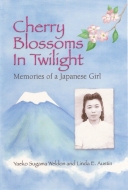
“Cherry Blossoms in Twilight”
http://www.moonbridgebooks.com

Posted in bad memories, book talk, memoir writing | 4 Comments

In the Garden of Beasts, in the garden of your life

I arrived at Erik Larson’s author event the other night to be ushered into a small overflow room with a TV viewer. There were about 250 people total in the audiences; I did not know Larson was so popular. I came to hear him talk about his latest book, In the Garden of Beasts, which is the true story of William Dodd, the first U.S. ambassador to Germany after the Nazis took control (apparently nobody else wanted the job).

Larson was inspired to write his book after reading The Rise and Fall of the Third Reich, by William L. Shirer—a thick nonfiction narrative that he said reads like a thriller. He also knew that most people, including himself, thought they knew plenty about Nazi Germany, yet he found so much more in the little details discovered in his readings. Larson is known for doing extensive research and in this case read numerous memoirs set prior and during WWII in Germany. He read Dodd’s memoir, based on his diary and written by Dodd’s wild child daughter, Martha. Larson found his story line in Martha, who had affairs with diplomats and dashing German officers. “She is the one transformed in the story, as every story must have transformation.” This book covers the difficult topic of why the Jews were mostly abandoned by the rest of the world, including the U.S., and how Hitler’s “pathology” could last and even spread.

In the Garden of Beasts, which I bought and perused, includes a lot of dialog that is actually direct quotes from source materials. Larson has melded his source documents into a story that remains nonfiction but reads almost like fiction, further confirmed by a number of Amazon reviews. I’m sure William Shirer would approve. The book ends with an epilogue summarizing Martha’s life (she died in 1990), a long list of sources, and a proper index. And how nice the publisher thought to include a 1933 map of Berlin.

I’m looking forward to reading In the Garden of Beasts. Larson told a number of ironic stories about details he found in his research, including Hitler saying in surprise that there was a “sea of meaness” in the people of Germany. Larson was also astonished that there was no uprising against Hitler who was viewed by plenty of people, including foreign diplomats, as crazy. I will be comparing Beasts to Laughter Wasn’t Rationed, a civilian memoir I read last fall that opened my eyes to life under the Nazi regime as well as survival through WWII Germany.

I wish I had read something like Larson’s work while writing my mother’s story of her youth in the years around WWII Japan. Ghostwriting someone else’s story is tough, because it is their story in their words—not yours. But, to produce a memoir that appeals to the public, it is necessary to find that transformation to focus on, as Larson mentions; memoir is not so different from fiction in that sense. It certainly helps, too, to make the writing flow like fiction. Another important tip is to include history and place in a memoir, to let readers more fully experience the story, to be “in the story,” which is Larson’s goal in his historical narrative books. While I did eventually realize these important aspects of memoir, especially including more historical details, it would have been nice to start out in-the-know.

PS If Erik Larson comes to your town for an author event, go! He’s a great speaker, funny and full of interesting historical tidbits from his research. Check out his earlier books, too.

PSS Film rights to The Devil in the White City were bought by Leonardo di Caprio, so perhaps we’ll see the old Chicago World’s Fair (and its serial killer) on the big screen.

Linda Austin
“Cherry Blossoms in Twilight”
http://www.moonbridgebooks.com

Posted in book talk, memoir writing, war stories | 1 Comment

The origin of Mother’s Day

I am loving the Facebook profile pics posted of everyone’s mothers. A Twitter friend remarked how glamorous they look in the old photos compared to us mothers today. Indeed, we live in much more casual times. The original Mother’s Day in the U.S. was instigated, so to speak, by social activist Julia Ward Howe, author of the words to the Battle Hymn of the Republic. Howe had been sickened by the carnage of the Civil War and wanted women to unite against war, a killer of their children. Her perseverance and activism resulted in the second Sunday in June to be set aside as Mother’s Day for Peace.

Our modern Mother’s Day was introduced by Anna Jarvis whose mother, Ann Marie Reeves Jarvis, worked to improve sanitary conditions for Civil War soldiers on both sides and later heal the rift between Union and Confederate neighbors in Virginia through annual Mother’s Friendship Day gatherings. Anna cared for her mother many years before death and afterwards missed her greatly. She felt children ought to appreciate their mothers while they were still alive, and her persistence succeeded in establishing a national Mother’s Day in 1914 to honor all mothers, living and dead. Anna was particular about the location of the apostrophe, as she wanted individual mothers to be celebrated, not an impersonal group commemoration. By the 1920s Mother’s Day had already been commercialized, and Anna was very disappointed.

Happy Mother’s Day to all moms out there. One of my Facebook friends posted a cartoon about mothers having Supermom capes in their closets—I hope you have some kick-butt boots to go with your cape.

Posted in history, holiday | Tagged | Comments Off on The origin of Mother’s Day