
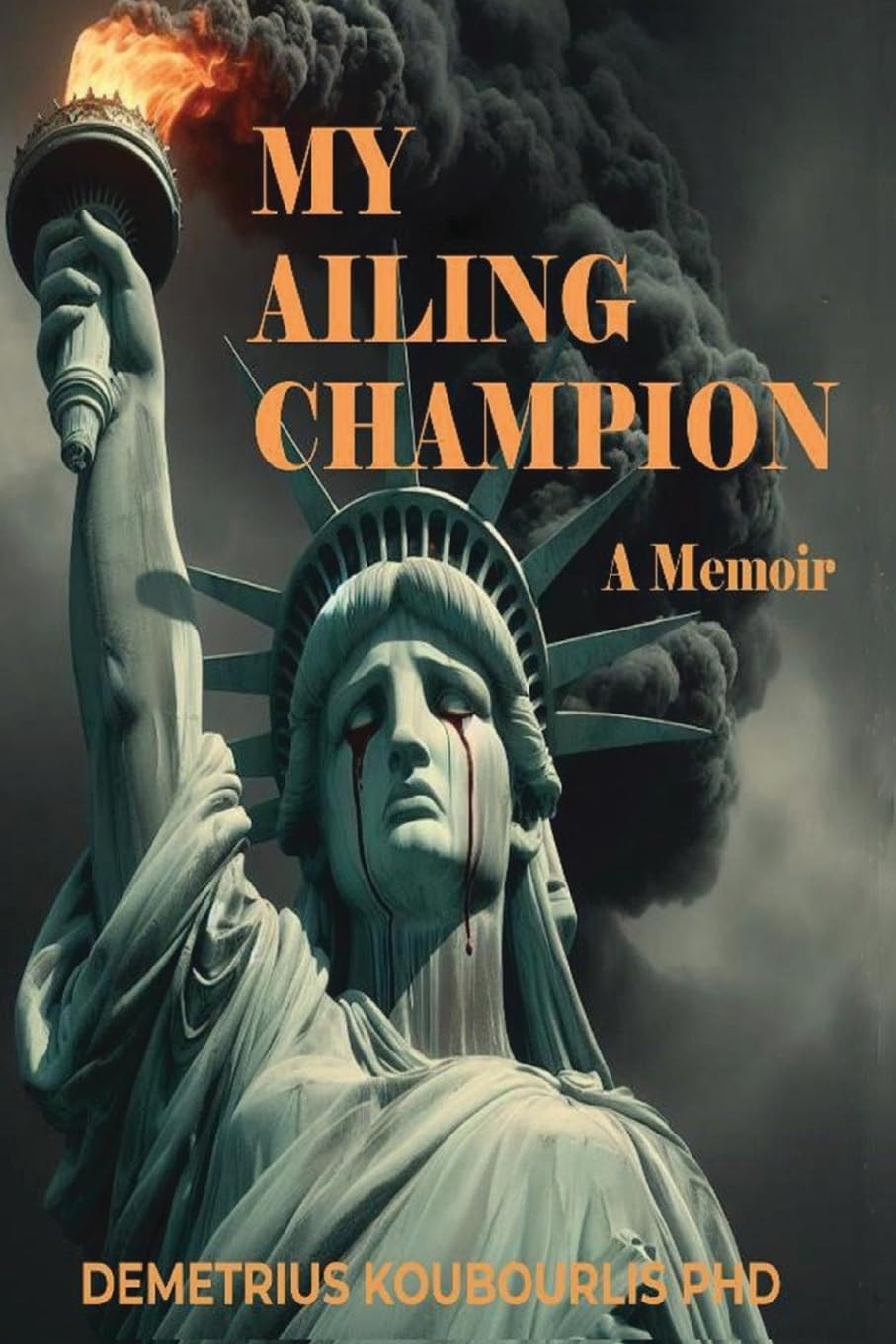
My Ailing Champion by Demetrius Koubourlis is not just an immigrant story focused on America as champion of freedom and educational opportunity but a great example of memoir writing. But is it a memoir or an autobiography? Like an autobiography, Demetrius’s story covers his difficult life from childhood in Greece to overcoming more obstacles until he earns full professorship in the U.S. in a challenging field, yet it stops as he’s on the verge of changing direction and finding financial success in real estate – I wanted to know more! Like a memoir, though, it is laser-focused on what it took to overcome Greek customs and traditions and his own heavy-handed father as he fought to go beyond grade school. He also expounds philosophical in essay-type form and “breaks the fourth wall” by directing questions to the reader. What a book, what a story!
Demetrius was born into a highly traditional, fiercely paternalistic culture that at the time valued working for the family and helping finance the daughters’ dowries. Demetrius yearned for knowledge and education but was ridiculed and thwarted by his father until finally he was beaten and rejected by his own family and became homeless as a teen. Because of his exceptional learning abilities, driving ambition, and downright luck, he was finally able to escape to the U.S. as a foreign student. More obstacles appeared, yet luck repeatedly was on his side, helped by his determination and willingness to sacrifice. This is an inspiring hardscrabble story of grasping for the stars and reaching them. And he gives credit to all who helped along the way.
What makes this a fantastic memoir is that the author is unafraid of baring himself, he admits his mistakes, lets us see his family dysfunction, and understands how Greek culture and tradition of the time affected everyone’s thoughts and behavior, including his. The level of introspection is astonishing. He resented what he had to endure, even as an adult, at the hands of his family, yet he was there for them until the end. All he wanted was to feel loved by them and to be allowed to follow his dream.
I did wish the author’s little Greece-born daughter and his American partner were included in his story more as they are nearly ignored, yet I’m sure they played a large part in his life. I was able to ask him about this, especially how his 5-year-old daughter adapted to her new life in the U.S., and here is his response, again in his thoughtful and ever so perceptive way, edited for brevity:
* * * * * * *
I loved my daughter a great deal. The child was happy to see me and enjoy her presents. My parents had long prepared her for this; they had gone out of their way to spoil the child with the best that they could or was available. She came to know her grandparents as her de facto parents. I spent a few weeks in that environment to help the child get used to me. No one, my parents and all relatives included, wondered whether it was a good idea to uproot this by now well-adjusted child and take her to America with me.
The real saga unfolds in the United States. My 18-year-old partner was totally devoted to me and eager to do whatever it took to make this work. And she tried very hard. We lived in a very challenging environment. We had financial problems. I was enrolled in a demanding graduate program. As I was by nature in a hurry, getting my degree was a priority. However, I spent as much time as I could with the child. The process of assimilation meant discarding the old culture and adopting the new. The child was met with scorn and ridicule at school because of her “foreignness” and understood what the solution was. English replaced Greek. The grandparents were virtually forgotten (we had no internet in those days; contact was by mail and only occasionally).
To say that everything went well would be untrue. My partner did the best she could, maintaining a job and a household while living below her previous standard. And I did all that was within my power to remain true to my dream of elevating myself and my family educationally and financially.
Sophia became a well-educated person, acquiring a Ph.D. degree in psychology. My partner graduated from college and even got an M.A. degree. But we all paid a price. We were somehow all traumatized, none, however, more than the child. Who knows what it takes for a child to lose its parents, be raised by another set of parents, learn one language, and adapt to a culture, only to be removed to another language and culture and yet another set of parents? No one would argue that of all the presumed victims here, the child reigns supreme. The child is the main victim with fewer choices than everyone else. The child is the true hero of this story.
* * * * * * *
In the later part of the book the author does tends to wax on a bit much in essay-like form. And I wanted the story to continue into the new direction toward financial stability and success – this would put it more into autobiography form but his life is so impressive! This is an enthralling story that kept me magnetically pulled in by honest writing and the author’s wisdom and understanding of human nature.
Published in 2024, the title, My Ailing Champion,” is reference to the U.S. he feels has been ailing, although in spite of anything going on here, it is and will always be the author’s savior. The book is not political but does offer some words of advice to all parties on getting along. Actually, it offers a lot of general insight and wisdom for all of us to get along with each other. The book is a tribute to the opportunities the U.S. offered a forever grateful man. While the U.S. is not welcoming immigrants these days, I’m sure it will again in the future because after all, the U.S. is the land of immigrants. Despite its faults, it is a shining star to all who hope.
(PS: Sophia will have her own interesting story to write for her family)





Excellent review, Linda. Demetrius’s story does, indeed, sound fascinating. I love the title he chose, and I love his loyalty to this country. It’s so easy, during dark times, to believe we’ve turned a corner from which we’ll never turn back, so this was heartening to read. Also, your comment about Sophia was exactly what I was thinking! As I work on my memoir, I often reflect on how challenges trickle through the generations.