What Will My Mother Say and other memoir fears

So you’re writing a memoir and you don’t want to lie and say everything was rosy, but you don’t want your family to send you hate mail. Whatcha gonna write? The big question is who you gonna write for?

The best memoirs are those where the author has come to some kind of understanding or healing from troubles. When the bad stuff is raw, then the revenge memoirs raise their serpent heads and who gains from those? Only the voyeurs. Everyone involved in the story, including the writer, is left feeling angry, and the innocent reader hoping for a good story with an inspirational ending is left blindsided. So it’s best to take a step back and consider…

If you’re writing solely for yourself, then you can whine and howl as much as you want. And guess what – only you are going to enjoy that. It may help you heal. Hide that manuscript under your bed until you can get some perspective. If you want to leave your memories to your family – kids, grandkids, sisters, brothers – write for them, which means tone things down, be tactful, try to understand what made your “perpetrators” behave badly. Some people are very sensitive and “exaggerate,” as Augustin Burroughs (Running With Scissors) has been accused of. He’s writing for a big audience so he could use some sensationalism to sell his books. You, lets hope you’re not in it for the big money and are mature enough to be polite.

There are always two sides to a story and readers will get a more 3D picture of your real-life characters if you can get inside their heads to decipher their behaviors or imagine what it was that caused them to be “that way.” If you write with at least some degree of understanding, then you should be able to stand proudly (and bravely) by your work in the face of your mother. Or your father, or your siblings. And, of course, it depends on how sensitive your family members are. (See Lori Gottlieb’s essay Mothers, Brace Yourself in the May 7, 2009, issue of The New York Times.)

Maybe the moral of this story is to be careful how you treat your kids because they could grow up and bite you with a revenge memoir. Here’s a light-hearted look at a dad’s fear. Me, I think I’m only guilty of shouting, “Clean your room!” too much.

Posted in bad memories, memoir writing | Comments Off on What Will My Mother Say and other memoir fears

Quilted Memories

The other weekend, my neighbor (The Cookie Queen, aka Mistress of the Needle Arts) accompanied me to a unique play entitled “The Quilters.” It was, oddly enough, a musical – with dancing! This production, fittingly performed at the Missouri History Museum, is based on the book The Quilters: Women and Domestic Art: An Oral History, by Patricia Cooper and Norma Bradley Allen. It is a series of vignettes as an elderly pioneer woman creates her final quilt – a legacy quilt – to remind her daughters of her life and theirs. Not only does the quilt recreate her lifetime, but some of the scraps that go into it are actual pieces of her life: her wedding dress, a baby’s blanket, a daughter’s dress. In my quilting ignorance I had thought the quilt would be made up of pictorial depictions, a la a landscape or appliqué art quilt, but as appropriate for that time and place in history it was a piecework quilt filled with traditional patterns. There were blocks such as the Rocky Road westward trail, the Dugout home and then the Log Cabin, the Windmill that pulled water from the well, Four Doves in the Window that reminded the mother of herself and her daughters quilting together, Crosses and Losses after a terrible wildfire, and the Tree of Life which formed the center of the quilt. The play made me want to create memory quilts for my own daughters, preferably with hand stitching involved.

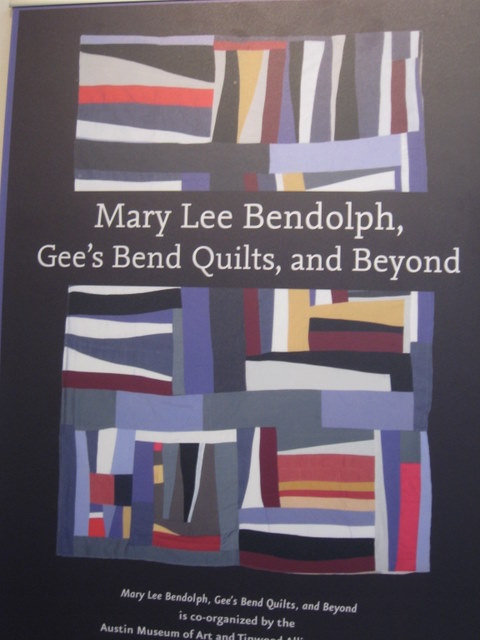
Along with this quilting play was an exhibit of quilts (through Sept 13) created by Mary Lee Bendolph, one of the Gee’s Bend quilters, made famous by a traveling exhibit of these African-American ladies’ work. From a small community in Alabama, tucked in an isolated curve of a river, the women created intensely colorful works of warmth and art that seem based on abstract paintings. They used strips (rectangles) and strings (wedge shapes) to put together primitive yet very architectural designs using whatever scraps they could find in their poverty-stricken lives. They didn’t worry about fancy stitching or the usual patterns because these were just quilts “for hard use.” After Mary Lee Bendolph became famous she said, “I can have any materials I want now, but I still love to use leftover and recycled clothes…I see the value of the leftover cloth. Old clothes have the spirit, and I can’t leave the spirit out.”

Someday when I retire(!) I want to quilt for my girls. I’ve already made each of them quilted Christmas stockings, but I want something bigger – at least a lap quilt – and more memorable. I’d better start planning and saving important scraps. I want there to be a spirit in each of those treasures.

*The Missouri History Museum in St. Louis is looking for stories of quilts. If you are in the area and can bring your quilt or a photo to a videotaped session, call 314-361-7369 or email jsowell at mohistory.org to set up a 45 minute appointment on May 9, 16 or 30.

**Want to try quilting? Check out The Quilter’s Ultimate Visual Guide: A-Z; experienced quilters might like Suzanne Marshall’s new book Adventures & Applique: Traveling the World of her inspiring award-winning quilts based on her travel memories.

Posted in capturing memories | 2 Comments

A Novel Thought About Fake Memoirs

Ben Crair, assistant editor of The Daily Beast, recently mused about the state of memoirs in his article “Who’s Afraid of Fake Memoirists?” Some may speculate that this age of materialism, of the quest for fame through any means, has contributed to a rash of literary exaggerations and embellishments-gone-too-far. But Crair speculates, “Maybe now, with new tools at our disposal, we are simply detecting a condition that has long gone underreported. Maybe the symptom of our age is not the fake memoirists themselves, but the catching of fake memoirists.”

That leads us to a sticky ball of wax rolling down the hill. Yeah, so what about those older memoirs? Are they totally true in the authors’ eyes, and does it matter to us now? Should we go back and try to fact-check them? Is Winston Churchill’s six-volume Memoirs of the Second World War totally truthful or is it a political ploy and public relations stunt? I would argue that, yes, we would be annoyed to find fakery in Confessions of an English Opium Dealer (Thomas deQuincey, 1821). Anyone, from long ago or recently, who embellished their memoir to the point of it becoming a novel deserves to be outed. Their book will still have value, as James Frey still has fans, but readers deserve a warning notice. A memoir that attempts to perceive history to one’s benefit is another story (and often someone else produces a book or essay to refute it – In Command of History: Churchill Fighting and Writing the Second World War, by Charles Jeanfreau).

Many modern memoirists are unafraid to throw every sordid detail of their lives into the public eye in an attempt at fame. (Did Madonna start this trend with her do-anything-for-attention, shove-the-envelope actions?) In Inventing the Truth: The Art and Craft of Memoir, William Zinsser compares older memoirs such as Angela’s Ashes (1996) with the new memoirs, “The national appetite for true confession has loosed a torrent of memoirs that are little more than therapy” or “self-indulgence and reprisal.” He goes on to state that a good memoir elevates the past to a larger truth. Amen.

So what’s the line between a novel and a memoir? A good novel strives to become a memoir, and vice versa – both must make the reader feel part of a reality – but, a memoir is a true reality, a true remembering – right or wrong (does that make sense!?). Ben Crair thinks that nowadays, in light of the many fake memoirs out, “If anything, you could argue that the fact-checkers are doing too good a job. There seems to be some risk that, in attempting to hold memoirs to journalistic standards of factuality, the watchdogs miss the forest for the trees, fixating on minor details in books whose general pictures are correct.” And he has a point there.

So, the little details of a memoir should not have to be fact-checked by an investigator, it is the bigger picture that is important. Of course fake memoirs should be rooted out, but let’s not go too far overboard and toss all the babies out with the bathwater. Authors do need to be honest enough to call it like it is – a novel based on facts may not be as impressive, but it is not any less a story than the real thing, and is sometimes better than the real thing.

PS: Don’t you think even Disney movies need a disclaimer? “Pocahontas is based on a true story, but fictionalized for entertainment purposes.” I swear people will believe anything, even stories about a girl raised by wolves.

Posted in memoir writing | Comments Off on A Novel Thought About Fake Memoirs