Media intelligence and frustrated story lines

What in the world is going on? Last week saw terrible tragedies in the US related to race relations. Police quick with their guns, fed-up black men using their guns to take revenge on anyone who looked like their “enemy.” Too bad about collateral damage. Hello, we are all the same species but with different phenotypes (outward appearances). Each of us is one in a billion (approx. 7.4 billion as of March 2016), but stereotyping, distrust, and downright fear abound. Lumping other humans into broad categories is an inherent survival instinct we who are no longer cavemen don’t need anymore.

The Civil Rights Era and time passing have brought awareness and understanding, and life is so much better for minority peoples, that’s true. But, that story has a sequel, and we need to be ever vigilant not to slip back into the previous stories. That old story actually still exists hidden behind politically correct facades, and too often is blatantly told. If you have a strong stomach just look at the online comments on news stories.

Black people’s stories of continued abused rights have been dismissed until what happened in Ferguson caused the narrative to explode. It is still exploding because too little has been done to give the narrative an ending–story fail! Whether you believe Michael Brown was shot for good reason or not is besides the point. There is an underlying valid frustration (struggle) still crying to be heard and resolved.

Everyone has their stories, but so many won’t listen–really listen–to others. Your story isn’t my story therefore your story can’t be true. Your story forgot important details. You made up your story. You exaggerated your story. You are repeating a false story. Talk to the hand. The media tells its own stories, too. Often they no longer objectively report but  insert their opinions blatantly or through choice of words (words have implicated meanings). For business reasons, the media also feeds our fears and encourages controversy. Headlines are click bait. Do not believe everything you read or hear. Look at other versions of the story. Wait for the real story  instead of running with hearsay. You’ve heard there are two sides to every story? There are more, depending on how many witnesses and how many people have agendas.

Please listen to each other’s stories! Do not invalidate other people’s feelings–they feel that way for a reason, so find out what that reason is. Learn how to discuss without belittling or attacking. Understand that fearful, frustrated, or angry people can lash out, and that’s usually not personal against you, but against the situation. Realize that if you go on the attack, your angry arguments will be ignored by all except your angry choir friends–you persuade nobody and will likely alienate. So try to keep your cool and really listen to others. We all have a need for our stories and cries to be heard. Maybe we will learn something that will make all our lives better. Don’t leave this story with a sad ending.
IMAG1876


Parts of a story line (plot):

Exposition-setting up the story, introducing characters and setting
Rising Action – event that marks the beginning of the struggle or conflict
Climax – highest point of the struggle or conflict
Falling Action-how the climax is dealt with, working on resolution
Denoument-resolution, summary and story ending



Posted in overcoming, storytelling | Tagged , | 3 Comments

Book marketing: what’s your story?

Marketing is about story. What’s your story and how do others fit into that? Recently I attended a book marketing workshop by Shawn Manaher—an excellent and personable speaker and expert in all manner of marketing, not just for books. Shawn gave us a series of questions to help us authors determine our reader profile. No, not everyone will want to read your book. Really. So imagine who will, and where will you find them. Questions include:

What is the typical age and gender of your reader?
What are their hobbies and interests?
Why do they read this genre?
What concerns, issues, or problems does your book address?
Where does your reader hang out online? (or maybe they don’t so how will you find them)

If you can answer these questions while you are writing your book, you will be able to write directly to that audience. What do they like, what do they want to know? Your marketing will be built into the story.

This got me thinking about why I focus on memoir, particularly historical and cultural ones. Why do I read so many of them? The number one reason is that I am curious. Second is that books about history, and even culture, generally focus on the big picture, not what really happens to people who live that history and culture. And no, I don’t care much about famous people’s special lives, I want to know about the average person. What was their daily life like? What did they think about? How did they face difficulties? Someone once accused me of being interested in everything. Of course, isn’t everyone? (No!)

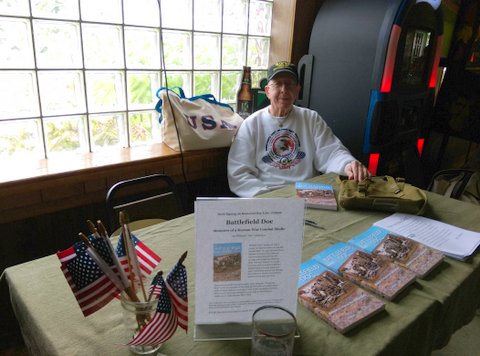
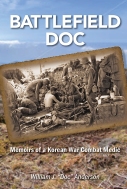
I wrote Cherry Blossoms in Twilight primarily for my family, to save my mother’s fascinating stories of growing up in Japan around WWII. I published for the world because nobody else had written about that. Even in Japan, that was not something the survivors cared to even talk about. There was a huge gap in history and perspective that needed to be filled. I worked with a Korean War veteran to turn his many pages of notes taken on front line combat duty into a readable series of stories, Battlefield Doc, because I had never heard such stories before. Sometimes when I read other veteran’s stories I wonder how they were in the same war! Depends on where they were.

Why are you writing your memoir? Why would you publish it for strangers to read? All memoirs are treasures for family legacy, but some cry out for the world to read. They capture details left out of history books. They give a different perspective. Some help others through difficult issues. Some are just fun! Almost all of them are learning experiences. Mostly, since memoirs are very personal, they hold hands with their readers and show them we all have a shared humanity. In a diverse and troubled world, reaching out to others and encouraging empathy and understanding is a good thing.

IMAG1846

If you want to know more about book marketing (lots to learn!), follow Shawn Manaher’s Book Marketing Tools blog.


Posted in publishing | Tagged | Leave a comment

Memorial Day – all quiet on the western front

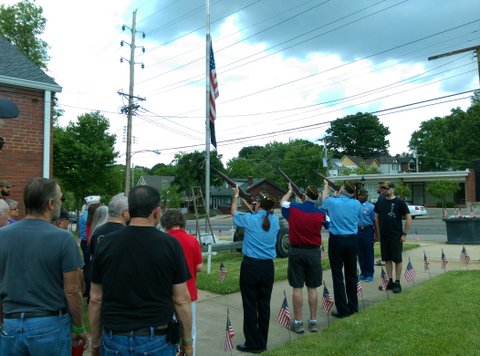
Outside, three shots fired into the air. Inside, I found my veteran friend had been startled by the sound of war. I had forgotten to warn him. We were at a VFW post on the western side of St. Louis to attend a Memorial Day ceremony and do a book signing at the barbeque afterwards. Doc doesn’t like to go to funerals or memorials, however, because he’s seen too much death of the horrific kind, and since then it’s emotionally difficult for him to solemnly focus on death. I left him inside the post building and joined a small crowd outside. At the end of the ceremony, three elder veterans picked up their old M1 rifles and fired three measured blasts. Then the bugler played taps and the half-mast flag was hoisted to the top of its pole.

Not long after Battlefield Doc was published, as a passenger on a car ride I picked up a copy of All Quiet on the Western Front left on the back seat. This famous novel by Erich Maria Remarque is based on his experiences as a German soldier during WWI. I became immersed in sections that in detached manner impressively captured the trauma and pathos of combat duty and the dead feeling of disconnect when a front line soldier returns to civilian life. It reminded me of Doc saying, “You have to put your soul on hold” when you’re on the battlefield. For some, part of that soul is lost forever, and so I remember combat survivors as well as battle dead on Memorial Day.

In the novel, young soldier Paul goes home on leave and his father wants to hear all about the front. “It is too dangerous for me to put these things into words. I am afraid they might then become gigantic and I be no longer able to master them. What would become of us if everything that happens out there were quite clear to us?” Many combat veterans don’t want to speak of what happened “out there.” They want to forget, except that what happened is embedded in their psyches. It’s important to honor the stories that we do hear, to understand what these men went through so we won’t take war lightly as something that happens “out there,” or on TV or in the movies. War is here, hidden in the minds of the survivors, and sometimes it comes out at night, or whenever there is the sound of gunfire.

Doc hopes that his simply-written stories of real-life combat duty will affect teens as well as adults. He hopes that what the men in the trenches of the Korean War went through will not be forgotten in the shadow of WWII or Vietnam – these men and their stories are worth remembering, too.

“This book is to be neither an accusation nor a confession, and least of all an adventure, for death is not an adventure to those who stand face to face with it.” – All Quiet on the Western Front

Post3500

Doc3

Posted in death, honoring veterans, war stories | Tagged | 2 Comments