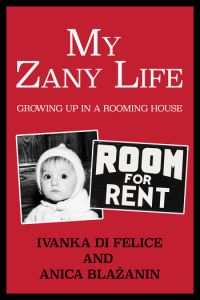
 Do you like hilarious true stories? Last year, I featured Ivanka di Felice and her delightful first book, a memoir titled A Zany Slice of Italy, about adapting to life in a new country with new relatives. Ivanka has recently published both a sequel, A Zany Slice of Tuscany, AND a prequel, My Zany Life: Growing Up in a Rooming House. I want to read both, but am particularly curious about her memoir of being raised in a rooming house, which she wrote with her mother, an immigrant from Croatia. The intriguing book description includes, “Many people think it’s tragic to grow up in a poor neighborhood, but the author assures us it is equally tragic growing up in a rich neighborhood when you are poor.”
Ivanka has answered a few questions about her book and about writing.
* * * * *
Tell us a little about where you grew up and what you mean by a rooming house. Most of us probably think of rooming or boarding houses as something out of history, like during the Gold Rush.
At great personal sacrifice (the book explains just how great) my parents scrimped, saved and borrowed money for the down payment on a lovely, large house on a tree-lined street in a fancy neighborhood. However, in order to afford this home, they never had the option of just our family living there. The only way they could keep it would be to rent out most of the house, in the most profitable manner. Thus was born “The Rooming House,” which sat among, but apart from, other stately family-owned homes.
I grew up in the swanky west-end neighborhood of High Park—except our house and those who lived in it were anything but swanky. My dad, or Tata, as we call him, started his “real estate empire” after my younger brother, Steven, was born. If there was a skill in renting out rooms and knowing how to read people and letting only the good ones in, then my parents did not possess it. Hence, we shared our home with a host of colorful tenants: some good, some bad, some funny, and some sad. Yet we survived, and I fondly recall the humorous memories even now.
You wrote this book with your mother. Was that a lot of fun, or did you have disagreements? Did you write chapters and she wrote chapters, or how did you go about writing?
We did not disagree on anything, however according to my mom the book is complete “thanks to my daughter who nagged me persistently to remember and to write what I have.” It is written in chronological order, so my mom wrote the chapters in the beginning and then makes a guest appearance in the middle and writes her conclusion on life at the end. The actual experience of writing with my mom can be summed up by my acknowledgments:
Congratulations are also in order to me, for the patience I mustered up while trying to decipher my mother’s notes and for partnering with probably the last known author to still use pen and paper and write in a painful scribble. My mother, well aware that English is not phonetic, applied her “more is more” theory and, just in case, added an extra vowel or consonant to each word. She demonstrated her creativity with each draft she sent me and she challenged my math. Sentences were written vertically and horizontally, and pages were randomly numbered, rarely in order. Celebrate the completion of this book with us, for it is nothing short of a miracle!
Yet as a final note, I want to thank my mom for being who she is and for having taught us the valuable lessons she did.
Your parents have an interesting story of how they met in Croatia. How did they meet and how did they end up in Toronto?
I don’t want to do a spoiler so let’s just say my mom lived in a small village in Croatia (formerly Yugoslavia). She lived like everyone else in the village, about ten feet from the main road. And once in a while, that road was blessed with the vision of a 1964 Ford Galaxy XL zooming past. The rest is history.
You’ve had quite a life. I loved your hilarious first book about adjusting to life in Italy and want to read the follow-up about life in Tuscany, which was also published recently—you’ve been very busy! What will readers enjoy or learn from your third book about growing up in a rooming house?
I hope readers will see that despite difficult circumstances, children can still be happy and, at that, with little. That being deprived materially does not mean you have to be deprived of happiness. Also, that it’s possible to look back on less than ideal situations without viewing them with bitterness but, instead, if we choose to, we can recall those memories through eyes of humor. And by the last chapter I am certain that anyone renting out rooms or apartments in their house (or even their shed) will definitely confirm references!
Do you have any advice for people wanting to write funny memoirs?
Dig into your memories and find situations that make people laugh, then expand on them. Think of stories you tell that others find amusing. During difficult situations jot down notes that can later be expanded on and can usually be viewed as a lot funnier than while you were actually enduring them. Chapter 68: George—The Human Boomerang is a case in point.
To quote my mom, “Ivanka taught me how to look on the funny side of life—not that all occasions could be viewed that way, but many could, and why not focus on those? As someone said, ‘Holding onto anger is like drinking poison and expecting the other person to die.’ It’s much better to try to find humor in the situations we encounter.”
* * * * *
Thank you so much, Ivanka! Sounds like your new books will be as funny and as sweet as your first.
Ivanka Di Felice is a writer living in Tuscany. She will assure you that it’s far less pretentious than it sounds. She owes her life to a 1964 Ford Galaxy XL. Her heritage proves that on occasion, reality is stranger than fiction. Ivanka has written the Zany Series of books describing a life of wacky adventures. In her quest for sanity, she decided never to own a rooming house.
Anica Blažanin, mother of Ivanka, was born in Croatia. More than five decades ago, she left her village of Mučna Reka, meaning “Sickening River,” for Canada with two battered, borrowed suitcases and a dream. Her life abroad was far from what she had envisioned. Regardless, she proves that despite life not always delivering what we have dreamed of, we can still be very happy.
Visit Ivanka’s Amazon page to see all her books.