
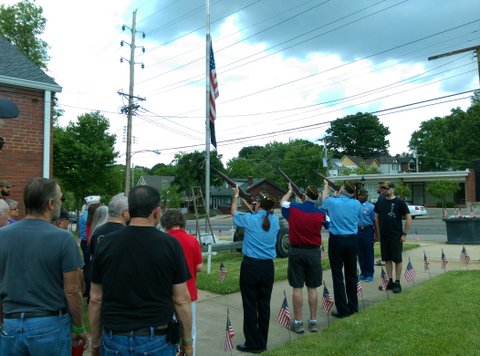
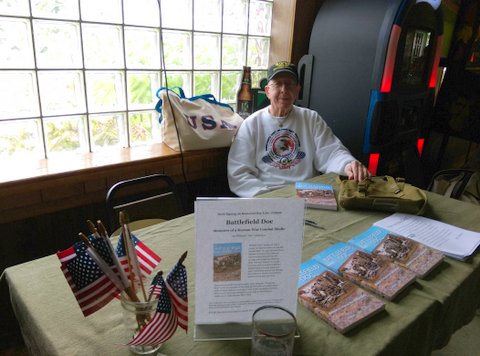
Outside, three shots fired into the air. Inside, I found my veteran friend had been startled by the sound of war. I had forgotten to warn him. We were at a VFW post on the western side of St. Louis to attend a Memorial Day ceremony and do a book signing at the barbeque afterwards. Doc doesn’t like to go to funerals or memorials, however, because he’s seen too much death of the horrific kind, and since then it’s emotionally difficult for him to solemnly focus on death. I left him inside the post building and joined a small crowd outside. At the end of the ceremony, three elder veterans picked up their old M1 rifles and fired three measured blasts. Then the bugler played taps and the half-mast flag was hoisted to the top of its pole.
Not long after Battlefield Doc was published, as a passenger on a car ride I picked up a copy of All Quiet on the Western Front left on the back seat. This famous novel by Erich Maria Remarque is based on his experiences as a German soldier during WWI. I became immersed in sections that in detached manner impressively captured the trauma and pathos of combat duty and the dead feeling of disconnect when a front line soldier returns to civilian life. It reminded me of Doc saying, “You have to put your soul on hold” when you’re on the battlefield. For some, part of that soul is lost forever, and so I remember combat survivors as well as battle dead on Memorial Day.
In the novel, young soldier Paul goes home on leave and his father wants to hear all about the front. “It is too dangerous for me to put these things into words. I am afraid they might then become gigantic and I be no longer able to master them. What would become of us if everything that happens out there were quite clear to us?” Many combat veterans don’t want to speak of what happened “out there.” They want to forget, except that what happened is embedded in their psyches. It’s important to honor the stories that we do hear, to understand what these men went through so we won’t take war lightly as something that happens “out there,” or on TV or in the movies. War is here, hidden in the minds of the survivors, and sometimes it comes out at night, or whenever there is the sound of gunfire.
Doc hopes that his simply-written stories of real-life combat duty will affect teens as well as adults. He hopes that what the men in the trenches of the Korean War went through will not be forgotten in the shadow of WWII or Vietnam – these men and their stories are worth remembering, too.
“This book is to be neither an accusation nor a confession, and least of all an adventure, for death is not an adventure to those who stand face to face with it.” – All Quiet on the Western Front
 The final chapter is on “The Really Big Stuff.” What were (and are) your hopes and dreams? What has been your passion in life? How did you get through bad times? What do you want to tell your children and grandchildren, or anyone else who would read your book? Kim gives many sample questions to choose to write about. On the one hand, she reminds, “You are creating a primary source.” Which means you were an eyewitness, someone who lived during those times. What did you experience? Your stories matter as history. On the other hand, what are the lessons you have learned, what wisdom do you want to impart? Who are you, what did you think, how did life affect you? You are a unique somebody. And you have stories to share!
 dog, and not just any dog, this particular dog. Dogs are as individual as people. There are dogs who have phobias about vacuum cleaners, and dogs who like to sleep under the covers, and dogs who believe that squirrels should be wiped off the face of the earth. There are dogs who turn up their noses at expensive kibble in favor of three-day-old garbage, and dogs who will learn how to roll over or shake hands. To some dogs, Frisbees are the reason for living. For other dogs, the most fun in the world is to force others to go where they want them to go, and if they don’t, the dogs get to nip their heels. And for still others, any day they don’t go swimming is an evil day indeed.

 moonbridgebooks