Finding stories for your memoir

“Everyone has stories.” Maybe you’ve heard that before and know it’s true, except you can’t think of your own stories. OTHER people have stories. Anyway, why would your family care about the few memories you have? Well, your family who loves you would like to hold onto who you are and pass you on to future generations. Having your stories around would help. And you have more stories than you know…

You are from a particular time, place, and culture. You are a time capsule containing a past that your current and future family members can delight in learning about and even be inspired from. Your stories can make history meaningful and personal and enrich your family’s lives as they learn more about who you were and who you are. They may be amazed and astonished, they may be inspired, they may understand you better. They may laugh, they may cry. Don’t be surprised if they love you even more! Sharing stories can make the bonds of family – and friendship – stronger.

My last post featured ghostwriter Kim Pearson, who has helped many people produce their memoirs but also is a ghostwriter for her dog! Her book for people, Making History: How to remember, record, interpret, and share the events of your life, is a valuable aid to life writing. I think it is particularly beneficial for anyone wanting to make a collection of short stories, versus a memoir that is one long story such as dealing with a debilitating illness or traveling through Europe one summer. Kim writes in a personable way, giving advice on life writing, addressing questions and fears, and giving examples of memories and short stories–maybe the last is the most helpful. Non-writers who feel intimidated will like holding onto Kim’s hand as she leads them through this process of remembering and sharing. Kim has included timelines (ex. Economics and Politics, Social Fabric, Wars and the International Scene, Arts & Entertainment) not only to prod memory, but to include within stories so readers can feel how a story fits into a bigger picture of life during that time.
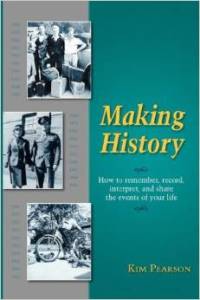
making-history-200x300The final chapter is on “The Really Big Stuff.” What were (and are) your hopes and dreams? What has been your passion in life? How did you get through bad times? What do you want to tell your children and grandchildren, or anyone else who would read your book?  Kim gives many sample questions to choose to write about. On the one hand, she reminds, “You are creating a primary source.” Which means you were an eyewitness, someone who lived during those times. What did you experience? Your stories matter as history. On the other hand, what are the lessons you have learned, what wisdom do you want to impart? Who are you, what did you think, how did life affect you? You are a unique somebody. And you have stories to share!


Posted in book reviews, capturing memories, lifewriting, memoir writing | Tagged , , | Leave a comment

Ghostwriting a memoir for the dogs (and cats)

Woof, woof! What is your dog saying to you? Do you have a cat with a big personality or an incredible tale? Today’s post is by Kim Pearson, a writer I follow through her blog, From the Compost, and on social media. She is not just a writer, she is also a ghost. And interestingly, she has channeled her dog in the book Dog Park Diary. Does your pet have stories?

********

A Dog’s Ghost

by Kim Pearson

I am a Ghost. Ghostwriter, that is. I write books for other people who don’t have time to write, or think they don’t have the talent to write, or just plain hate to write – some people would rather clean the toilet than write. Nevertheless, they have a story, or an idea, or a Cause – and they want the world to know about it. So they hire me to write their books. So far I’ve written nearly fifty books for other people, and everyone is happy. Life is good.

The biggest challenge about ghostwriting is that you must become someone else. I am invited into another person’s head, and allowed to poke around. I mine the data and the passion I find there, and bring it to the surface so I can play with it.

This isn’t easy. Your brain doesn’t work just like mine. In order to find the information and the emotion that I need to write like you, first I have to think like you. And actually, this is impossible.

So have I figured out how to do the impossible? No, I’ve just learned to pretend really, really well. I pretend to think like you. And if I pretend hard enough, something weird happens to my brain and I do think like you – at least while I’m writing your book.

Actors do this when they portray a real-life person. Think of Jamie Foxx as Ray Charles. He was more like Ray Charles than Ray Charles was. Through the mysterious alchemy of art, for the duration of making that movie, Jamie Foxx probably thought like Ray Charles. And that’s what ghostwriters do too. They’re just not in front of a camera when they do it.

I began to understand the dynamic of pretending when I wrote a book for a dog. In a dog’s voice. It was about the dog’s visits to the dog park, and the experiences she had there. It’s called Dog Park Diary: the social round of Goody Beagle. Now I’m writing the sequel, about Goody Beagle’s fur brother Alex, due out next year.

All my interpersonal skills were no use in writing Goody’s book. I had to pretend to be aDogParkDiary dog, and not just any dog, this particular dog. Dogs are as individual as people. There are dogs who have phobias about vacuum cleaners, and dogs who like to sleep under the covers, and dogs who believe that squirrels should be wiped off the face of the earth. There are dogs who turn up their noses at expensive kibble in favor of three-day-old garbage, and dogs who will learn how to roll over or shake hands. To some dogs, Frisbees are the reason for living. For other dogs, the most fun in the world is to force others to go where they want them to go, and if they don’t, the dogs get to nip their heels. And for still others, any day they don’t go swimming is an evil day indeed.

But there are some things about being a dog that are common to all dogs. For one thing, being alone is the worst fate that can befall them. But the big thing, the biggest thing that matters to a dog’s ghostwriter, is that they don’t think in pictures or words, like we do. They think in smells.

How to think in smells is impossible to explain fully in an article made out of words. But thinking in smells is how I was able to write in a dog’s voice. I pretended that smell was everything to me. I went around sniffing the ordinary things in my house and my yard – the dishwasher has a smell, the dandelions have a smell, the mailbox has a smell. Even if I couldn’t actually smell them, I pretended that I could. And guess what? When I wrote the story, the correct doggy words drifted up to my brain from my pitiful olfactory bulb (pitiful in comparison with a dog), and I got close to what mattered to that dog. I know this is true, because she told me so.

And now writing for people is a piece of cake.

********

Kim Pearson is an author, ghostwriter, and the owner of Primary Sources, a writing service that helps others become authors of polished, professional, and compelling books. She is the author of Making History: how to remember, record, interpret and share the events of your life and of Dog Park Diary (ghostwritten for a dog!), as well as fiction and haiku poetry books. She has ghostwritten (for people) more than 45 non-fiction books and memoirs. To learn more about her books or services, visit Kim Pearson’s website, Primary Sources.

Note: Kim’s Making History book may be just the thing to motivate you to write your own (human) stories. Scroll way down her Books web page to find a link to an excerpt.

Posted in ghostwriting, pets | Tagged | Leave a comment

Memoirs don’t feed the hungry, or do they?

Happy Easter! Thank goodness for Jesus! This post may seem religious, but it’s really about making choices about what matters. Sitting in church last week, I thought about how I am not very active in church anymore. I have not taught Sunday school or sat on any committees or been involved in mission-type programs for quite a few years now. Our church offers a lot of opportunities to help the down and out, but all I do is bring food each Sunday for local pantries and donate school supplies once or twice a year. I do regularly send greeting cards to an elderly homebound church member, and I do usually adopt a family at Christmas. Jesus told us to take care of those who are the least and the lost, but I didn’t think I was doing my part very well. I am too busy.

What am I doing instead? Besides my part-time job and taking care of house and yard, I have my little book publishing company, help others figure out how to write and publish their memoirs, and participate on three very active nonprofit boards. I get upset sometimes because I don’t have much free time, but I love all that I do and don’t want to stop doing any of them. None of them, though, is helping the world be a better place. I felt bad.

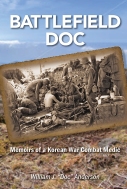
Then I thought that maybe these things I do ARE actually helping, just in small ways. Two of the boards I am involved with share culture, which enriches lives and helps open people’s minds to worlds besides their own little ones. Helping people write and publish their memoirs not only enriches the authors’ lives and that of their families, but many memoirs are very helpful. They can be healing for the author, let others feel they are not alone, give new ideas for coping, or give the gift of laughter to relieve stress. Memoirs encourage empathy and understanding as they teach new perspectives. Cherry Blossoms in Twilight has taught many older Americans that their WWII enemy’s civilians were very much like them, something to remember in all wars. My latest project, Battlefield Doc, gives civilians insight into what combat was like during the Korean War, and a serious appreciation for combat veterans, many permanently traumatized by their service and well-deserving of the best health care.

I will continue to feel a little guilty, but I realize it’s okay if I don’t join the Peace Corps like my gutsy writer friend Sonia Marsh. I am not smart enough to come up with a Shower to the People van like Jake Austin. For now, I will just plug away and make little differences one person at a time and continue donating to some of the infinite number of worthy programs out there. You can’t do it all, you have to choose. Sometimes, of course, just a friendly smile or hug can make a world of difference to someone. Let your light shine. Happy Easter!

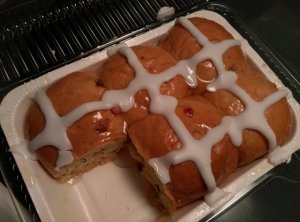
HotCrossBuns

hot cross buns

Posted in memoir writing | Tagged | 4 Comments