Ivanka di Felice, born and raised in Toronto, Canada, fell in love with Italy and is now a  writer living in beautiful Tuscany. But from her bio, “She will assure you that it’s far less pretentious than it sounds. In her quest for happiness, she followed Nora Ephron’s advice: ‘Secret to life, marry an Italian.’” Ivanka has written A Zany Slice of Italy, a delightfully charming and funny memoir made up of short stories about her “Italian Prince,” who was once Canadian, and his many traditional Italian relatives plus equally quirky friends and neighbors in Italy. Under the Tuscan sun you apparently become half baked. I am in love with this book! Here are a couple tidbits:
“The cantina is stocked with at least a year’s worth of food and wine, ready for any impending natural disaster, a world war, or a few typical Italian family dinners,” and later, “although we had just recently visited and returned with a car full of food, an Italian mother knows no bounds. I bring my overnight bag outside and find the car loaded to the brim. A virtual grocery store has once again taken over the trunk. The two chickens are in a little box next to the car.” (Ivanka’s favorite story is about the chickens and a policeman.)
“Giorgio has much to show us, and time is of the essence! Obstacles such as our extreme jet lag will not be allowed to get in his way… Sitting in the backseat, I soon realize I’ll be calmer if I look sideways, rather than straight ahead. In matters that relate to speeding oncoming traffic, it’s best to remain ignorant.”
Following are questions I asked her before reading much of the book, which I then devoured as though it were homemade pasta with zingy fresh tomato sauce. Ivanka includes a few recipes at the end of the book and I made a sloppy American version of the Pappa al Pomodoro (fresh tomato with drowned bread) soup to eat while reading. It was delicious!
- You have interesting and hilarious stories of adapting to another culture. Did you keep a journal? At what point did you decide to write your stories and did you intend from the start to publish for the public?
We first lived up in the hills of Abruzzo with no TV, no phone, and no internet. We decided to “spice things up” by buying an old second hand computer (from a fugitive it appears). With not much else to do I started writing short stories to send to update friends about our last known whereabouts. It was thanks to their encouragement and thanks to the advice of a wonderful agent in London that I began to polish up the stories and get them ready for book format.
Or, perhaps I subconsciously wrote so that when my husband and I dispute “facts” then I can refer to page xx of my book and say “well, according to my book….” Of course, if my book confirms that he was correct, then I say nothing and hope it will pass unnoticed.
- Did you write linear on a timeline, or scattered stories? Did you work from an outline? How long did it take to write your book?
The stories take place chronologically. As funny things would take place I would jot down notes (behind the backs of many a relative) and then later write a story based on these notes. It was a total of six years from the early beginnings typing on a possibly stolen computer to when I handed it over to my editor, Patti Waldygo, in early 2013.
- You’ve probably read or seen the movie “Under the Tuscan Sun.” I saw the movie, which is also about adapting and has funny moments. How is your book different, and was “Tuscan Sun” any sort of influence on your writing–maybe even something to avoid similarity to?
While on occasion I cannot help but mention the wonderful food, fashion, and people, my account of our year in Italy includes an unusual angle. Frances Mayes did not have what I have—relatives! Without them, this novel would fail to capture the realities and true essence of life here. Hence, while Frances Mayes was dining by candlelight, my glass candle holders were doubling as tomato holders; each one had a freshly picked tomato balanced on top, courtesy of my mother-in-law visiting.
I write humor and have chosen to write about the quirky situations and occasional mishaps that we have found ourselves in simply because they are funny. Plus, I wanted to avoid readers asking “Just how many more walks in glorious sunflower fields do you think us readers can take?”
- What does your husband and his family think about being in the limelight, for better or worse? What do your Italian neighbors think about this book? Did you use real names?
Prior to publishing, I had both my husband and my sister-in-law read the book to see if they felt anything should be taken out. They loved it as it is (whew!), and my mother-in-law, the real star of my book, is really good-natured and laughs out loud when I recount the stories to her. However, just in case, I think it best it never be translated into Italian, and I have put this disclaimer at the beginning of my book: The story you are about to read is true, though some names have been changed to protect the innocent, namely the author.
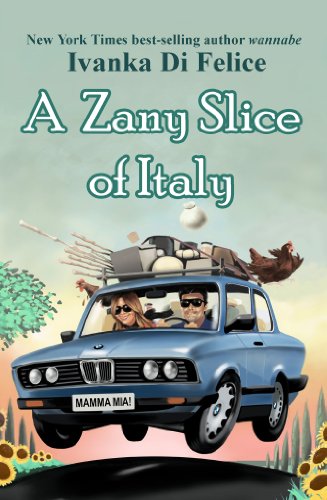
- Your book is well-written and I like the cover. Can you tell us a little about your self-publishing journey? There’s a lot to learn about that.
Thank you. I was fortunate to find a wonderful editor and great cover designer. The cover is based on a chapter from my book. I sent Joe Shepherd the chapter, a picture of our car, and a picture of David and me—his imagination did the rest.
Dorie Simmonds, an agent in London, gave me suggestions on how to improve my book. I followed them and she took me on as a client in 2013. Dorie worked really hard on my behalf, however due to the abundance of travel memoirs it was hard to find a publisher. In the meantime, I had read up on self-publishing and decided that instead of waiting I would try to self-publish. Dorie was understanding and wished me the best. Even though my book was edited and ready to go, I soon realized how handy it may have been to have a publisher – I spent hours looking for a cover designer, for formatters for the e-book version and print version, getting ISBNs, trying to figure out U.S. taxation issues, etc., etc. And it never ends! You then have to advertise, promote, etc. In order to be successful you need to invest a lot of time (and money, sigh!)
(Marie Lavender’s “Writing in the Modern Age” blog has a great article by Ivanka explaining editing in “22 Ways Most Authors Need an Editor” – Authors, please read!)
- Is there anything else you’d like to tell us about writing or publishing? I hear you are working on another book.
Find your style and stick with it so that writing is enjoyable. Not everyone will appreciate your book but at least you are doing what you enjoy, and there will be many that do appreciate it. While no author likes getting bad reviews, it is good to remember the story about the Man, the Boy and the Donkey – no matter what you write you cannot please everyone!
Also, it is extremely important to invest in a good editor—one whose style matches yours. I sent out my story “Stranieri Giusti” (The Right Type of Foreigners) to five editors and asked for a sample edit. The story came back essentially the same, but the editor I chose had a style that just merged with mine. She had a perfect balance of fixing grammatical errors and tweaking while letting what she calls my “unique humorous voice” still come through.
Yes, I am working on my next book for our “adventures” never seem to end! 😉
* * * * *
Thank you, Ivanka! I think you have done everything right and are on your way to being a best seller, at least in my books. 🙂
Find A Zany Slice of Italy on Amazon US or Amazon UK. I fell in love with the description and was not disappointed. I highly recommend this book so that you, too, can laugh and love those Italian relatives (and bask in the glow of sunflowers). Think about injecting a little humor in your life writing!





 moonbridgebooks