Is your memoir worth the time to write?

“Worth the time to write?” I repeated—raising my voice into a question—when a man said Denis Ledouxto me at a conference where I was speaking that most people didn’t have a memoir that was worth their time to write. “Not only is every life worth writing about,” I countered, “but the writing of a memoir is a healing and developmental process for the writer. There is something in the telling of a tale that produces satisfaction and resolution and often growth.”

“I don’t know about the healing,” he said, “but I do know that most people haven’t done anything interesting enough to write about, let alone have someone else read it.”

“I don’t think children and grandchildren feel that way,” I answered. “I’ve never met anyone who wasn’t happy to have a memoir by a father or mother.”

“Well, okay,” he conceded, “but who else is interested?”

“First of all, the size of the audience is not what makes the writing of a memoir significant. There is worth in the telling itself.”

An Important Point

While there continues to be an insatiable hunger to know about one’s family and culture, the man’s commentary, of course, held an important point for you—for any of us—to consider. If you have not led a momentous life, are the stories you have to share worth the time to write them?—speak them, yes, because sharing a memoir is a meaningful way one generation transmits stories to another. But, writing them is so much more difficult—is the sacrifice of time and energy really worth it for you?

Let me repeat: it is appropriate to write stories solely for a family or other small readership. There is nothing “wrong” or not worthwhile with a small, familial audience. The value of any piece of writing is not measured by how many people—total numbers—have read it. This emphasis on size is a spin-off of the commercialization of worth. It is a result of the creation and promotion of the “superstar” in our culture.

The worth of a memoir is better measured by the inherent value to the writer and to its selected audience—whether that is your family or the world. The act of writing will change you and your relationship to your life. Writing is significant in itself.

“Writers, if they are worthy of that jealous designation, do not write for other writers. They write to give reality to experience.”

                                                                        —Archibald Macleish

Action Steps

  1. For whom do you want to write your stories? This is your audience. The answer could be as varied as: for my family; for parents of Down Syndrome children; for men who are about to retire; for women who love judo. Describe them, their needs and their interests in some detail.
  2. Why do you want to write for these people? In what way, do you need for them to hear your stories? In what way, do they need to hear your stories? Again, write lengthy responses.
  3. Write about the immortality writing will bring you as your memoir and family history live on into future generations long after you are gone. Is this important and comforting to you?
  4. Place your writing from this exercise in a three-ring binder.

* * * * *

Denis Ledoux is the author, most recently, of How to Start to Write Your Memoir which is Book One in the seven-part Memoir Network Writing Series. This post is adapted from that e-book. Also in publication is Don’t Let Writer’s Block Stop You. A complete list of publications is available. To be placed on an alert list, send an email.

How to Start to Write Your Memoir

Memoir Network Writing Series

 Don’t Let Writer’s Block Stop You

Posted in lifewriting | Tagged | 13 Comments

Color printing and good food for your memoir

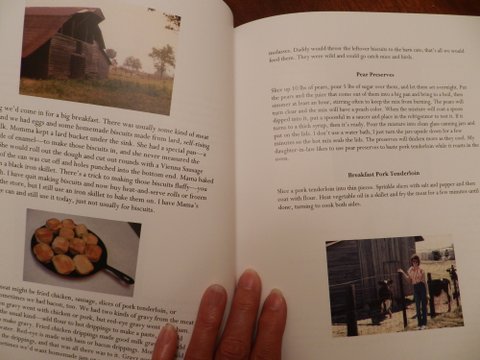
My mom-in-law is known for her soul-satisfying Southern cooking. If I lived closer to her, I’d gain a lot of weight but probably be less stressed thanks to all those endorphins she brings to the table. She also has some fascinating stories from her childhood growing up on a farm in the Tennessee countryside during the 1940s and 50s. She’s seen the advent of electricity, indoor plumbing, and automobiles. She’s picked cotton by hand. I had to get all these stories down on paper to save for generations, and why not save those recipes, too.

Last summer I published her book of stories and recipes, also photos of food, farm, and even farm crops since most kids these days have no idea what okra flowers or purple-hull pea pods look like. I’m glad my own kids have helped harvest the crops from my in-laws’ current big vegetable gardens. Stooping in the heat and buzzing insects to pull potatoes out of the dirt and snapping a giant pile of green beans to ready them for canning are meaningful life experiences in my books. Don’t take for granted where your food comes from, and appreciate those farm laborers.

I had the book printed for family only through Lulu.com since I only needed about 20 copies. Lulu did a fine job on the color interior!  I scanned old photos, including some faded b&w ones, at 300 dpi and used high-resolution digital photos taken with my decent-quality Nikon Coolpix. Lulu’s color printing is not meant to make glossy, pro-photography, coffee-table style books or color-illustrated children’s books, but is just fine for family books with smaller size photos or art. The price was right, too. The 36-page paperback, 8.5” x 11” size, was about $18 each. Can’t beat that for color printing. I uploaded a photo taken in my in-laws’ kitchen for the cover and used a free Lulu cover template. Note from my last post, Far-reaching Effects of Family Stories, that Theresa had trouble with Lulu’s printing of her b&w photos. I’ve never had trouble with that before, but that’s something to take into consideration – and always get a print proof copy to head off any problems.

We are thrilled to have Grandma’s cool stories and those recipes saved. Even if we never make some of those rich recipes, they are of historical and cultural interest. Food was a big part of farm life. Homemade boiled custard, mmm. Farming sure has changed over the years. If you’ve got farm stories in your family, write them down to save. Even if you don’t have Grandma’s recipes, you can still write about the food. Tell what you do know and let the younger generations taste it in their hearts and minds.

PS: I enjoyed Carol Bodensteiner’s memoir of farm life back in the day, Growing Up Country: Memoir of an Iowa Farm Girl.

Farm Lifewriting

DSCN5119

DSCN5118

Posted in capturing memories, grandparents, heritage | Tagged , , , | 5 Comments

The far-reaching effects of family stories

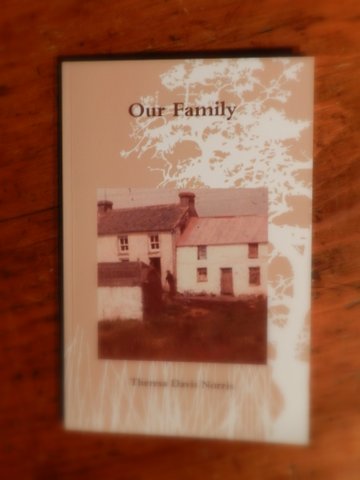
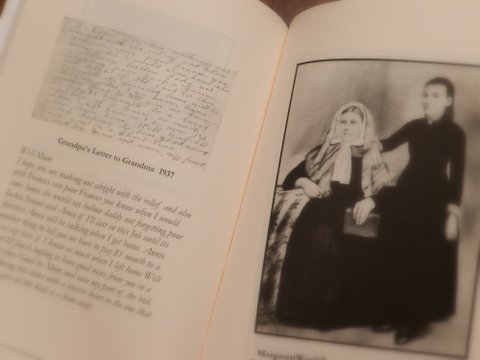
I received a wonderful thank-you letter from someone who discovered this website and was inspired and encouraged to go forward in publishing her own book of family history and stories Theresa's bookusing Lulu.com. Theresa’s book is beautiful! She used a free Lulu template and her own photos for the cover. She created the book to honor and memorialize her Irish immigrant grandparents. She turned her own memories and the information she discovered from researching into a nice story and then followed that with the individual stories told to her by elder living relatives. She included old photos, copies of some genealogical documents such as immigration and census records, and some copies of old handwritten letters which she typed up content or summaries of to add below them. She even included a few of her grandmother’s recipes.

Theresa’s goal was “to document and share with family members and my grandchildren so that they would also benefit from this wonderful history,” but something interesting happened. I will let her tell this story.

* * * * *

I had a wonderful and unexpected gift from doing this book, too. I had ordered about 50 copies to give to cousins and relations. My intention was never to market this book as it was a private and personal story. However, I found that only a handful of my first cousins were really interested in the subject or even the process to complete the project. Of course, there are just times in one’s life when we are interested in family history and also there are usually only a few family historians who really value the information. I don’t think it was my writing, but just the subject matter. Interesting, too, is that we all see “our family” history through a different lens.

Last spring, newly retired, my husband and I took a transatlantic cruise from Ft. Lauderdale, Florida, that ended in South Hampton, England. At the last minute I made arrangements to meet my cousin Margaret in London . We had met over 40 years ago when she visited my grandmother one summer. We were never in contact again but somehow reconnected and it was like we knew each other. She shared to me that the love of her mother and my grandmother from their modest cottage in Donegal was present at our table. We both shared tears, laughter and much love that day in our memories.

Upon returning home, I sent Margaret one of the books. She wrote to me that she got home from work and didn’t take her coat off but sat and read and cried reading the book! She loved the stories! Margaret quickly spoke to her relations and the book was purchased online from Lulu  from my relations  living all over the United Kingdom, Ireland, and Australia. They all bought the book and we have opened an active dialogue about our mutual family history.

These are all descendants of my grandmother’s siblings and even her parents descendants. There are many relations that I truly never knew at all. My grandmother was one of nine children with only her sister emigrating to America. She has also been deceased since 1977 so many family connections were lost. This past October my husband and I traveled again and we went to Scotland and Ireland. These trips were filled with meeting and enjoying family members all over. The book, Our Family, was really my entry to my family history and now a living history that is a fantastic treasure to me.

I have made friendships with my relations that will last forever. When we visited Ireland and the family homestead we were given the grand tour of places that we would never have had access to or even known about. Relations from England flew to Ireland to ensure that we would see our family history! These were cousins who I never knew or ever met. The book was my introduction to them and led them to invite me into their lives and to uncover and celebrate our family history. I want to thank you again for your inspiration and encouragement as it really made a difference to me to complete my project! Blessings!

* * * * *

Congratulations, Theresa! You have received many blessings thanks to your book!

Note:  Theresa did have some issues with Lulu.com’s printing. The copies printed in the UK were great, but the US batches of copies she ordered sometimes had problems with how the photos looked. Theresa said Lulu did replace the bad copies with good ones at no charge, but this is something to watch for. Last spring I published through Lulu copies of my mother-in-law’s stories and recipes, including old b&w and new color photos and they turned out perfect (color interior!), so who knows what’s going on. It always pays to get a proof copy in print – do not depend on an electronic copy (e-copy).

Theresa's book2

Posted in Uncategorized | 9 Comments