Finding and keeping cultural heritage

Besides the usual busyness of my life, I’ve been busy the last few weeks getting ready for the annual Japanese Festival in St. Louis. Per the last census, our area has a little over 3,000 people claiming Japanese heritage, way below the Korean, Vietnamese, and Chinese local populations, but we have one of the largest Japanese festivals in the nation. Almost the entire community of us helps with the festival, and seems like everybody becomes Japanese during Labor Day weekend, dressing in happi coats, yukata and even kimono. Yukata is the casual, cotton summer kimono. Plenty of non-Japanese, including men, wear yukata to the festival and maybe even carry sun parasols.
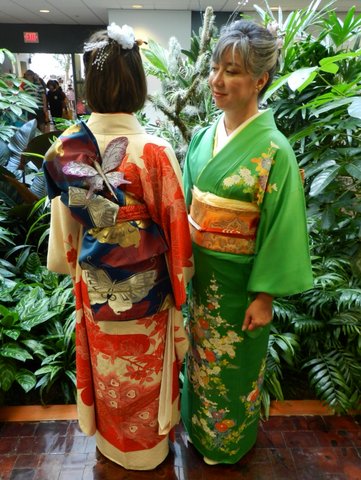
kimono showThis year my younger daughter and I were honored to be models in the very popular kimono show, put on by a certified kimono expert with ten years of training in Japan. I looked so good I didn’t recognize myself, thanks to an elegant emerald kimono and the magic of a specialist hair stylist. My daughter was more beautiful than usual, wearing the long furisode sleeves of young, unmarried women. Women in Japan don’t wear kimono much anymore, and we could understand why! We were (barely) walking pillars, bound tightly by many narrow ties and our wide obi sash.

Since I have never really lived around other people of Japanese heritage before, except for my mother, I feel like I’ve finally found “my people.” I am immersing myself in the Japanese cultural offerings through the Japan America Society and several local universities. I eat Japanese home cooking in potluck lunches with my friends – nothing like what the restaurants serve. I’ve started Japanese language lessons at the Saturday language school because now I have plenty of people to practice with. All this without hopping a plane to cross the ocean.

Japanese food

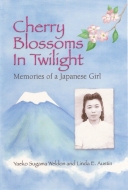
I guess I’m so enamored with my cultural heritage because I’m so close to the immigrant generation (my mother). I have her stories and fresh culture she passed on to me. I try to pass on the culture to my quarter-Japanese children, and thankfully we have my mother’s stories in her Cherry Blossoms in Twilight book, but I think it’s all diluted by the river of America. We have to work at passing on the traditions and stories of our heritage and hope future generations care. As I’ve seen, though, our own future generations may not care, but somebody else’s might. Yukata for everyone!
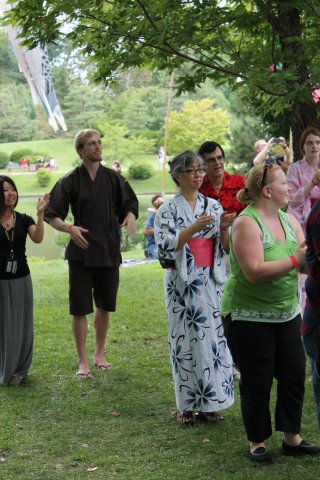
bon dancing in yukata
bon dancing in yukata

Posted in heritage, multicultural | Tagged , | Leave a comment

Who wanted war anyway?

My mother, who survived WWII as a civilian in Japan, asked this question in her memoir, Cherry Blossoms in Twilight. This week I have a guest post about war on fellow memoir author Gwen Plano’s blog. War and its effects are sadly always pertinent, and much on my mind now as I read the latest news and remember this month the anniversary of the dropping of the atomic bombs on Japan and of the end of WWII.

Whose idea is war, and who then is forced to fight it, and who are the ones dying

I like Gwen’s previous post, Can we build a bridge between our differences.

Gwen was featured on my blog a month ago in A Memoir of Overcoming:  Gwen Plano and Letting Go in Perfect Love


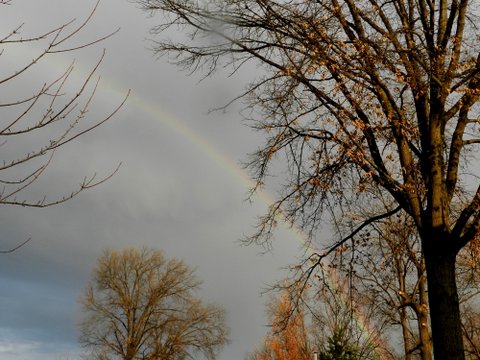
If there are still rainbows, there is still hope

If there are still rainbows, there is still hope

Posted in Uncategorized | Leave a comment

Biography and Memoir: how important are approvals

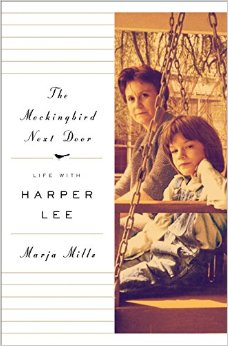
Mockingbird Next DoorThe famously reclusive Harper Lee of To Kill a Mockingbird fame is in the news recently denying she approved of and collaborated with Marja Mills writing the recently published The Mockingbird Next Door, about her and her sister Alice.What happened? Marja Mills, a former Chicago Tribune reporter swears she had Nelle Harper Lee’s years-long friendship and the go-ahead to write about her for publication. Nelle’s sister Alice and a close friend say Nelle knew Marja was writing a book about the sisters. The Guardian has a good article, “Should Marja Mills memoir have been published,” stating details of the situation. Marja seems like a nice woman and the book is very nice to Harper Lee. Marja and Penguin Press went ahead and published the book. What would you do?

So let’s look at this situation, because I think it could happen to anyone writing a memoir or biography. Nelle Harper Lee was 75 years old when Marja Mills knocked on her door in 2001. She was apparently in good health physically and mentally and became good friends with Marja until at least 2007 when she had a stroke at age 81. Five years later, the book’s rights sold and Harper Lee was angry. At that time her sister Alice wrote to Marja, “Poor Nelle Harper can’t see and can’t hear and will sign anything put before her by anyone in whom she has confidence. Now she has no memory of the incident.” A close friend of the Lee sisters also verified Harper Lee’s collaboration. Had Alice, the friend, and Marja been going behind Nelle’s back for six years until the stroke? After watching my mother’s difficult journey through dementia, I’m thinking the stroke mixed with elder age affected Harper Lee’s mind a bit.

Marja Mills does not need Harper Lee’s approval. The memoir is not Harper Lee’s ghostwritten memoir or her biography, but is Marja’s writeup of the time she spent with the Lee sisters and the stories they told her. Nobody is saying the stories are lies, and Harper Lee knew (or soon discovered, as she said later) that Marja was a writer and putting together a book. I don’t see any devious behavior, but a lesson here is writers should think about somehow get proof that a subject is cooperating—while the subject is of sound mind. Saved letters or emails would work. Audio or video of interviews can be prefaced with a statement of full knowledge. If there is any question about the mental capacity of a willing person to begin with, there should be no book, or the family should be consulted, too. I have done that myself when capturing stories of a very elderly subject for educational and historical purposes, involving family so as to avoid possible trouble. Even so, if the subject changes her mind, a moral dilemma exists—to publish or not. I am putting together someone else’s historical memoir for publication, but if he balks at any time, I will not publish it despite all my hard work. To me, though, that is more clear cut than what Marja Mills is dealing with.

Marja Mills was honoring her own time and efforts and the still-lucid elder sister Alice’s wishes in publishing her book. She will have to make peace with herself in going against Harper Lee’s change of mind or diminished mental capacity.  She will have to cringe when others who don’t know all the details lambast her for being immoral. Anyone who writes biographies of living persons could have this problem. Everyone who writes a memoir could have this dilemma. Some solve it by waiting until the person dies. Some will forge ahead because they believe the story has an overriding value. Some will go ahead because they primarily hope to make money off someone else’s life. After reading all the details found in the news about this situation, I think Marja Mills could have waited until Harper Lee passed away—up to ten years. I don’t see her, however, as deceptive or money-grubbing. I see a woman who truly liked Harper Lee as a person, worked on the stories with the sisters’ full knowledge, and wanted to make sure they were represented correctly and kindly rather than by heresay and speculation after they died. Because if you don’t tell your stories, somebody else might make them up.


Posted in book talk, lifewriting, memoir writing, publishing | Tagged , | 2 Comments