Yesterday I attended our local writer’s guild meeting to hear about writing for kids. Ryan Nusbickel had the most delightful young children’s books – fun and funny in text and his own illustrations – and the stories were set in our city! All the special things in St. Louis, from toasted raviolis and gooey butter cake, to our jokes to get a Halloween treat and more! I learned there are people in our country who do not know we have a Gateway Arch – or even know what that is! Anyway, dad Ryan wrote these stories for his kids, and based on his own family experiences. What treats for his kids and everyone else’s around here!
Maybe you can write fun stories about your family life. I see my Facebook friends posting the darndest things their kids or grandkids say and do. Things that should be remembered and immortalized as they are so funny or so clever. You don’t have to be a great artist to draw some pictures to go along. Kid books can have kid-like art. Have a go at it! Maybe you even have art by your kids that relates to stories. The stories can be short, just a funny sentence or a few lines. I should make a page of my kid as a tot singing “Jesus loves me, this I know, for the Barbie tells me so.” Or startling me as she sat in the bathtub bubbles and sang “Achy Breaky Heart” learned at her Alabama day care.
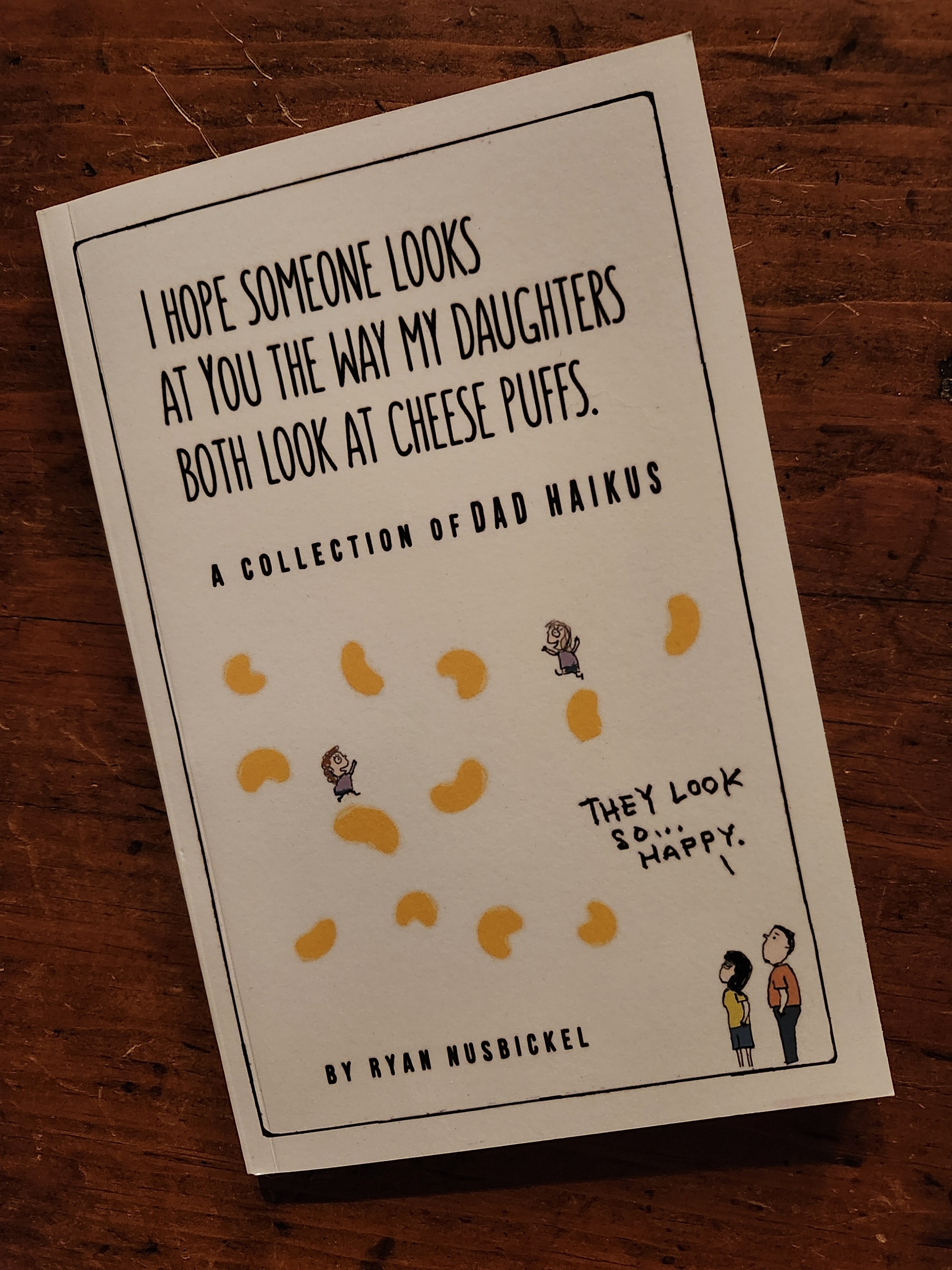
Plenty of meeting attendees bought Ryan’s books. Having no kids left in my house, or any grandkids expected, I bought his more parental-unit oriented book that made me laugh out loud. How could I resist his collection of dad haiku! (Not really haiku but one sentence broken into 3 lines of the 5-7-5 syllable style, but I didn’t want to tell him that and spoil any fun.)
Check out Ryan’s website at http://www.nusbickelbooks.com/ to get some ideas—and even buy a book, especially if you have St. Louis area roots.
The other month I read Smiles and Spices: Journeys and Encounters in East Asia by Carrie Riseley of Tasmania. She’s also lived in Australia, Japan, and England. Carrie is way braver than me. She goes off wandering in strange countries by herself. My young niece does this, too, and she usually finds herself the only American. Apparently, world wandering is a thing mostly among younger people of other countries.
In Smiles and Spices, Carrie documents her mostly solo travels to South Korea (and the DMZ), China, Tibet, Hong Kong, Macau, Vietnam, Cambodia, Thailand a bit, and Taiwan and incorporates interesting bits of culture and history. Her tales are scary but fascinating to me, as she navigates various methods of transportation with the accompanying issues, going to very rural areas with “toilet adventures,” getting lost, driving narrow roads along cliff sides. She stayed mostly in hostels, which I learned are a great place to make friends you might then see elsewhere along your journey, and you might even travel along with some of them a bit.
Yes, I had to do some editing. My travel journals are very, very extensive. For my first book, All Aboard!, my first draft was I think 169,000 words! That’s far too long for a book—80-90,000 is considered a good length for a book, 100,000 max. So, I edited all three of my books down to 100,000 words. Sometimes that meant cutting out any boring bits and sometimes it meant reducing the number of words in a sentence, e.g. “The next day I went to Riga, the capital of Latvia, and I was amazed at how diverse the architecture was” can be cut down to, “My next destination was Riga, Latvia’s capital, which has surprisingly diverse architecture.” The latter option also reads better, which is another thing I think about when I’m editing, e.g. make sure I haven’t said too many “verys” or “wows” and make sure it sounds good to read. But overall, I haven’t changed all that much of my original journal text.
For Smiles and Spices, in addition to doing the above I had to stitch my multiple journeys to Asia together because unlike All Aboard!, I didn’t undertake the whole journey in one go. But stitching those together wasn’t so difficult because I elected to just put different sections into the book with a map of the relevant region at the start of each section.
For Japan Unexpected I used the same process, again publishing mostly just what I’d written when I was in Japan . . . The original journal was written just for me to read, and I have a lot of prior knowledge of Japan. So, I added some cultural explanations during the editing process so that the book could also be enjoyed by people with no prior knowledge.
The advice I would give to anyone else wanting to do it is: make sure you read over the entire draft—whilst editing—at least seven times, preferably more. That’s the only way to catch typos, too, which hide in plain sight. You can also do a Ctrl F search for words like “very” and take them out, but not all of them. I’m keen to preserve the original tone of my writing because therein lies my excitement at what I was seeing and experiencing while travelling. So, I leave some of the “verys” and “wows” in. I wrote the journals for me to read myself, so luckily I enjoy reading them and didn’t mind going through the entire manuscript seven times!
* * * * *
Below is Carrie’s travel advice from Smiles and Spices:
The best thing, always, when seeking to understand and really experience being in another place, is to get to know the people . . . it’s not always possible, but every interaction pushes you closer. . . . the only way to truly learn what a country is like is to navigate it yourself. To buy your own food and bus tickets; to smile at locals on the street; to watch them eating, praying, shopping, and driving; to learn how to say “thank you,” to get lost and found.
Learn more about Carrie and her books and see her photos and blog at Carrie’s Travel Books. She is on Facebook, Twitter (@CazTravelBooks), Instagram and LinkedIn.
Now that J.D. Vance and his Hillbilly Elegy memoir are big in the news again, I’ve been reading reactions (pre-VP GOP nomination) to his story of escaping Appalachia by people who have actually lived in or studied Appalachia. Vance’s story is not of Appalachia but of escaping a poverty-stricken small town in the Rust Belt while having a dysfunctional family with roots in Appalachia. (See a map of the Appalachian region here, not all impoverished.) The memoir is said to be “a critique of the country’s treatment of white blue-collar workers” and probably that’s where the problems lie.
I did not read Vance’s memoir or see the movie, just enjoyed reading the comments and reviews of others with LIVED experiences in Appalachia. The takeaway is that you can’t really know what a community or group of people are like based on ONE person’s stories, and certainly not on one person’s opinions. Writers should not be making broad statements assuming what they see or experienced is what it’s ALL like.
Hillbilly Elegy criticisms include that Vance generalizes Appalachian people and their lives and tells what’s wrong with them. It’s funny to read reviews from people who had very different experiences in their impoverished real Appalachian lives, even someone who grew up poor in a downtrodden Ohio town near where Vance was raised. It is misleading and downright wrong to make sweeping generalizing statements, and stereotyping is bad. Drunks who fight and beat their wives are “the embodiment of the Appalachian man” – yikes! Not everyone in your area, your family, your class of people, your whatever, is the same or has the same opinion as you. And, of course, readers need to be astute enough to know this and not make generalizations on their own either. Yeah, right. Again, as writer, you should not be making broad generalizations look like fact.
Vance had family dysfunction but did have a caring though rough “Mamaw” who raised him, pushed independence and self-sufficiency, and tried to get him to do well in school, but it’s the Marines that really changed him and moved him forward. And he took advantage of the great benefit of the military paying for college. Not sure how he got into Yale, but it would be interesting to read how he had to adjust to be among the elite, coming from his outsider background. A life takeaway is that having good, supportive people around you or involvement in a good organization that steers you in a good direction can make a huge difference. Look for the helpers, and for good luck, and give credit.
Similarly, another criticism of the Hillbilly Elegy escape story is his implication that if he can do it, anyone can, which Appalachian-raised readers say ignores the deep feelings of hopelessness from the struggle of just daily living, and I’d add especially in a depressed-area bubble, and especially for women tied to low expectations and low-level education due to too-early childbearing. It’s hard to rise above that kind of exhaustive poverty and it can easily lead to alcoholism and drug use to cope. Blaming people for not being strong enough or smart or lucky like you looks bad on you. Instead, give insight of what your situation was like but encourage and inspire. Those are very good reasons to write your stories for others to read. And learning about difficult lives can give us empathy and maybe motivate us to somehow help. Real heroes help others up.
Many readers say Vance’s writing is very good and he has an interesting story and observations, but others see stereotypes, generalizations, and blaming people for staying poor. He gives simplistic (or misleading, even offensive) thoughts and opinions of people in poverty. You’d have to read for yourself.
I recommend Mary Karr’s rough and tumble memoirs that tell how she eventually rose from an extremely dysfunctional childhood in a struggling blue-collar area—without making herself the hero of her story, denigrating others as less than, and being an armchair sociologist.