What to do with old family movies, slides, and all those print photos

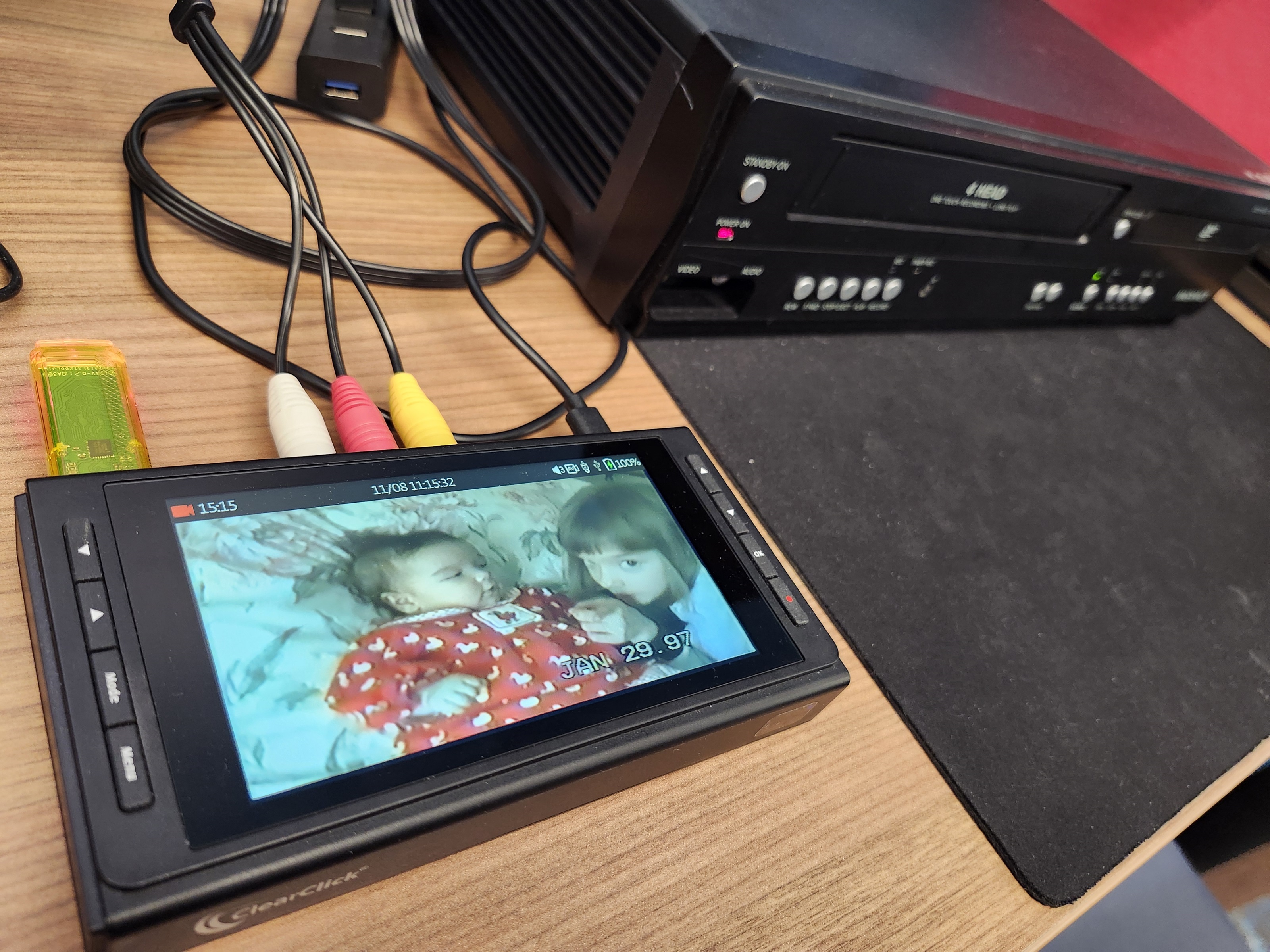
I spent some time at our county library the other day getting a VHS cassette of clips of my kids’ childhood digitized to an .mp4 file stored on a flash drive I brought along. Two libraries near me have equipment that digitizes old home movies in various formats, audio recordings, and slides, negatives and print photos—for free! Check to see if a library near you does this. The county library branch lets anyone come in to use their equipment during a pre-registered time slot, with staff providing instructions and help. The other library is independent and requires a library card to pre-register to drop off items that their staff will digitize and then notify when ready for pickup. Imagine that! Check with your libraries to see what services they offer these days—you might be amazed.

If you have a lot of video to digitize, you could buy a digitizer that hooks up to a VCR/DVD player. The county library uses ClearClick converters which can be bought online for about $200. The library has Wolverine converters to handle slides, negatives, and 35mm film fed through and saved one image at a time. I don’t know what is used to save audio, especially what’s on old audio cassettes. I have some CDs holding interviews with long-deceased immigrant relatives but my old computer has a CD drive so I could pull the files off that. Most computers these days do not have CD drives.

Some—or a lot—of us have carousels of slides I’d advise at least holding them up to a bright light and weeding out bad, faded, or unflattering shots, duplicates, and ones that don’t seem that important anymore. Save ones with meaningful people in them versus flowers and scenery you can otherwise find in an online search. Same with old print photos from pre-digital camera days.

To digitize print photos, all you need to do is take good photos of them with your cell phone! Crop the images, straighten them, fix the lighting—using your cell phone. Then connect your phone to a computer to download the images and organize them into folders, like by year or subject, or save to the Cloud.

With antique photos, once digitized and moved onto a computer, you can use programs already on your computer to fix them up further. I just open a photo and use Edit to fix lighting, increase color saturation or contrast, or turn a photo into black and white. Black and white can mask bad lighting and make faded photos look clearer, increase contrast as needed.

For even more photo fixes, opening in Paint (right click on the photo and choose) allows you to use an eyedropper icon (color picker tool) and a “brush” type (I use watercolor) to fix discolorations and remove those white spots common on old prints. Click on the eyedropper, click on a brush type, then move the eyedropper near to a discolored area, click in the area to pick up the correct color and then “brush” over the discoloration. Adjust the brush size with a slide bar on the left edge of the photo image. You can magnify the image for detail work with a slide bar at the bottom. I’ve even managed to remove fold marks going across a photo. You may need to mottle an area of foliage using different shades.

Technology is on your side now to make digitizing easier, so hope you didn’t throw out your old home movies or slides thinking they were lost to old formats or too expensive to send off to save to modern formats.

Posted in capturing memories, photos | Tagged | Leave a comment

Writing a Children’s Book For Your Kids (or Grandkids) to Capture Their Childhood

Yesterday I attended our local writer’s guild meeting to hear about writing for kids. Ryan Nusbickel had the most delightful young children’s books – fun and funny in text and his own illustrations – and the stories were set in our city! All the special things in St. Louis, from toasted raviolis and gooey butter cake, to our jokes to get a Halloween treat and more! I learned there are people in our country who do not know we have a Gateway Arch – or even know what that is! Anyway, dad Ryan wrote these stories for his kids, and based on his own family experiences. What treats for his kids and everyone else’s around here!

Maybe you can write fun stories about your family life. I see my Facebook friends posting the darndest things their kids or grandkids say and do. Things that should be remembered and immortalized as they are so funny or so clever. You don’t have to be a great artist to draw some pictures to go along. Kid books can have kid-like art. Have a go at it! Maybe you even have art by your kids that relates to stories. The stories can be short, just a funny sentence or a few lines. I should make a page of my kid as a tot singing “Jesus loves me, this I know, for the Barbie tells me so.” Or startling me as she sat in the bathtub bubbles and sang “Achy Breaky Heart” learned at her Alabama day care.

Plenty of meeting attendees bought Ryan’s books. Having no kids left in my house, or any grandkids expected, I bought his more parental-unit oriented book that made me laugh out loud. How could I resist his collection of dad haiku! (Not really haiku but one sentence broken into 3 lines of the 5-7-5 syllable style, but I didn’t want to tell him that and spoil any fun.)

Check out Ryan’s website at http://www.nusbickelbooks.com/ to get some ideas—and even buy a book, especially if you have St. Louis area roots.

Posted in book talk, capturing memories, grandparents, lifewriting, raising kids, storytelling | Tagged , | Leave a comment

Travel Writing – Smiles and Spices and more

The other month I read Smiles and Spices: Journeys and Encounters in East Asia by Carrie Riseley of Tasmania. She’s also lived in Australia, Japan, and England. Carrie is way braver than me. She goes off wandering in strange countries by herself. My young niece does this, too, and she usually finds herself the only American. Apparently, world wandering is a thing mostly among younger people of other countries.

In Smiles and Spices, Carrie documents her mostly solo travels to South Korea (and the DMZ), China, Tibet, Hong Kong, Macau, Vietnam, Cambodia, Thailand a bit, and Taiwan and incorporates interesting bits of culture and history. Her tales are scary but fascinating to me, as she navigates various methods of transportation with the accompanying issues, going to very rural areas with “toilet adventures,” getting lost, driving narrow roads along cliff sides. She stayed mostly in hostels, which I learned are a great place to make friends you might then see elsewhere along your journey, and you might even travel along with some of them a bit.

Carrie’s previous travel memoirs are All Aboard!: A Journey on the Trans-Mongolian Railway and Through Eastern Europe, and then Japan Unexpected. I very much enjoyed reading and learning from Smiles and Spices and highly recommend that book, and I’m sure her others are equally fascinating.

I asked Carrie how she went from journal to book:

* * * * *

Yes, I had to do some editing. My travel journals are very, very extensive. For my first book, All Aboard!, my first draft was I think 169,000 words! That’s far too long for a book—80-90,000 is considered a good length for a book, 100,000 max. So, I edited all three of my books down to 100,000 words. Sometimes that meant cutting out any boring bits and sometimes it meant reducing the number of words in a sentence, e.g. “The next day I went to Riga, the capital of Latvia, and I was amazed at how diverse the architecture was” can be cut down to, “My next destination was Riga, Latvia’s capital, which has surprisingly diverse architecture.” The latter option also reads better, which is another thing I think about when I’m editing, e.g. make sure I haven’t said too many “verys” or “wows” and make sure it sounds good to read. But overall, I haven’t changed all that much of my original journal text.

For Smiles and Spices, in addition to doing the above I had to stitch my multiple journeys to Asia together because unlike All Aboard!, I didn’t undertake the whole journey in one go. But stitching those together wasn’t so difficult because I elected to just put different sections into the book with a map of the relevant region at the start of each section.

For Japan Unexpected I used the same process, again publishing mostly just what I’d written when I was in Japan . . . The original journal was written just for me to read, and I have a lot of prior knowledge of Japan. So, I added some cultural explanations during the editing process so that the book could also be enjoyed by people with no prior knowledge.

The advice I would give to anyone else wanting to do it is: make sure you read over the entire draft—whilst editing—at least seven times, preferably more. That’s the only way to catch typos, too, which hide in plain sight. You can also do a Ctrl F search for words like “very” and take them out, but not all of them. I’m keen to preserve the original tone of my writing because therein lies my excitement at what I was seeing and experiencing while travelling. So, I leave some of the “verys” and “wows” in. I wrote the journals for me to read myself, so luckily I enjoy reading them and didn’t mind going through the entire manuscript seven times!

* * * * *

Below is Carrie’s travel advice from Smiles and Spices:

The best thing, always, when seeking to understand and really experience being in another place, is to get to know the people . . . it’s not always possible, but every interaction pushes you closer. . . . the only way to truly learn what a country is like is to navigate it yourself. To buy your own food and bus tickets; to smile at locals on the street; to watch them eating, praying, shopping, and driving; to learn how to say “thank you,” to get lost and found.

Learn more about Carrie and her books and see her photos and blog at Carrie’s Travel Books. She is on Facebook, Twitter (@CazTravelBooks), Instagram and LinkedIn.

Posted in book reviews, book talk, journal, memoir writing, multicultural, writing skills | Tagged | Leave a comment