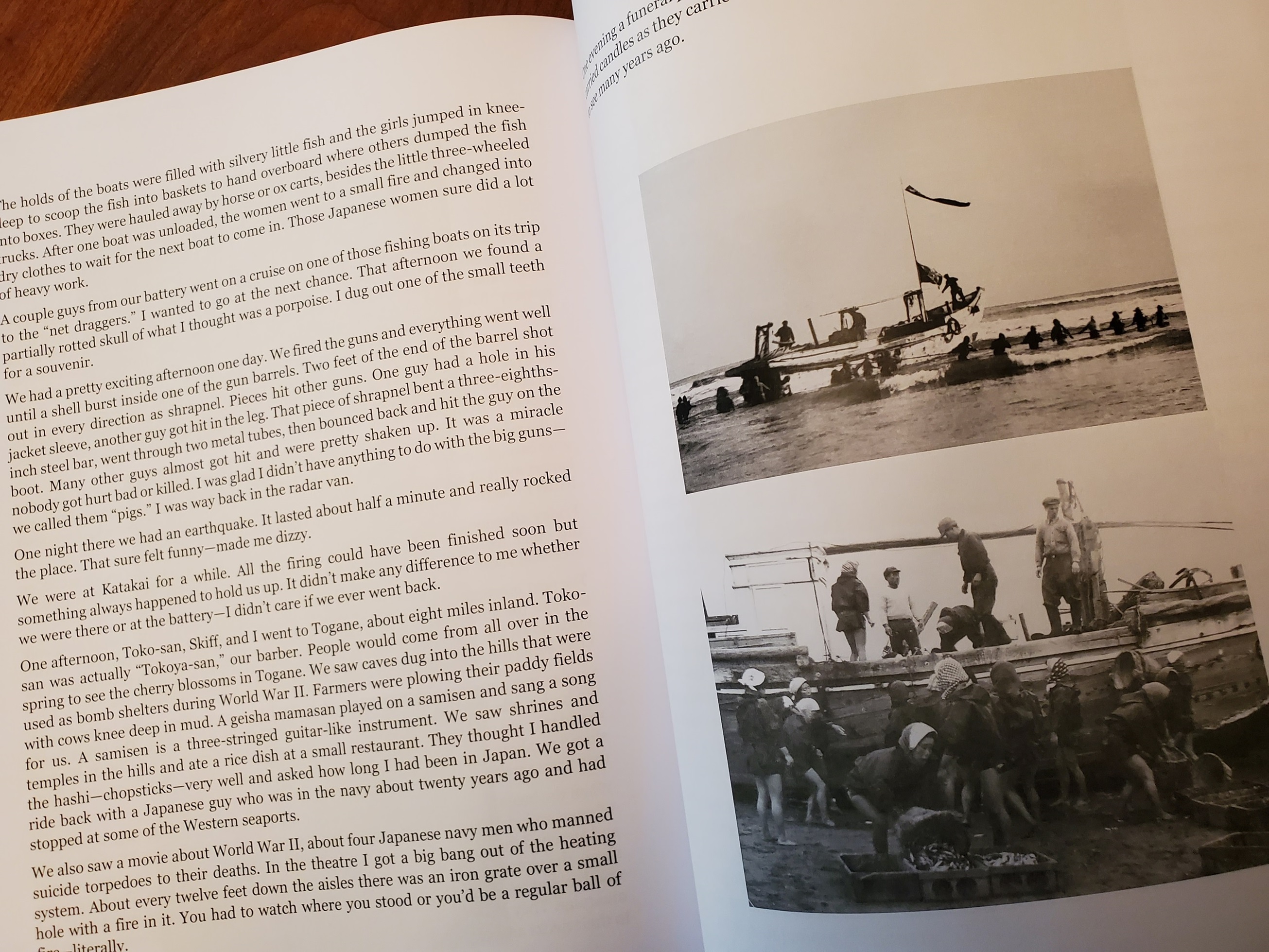
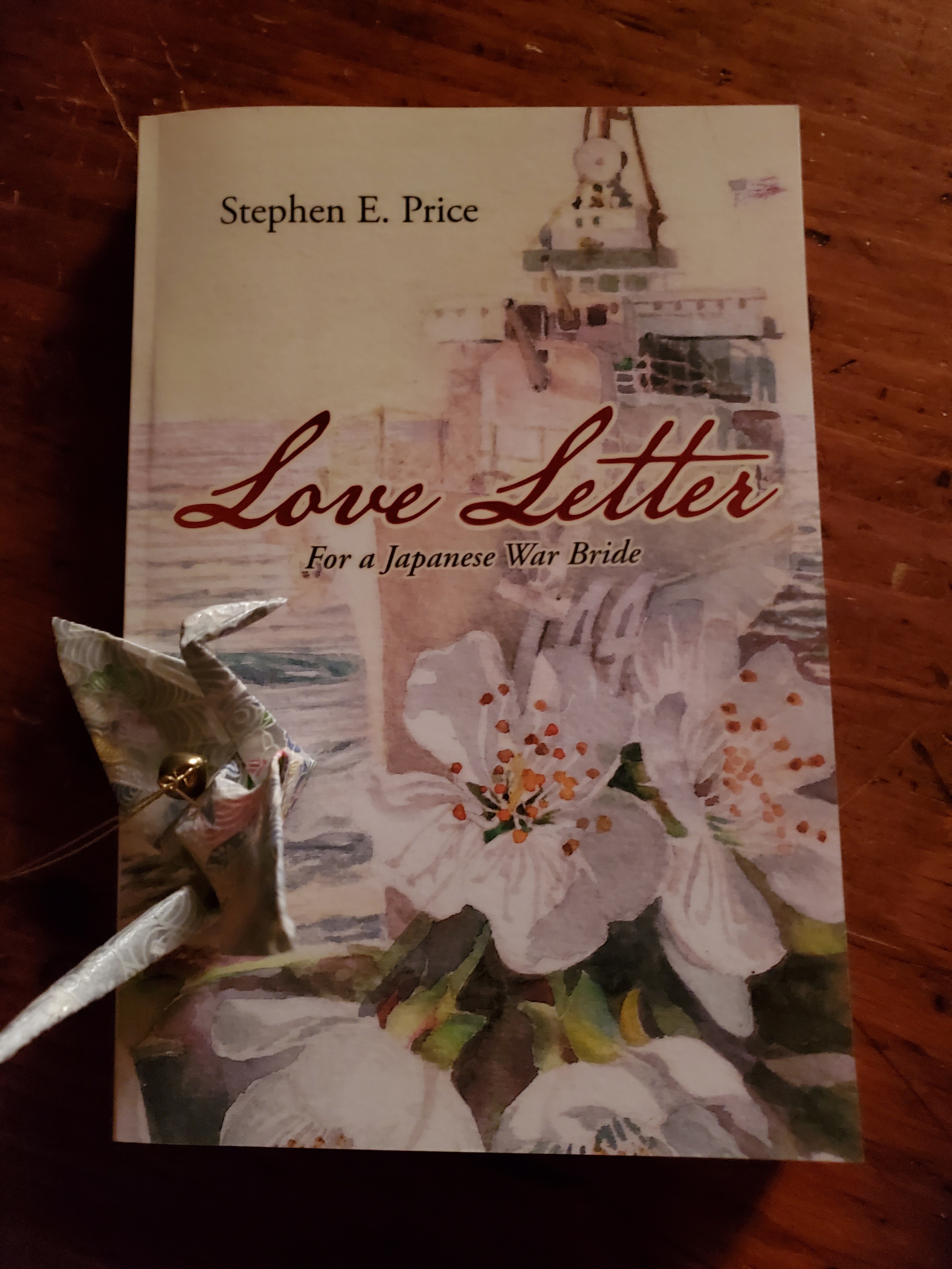
What a delightful story! Just finished reading this beautiful memoir (not letters) of U.S. Navy man Stephen whose life was changed when he met a Japanese girl while stationed in Japan during the 1950s. What looks like it was meant to be a family-only tribute to memorialize his deceased wife, Ryuko, this was published after Stephen’s death by his then wife, Arlene. It is a sweet love story set mostly in post-war Japan and full of sensitive observations of daily life and culture, not the usual “gaijin” male writing about those people in Japan. Stephen learned the language and enjoyed living in a rental house by the sea with his beloved Ryuko while Japan was still recovering from WWII and not yet modernized. Once they could be married, the couple went to live in the U.S. where Ryuko learned to adapt.
I can tell Stephen wrote this for his children to remember their mother as well as to honor Ryuko after her untimely death. It has a lot of personal details and thoughts that most non-family readers would find distracting, yet it captures so well life in the Navy and in old Japan. This is around the same time my Army dad met my mother in Japan so I found these details dear to my heart. I am working with my dad to finish his memoir that ends with his impressions of post-War Japan and his marriage. My dad, like Stephen, loved this Japan and came home with a wife, as did so many of our military men stationed there.
Years after Ryuko died, Stephen married Arlene who obviously did not feel threatened by her husband’s previous great love and felt his story was beautiful and important enough to publish for anyone to read. So we get to read this very sweet, very personal story brimming over with love and immortalizing both Stephen and Ryuko and the old culture of Japan. As my dad ends his memoir, sayonara.
Part of why I encourage life writing is because the past certainly does affect the future, as I discovered with my own mother. Knowing the past of our parents and grandparents helps current generations understand where behaviors come from and can help thwart continuing effects of past bad experiences. Researchers are actually wondering if trauma can leave a chemical mark on genes that can be passed down to the next generation.
Jeanne Felfe is a writer friend who published her mother’s long-set-aside memoir, I Want to Live! My Journey Beyond Generational Child Abuse, earlier this year. Helen Imagene (Jean) Felfe’s story is of her abusive family and finding the strength to break the cycle to save her own children from violence. Following is her daughter Jeanne’s story of publishing her mother’s writing to honor her story and hopefully help others.
* * * * *
When I was in my late 20s, I rescued my mother’s life’s work—her memoir about surviving child abuse, motherhood, and her mental illness. She threatened to burn it—and all her other writing—in a suicidal rage after another rejection from a publisher who told her that “wanting to prevent child abuse was a poor reason for writing a book.” Since it only existed on paper, if she’d burned it, it would have been gone forever. Visions of my mother’s words—and the history of my childhood—curling up amidst black smoke and morphing into ashes forced me to take custody of this stack of hand-typed papers.
Knowing the depth of her fragility, and believing she would eventually change her mind, I figured I could return it once she found a publisher. Instead, it remained on a shelf with a deteriorating rubber band around it for almost four decades, traveling with me through three states, three marriages and raising a child of my own, and beyond Mom’s death in 2012. And yet, I still had no idea what I was going to do with it, other than maybe copy it so family members would have it.
In early 2015, while in Texas caring for my dad, I spent hours culling through file drawers, boxing up the rest of Mom’s stories and articles she’d written for a variety of publications. By now I was in the middle of writing my first novel, had begun to study self-publishing, and was an active member of a writers’ group. The first glimmer of an idea whispered … maybe I could publish it. It would remain on my shelf for another seven years while I completed and published Bridge to Us, compiled and published an anthology—Elemental Tales—had dozens of short stories published, and served on the board of Saturday Writers, as president for three years.
Then, when COVID turned the world upside down in 2020, my life shifted. Things I’d once been passionate about lost meaning. I went deeper, once again searching for my “why.” While editing a client’s manuscript, Mom’s voice called to me, letting me know it was time. The last of her thirteen siblings had recently passed away, so all those around during her childhood, those who might have seen things differently or who had experienced them in another way—some of whom objected to her sharing this story during their lifetimes—were gone.
I began working on this effort in 2021 while the world was still in a pandemic and after receiving a life-altering autoimmune disease diagnosis. Needing a break from my own creative writing efforts, I decided to tackle Mom’s memoir as a labor of love. Since it only existed on paper, I painstakingly scanned a chapter at a time, converted it to PDF and then to Word. Aged pages—some with hand-written corrections—produced a myriad of weird errors and strange hieroglyphs that needed to be fixed one by one.
I pulled pages from piles of hand-written journals and added those at the end of the book, edited the entire manuscript, found an inspiring cover, and published I Want to Live! My Journey Beyond Generational Child Abuse on Feb 25, 2023, on what would have been Mom’s 90th birthday.
I understood the book wouldn’t have wide marketability—it’s too private, too personal. Despite this, my mother was brave enough to bare her soul, hoping to prevent even one child from suffering the kind of abuse and neglect she and her thirteen siblings had suffered. I simply had to be brave enough to publish it. That my mom never got the chance to see it published was something I could remedy by bringing her work into the light of day. This is my gift to her legacy.
Recently I found a box of letters my mother had saved – dating back to the 1970s. There were letters from Japan I had to use Google Translate to understand and letters from my American grandmother and spunky great-aunt Chris. Some letters were even from me during 1994 when we lived in the UK.
The bundle of letters from my mother’s sister in Japan contained pressed leaves and flowers. My mother used to send greeting cards that included pressed leaves and four-leaf clovers. I send greeting cards with pressed leaves and flowers.
The handful of letters to my mother from my dad’s mother and his aunt showed how his relatives loved my mother and tried to support her during my parents’ divorce, a devastating time for my mom. Reading the letters, I loved these family members even more. The last letter from my grandmother was written on the back of a greeting card and she noted her breathing had gotten bad—she died the following spring when I was away at college. The last letter saved from Aunt Chris was written two years before she died. The handwritten letters held dear memories of people I loved but long gone. Their letters held memories I did not want to throw away despite my big project of downsizing.
Nowadays people don’t write letters, they text on cell phones, even post or message on Facebook. Maybe call on special occasions. Email is out, too old school. Nothing to save to look back on, to remind of what was. No more handwritten messages holding physical remnants of someone’s life. No more pressed leaves or flowers sent. All the more reason to write the stories. Save the memories somehow.