Memories of your childhood home

What do you remember about the house you grew up in? When thinking back on our lives we immediately think about what we did and maybe how we felt, but often forget about background “accessories,” such as the house and yard, the town, the neighborhood. A friend, who helps others find the history of their older homes in St. Louis, recently discovered History of Homes website which collects house memories of people worldwide as well as old photos, which got me thinking about the house I grew up in . . .

Our ranch home had three square bedrooms and one bathroom which got quite busy as my sister and I grew older. The living room for the longest time grew green shag carpet—a meadow for my roaming horse collection. A Japanese-style tokonoma (decorative) area against one wall was a backdrop for special family photos. The linoleum-floored kitchen/dining room (arena for a dishwater fight) had a sliding glass door leading to a patio and kidney-shaped goldfish pond with waterfall in a Japanese-flavored yard. The utility room had upper cabinet doors painted by my sister and I when we were teens: funky-style Ginger Baker and Eric Clapton from one of the Cream covers, Pink Floyd’s Dark Side of the Moon triangle. The house had redwood-painted wood siding with a covering of brick along the lower front portion of the house. A mass of junipers hid the brick until my mother chopped them into giant bonsai.

Our home always felt plenty big for our family of four, but I remember well when I first returned after moving far away how small and dark the rooms seemed. What had happened? I guess I had grown out of that house as one grows out of a pair of favorite jeans. It was sad to see my old friend become just a shell for my fond memories. Much later, when my mother moved away and the new owners cut down the trees, I couldn’t bear to drive by.

Too bad I never took any photos of our old house in its prime, with the big silver maple I used to climb up to the sky, and my favorite sour cherry tree that would be full of warm, ripe red. As an adult, I’ve taken photos of each of the many houses my husband and I have lived in, and so our children will always be able to see where they once lived. When you write about your childhood, remember to include your old friends, the houses you grew up in.
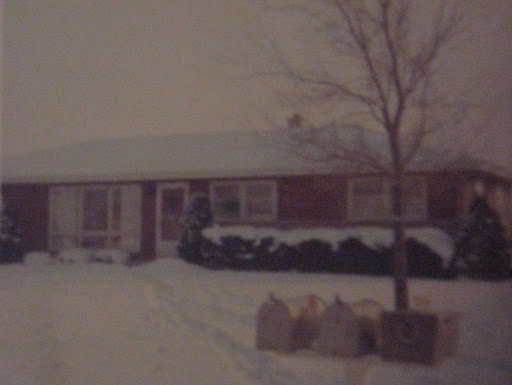
My childhood home in its early years.

Posted in Uncategorized | Comments Off on Memories of your childhood home

Creating real memoir books with Lulu

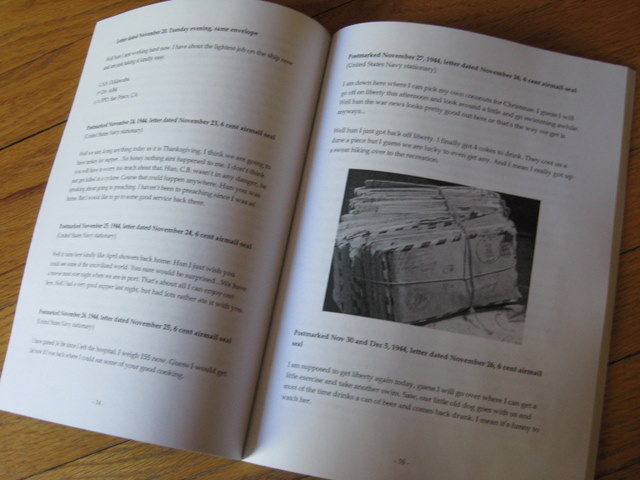
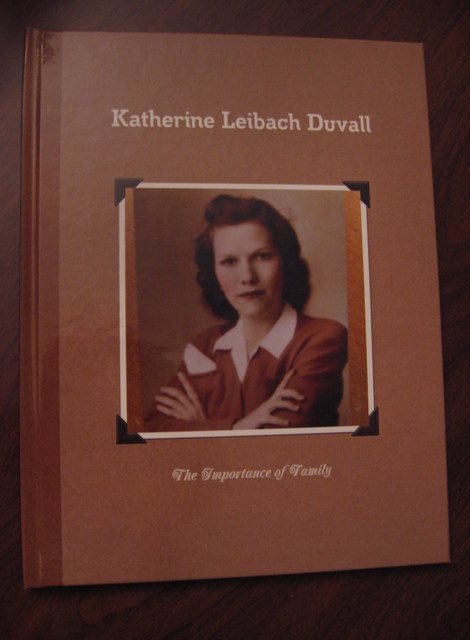
A couple mothers I know received beautiful gifts of memories for Mothers Day. The memoir books I’ve been working on arrived in the mail this week from Lulu.com. Kate’s bittersweet memories from childhood, including being orphaned at age 13 and caring for her little brothers, became a 24-page hardcover with her photo on the front. She was amazed at how nice it looked, pleased and honored that someone thought her stories were worth that kind of effort. Her daughter was very excited and asked me to order another ten copies. My mother-in-law was also very happy to receive an 84-page soft cover book of the highlights of her father’s stack of letters to home during his WWII service. She called to thank me and tell me she had tears in her eyes as she read the first section.

To get the manuscripts printed and bound, I opened an account with Lulu.com, a popular “self-publishing” company which actually serves as a publishing services company too expensive to use for those intending to sell their books to the public. However, for private family memoirs needing small quantities, Lulu is a good deal. It would have cost me almost as much at Kinkos to have the pages coil bound with frosted plastic cover as it did to make real-book copies at Lulu. Lulu has a number of format styles for book covers, or you can upload your own design at extra cost. You can choose the exact color shade(s) for your front and back covers, add photos and text. My advice is to choose standard paper vs the ultra thin “publisher” grade paper. A Word file can then be uploaded to the site, but I created a pdf file (using the free PrimoPdf download) since there were photos set into the text that I wanted to make sure would stay in place when converted to book. Be sure to double-check cover and manuscript to ensure all is well, and this was a little awkward as there was no way to “back up” from view mode so I had to just close out the window and then get back into Lulu. Once “published,” copies can be ordered and will arrive in about a week. I chose trackable shipping which is a little more expensive than regular. The FedEx man delivered the books well-packed within cardboard boxes.

The minimum page number for hard cover is 24 total (counting fronts and backs), the minimum for soft cover is 84. Both books were at the bare minimum, which can make binding more difficult. The hard cover appears to be of high quality binding, the soft cover is good and held up to reading. There was some tiny “chipping” at the tops and bottoms of the narrow spines, this from cutting the covers to size—not much to complain about, and should not occur with thicker books. All in all, they look very nice and are impressive for the family. The 84-page 8 ½” x11” book is $6.84 each, the same size 24-page hardcover is $15.63 each. There is a discount if ordering 50 or more copies. Lulu conveniently prices everything out for you immediately as you choose your options of size, binding, number, shipping method.

No excuses now, it is easier than ever and not too expensive to create your own real book of memories.

Posted in memory books, publishing | Tagged , | 4 Comments

Is history out of fashion?

I am relaxing a bit after organizing a wonderful two days with what I consider a rock star of WWII Japan-America history. Beate Sirota-Gordon came from New York to speak in Chicago and then St. Louis to discuss her role as a 22-year-old girl on the committee to draft the new post-WWII Japan constitution. Daughter of an internationally famous Russian-Jewish pianist teaching and performing through the Imperial Academy of Music in Tokyo, Beate was raised in Japan and separated from her parents during WWII while attending university in California. Working as one of the few Japanese translators in the U.S., she was able to support herself and, after the War, was eagerly accepted by the State Department to work overseas, which enabled her to be the first female civilian allowed into Japan following the War – and she was then able to find her starving parents and sneak food to them. She became involved in General MacArthur’s committee to draft the new Japan constitution and was instrumental in giving Japanese women equal rights – not a small accomplishment in that male-dominated time.

Mrs. Gordon’s stories are absolutely fascinating glimpses into pre-WWII Tokyo and, of course, she has the inside scoop of the proceedings of that frantic seven days in which the committee had to produce a final draft – why seven days is a mystery she reveals in her presentation. Mrs. Gordon is a gifted and fun story-teller who held everyone in wide-eyed trance. She is a living artifact of history, and yet her presence was snubbed by all the local papers even though her famous parents lived here for many years and her father performed live over local radio. Why?

Is living history not of interest anymore? None of the papers printed even two sentences about this event, and the St. Louis Post Dispatch choose instead to print something about fashion in media in its Events Today section. No thanks to St. Louis media and its fashions, Mrs. Gordon’s event was attended by over 100 people due mostly to in-house publicity by several of the area’s universities, the Japan America Society and the JAS Womens Association. I was relieved that the auditorium was filled and many surrounded her to chat, have their photos taken with her, and ask for her autograph, as I would have been greatly embarrassed by our town’s disinterest if we did not have a good crowd. Mrs. Gordon is known even by taxi-drivers in Japan and has traveled the world giving talks. It is sad, indeed, that our town’s papers chose not to inform the public. Let us hope that death and destruction – and fashion – are not the only things of interest to the media anymore.

Posted in history | 3 Comments