Using artwork and photos in memoir

Tonight I attended a talk by famous architect Gyo Obata whose artist/professor father was imprisoned in a U.S. internment camp along with his family during WWII. Gyo escaped by being allowed to attend Washington University in St. Louis, which agreed to accept about 22 Japanese students at that time. Photographer Ansel Adams’ son Dr. Michael Adams was also there to speak about their family’s friendship with the Obatas and how Ansel Adams was asked to document the Manzanar camp in photos.

After Chiura Obata’s death, his granddaughter wrote Topaz Moon, what amounts to an illustrated, historical memoir of the family’s internment time based on letters, stories from her grandmother, notes written by her grandfather about his sketches and paintings, and research about the internment. Obata’s art is mostly sumi black Chinese ink or pencil on white paper – often simple depictions of everyday camp life that serve as snapshots since cameras were not allowed inside. He may not have been a writer, but he captured the dust storms, the crowded living conditions, visitors meeting through barbed wire, as well as the beauty of the distant mountains.

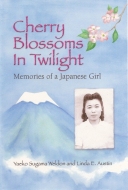
My own mother used to be a talented artist and when telling me her childhood stories for Cherry Blossoms in Twilight, she often doodled to help explain her words. Fortunately I kept those sketches and was able to use many in the book – a picture is worth a thousand words, you know, and especially valuable as part of the essence of the person who created it.

Visuals in a memoir are a wonderful addition, from photos of artworks or craft pieces to the scanned handwriting from letters or recipe books to little scribblings or doodles. They illustrate more fully who the person is in ways that mere words cannot. Of course, photos of the memoir subject and their family are wonderful to see included. Most of us use the camera to document important events, but perhaps the most important events are the everyday ones. Those are the ones that really capture the personality and loves – a mother cooking, planting flowers, playing the piano or a father grilling a steak, sitting in a favorite car or kids sitting on the porch eating popsicles. Don’t forget the photos of a pet cat purring in a lap or a beloved dog getting his ears scratched. With a little extra thought, a memoir might expand into quite a three-dimensional picture.

Posted in capturing memories | Comments Off on Using artwork and photos in memoir

Should you write about your kids?

Julie Myerson, British mom and writer, was lambasted for writing about her drug addicted teen in her recent book The Lost Child: A Mother’s Story. Her son called his mother “obscene” for “exploiting and exaggerating” his troubles even though he liked an early draft showed to him and let her use some of his poems. The book has just come out in the U.S. and Myerson is awaiting a possible backlash here. Or perhaps Americans are more used to exposes on drug abuse and tell-all stories in both books and in the media. Myerson states, for one, that this is her story and the way she saw it and, second, she saw a need in the U.K. to support other parents dealing with their childrens’ drug abuse, to let them know they aren’t alone. U.S. authors David Scheff (Beautiful Boy) and Michael Greenberg (Hurry Down Sunshine) have recently written about their children (drug abuse, mental illness, respectively) to popular acclaim. Read the Amazon reviews of these books to see many thankful responses of others dealing with loved ones lost in similar circumstances. “Heartbreaking,” “inspiring,” and “hopeful” describe these books.

Myerson made the decision to write her story to help other parents. It is unclear at what point her son decided it was a fictionalized assault on his privacy – he was in his late teens when the troubles began and 20 when the book was first published. Scheff’s son and Greenberg’s daughter, on the other hand, were of legal age at the time of writing and approved of their fathers’ writings. A New York Times article, A Mother’s Memoir, A Son’s Anguish, gives an excellent discussion of this privacy dilemma. Underage child involved or only adults, all memoir writers must decide what to include about others in their lives and whether it is worth the possible ire or embarrassment of those others. If your book will help others desperately needing support, if it will help others gain understanding of the plight of others, is it worth it? Is it worth it for anything less? Can you be more tactful and respectful? These decisions should be made with a clear head sans thoughts of anger or revenge. And hopefully sheer exploitation for financial gain never crosses one’s mind.

See also What would my mother say, and other memoir fears

Posted in memoir writing | 3 Comments

Living the memory – Jim Ballard

James Ballard’s final post here reflects on observing one’s self in the here and now. What happens today are the seeds of future memories. Do you see them forming?

Part 3. Living the Memory

It can be confusing to think of creating a memory, because memories are moments of looking back at the past—i.e., they are re-collections. A useful way to get your mind around the issue is to play around with time.

Look back from the future

Take yourself in your imagination to a future moment in which you are looking back at Now. In that imagined future time, talk to yourself about this present moment. Say, That was important, and I didn’t even know it. How could I have dreamed what would occur as a result of that time?

See the present as memory potential

Looking back from the future puts you into a frame of mind of observing what is unique and potential about where you are right now. Practice being awake to the beauty and wonder of each passing moment. That is, after all, the only way to truly be alive.

Good luck making moments memorable!

Thanks, Jim, for your thought-provoking posts! Jim is a nationally known life coach, author, and motivational speaker. His fables challenge readers and listeners to manage their minds to generate joy by going beyond themselves. Visit Coach Jim’s blog or Jim Ballard’s website for further inspiration and information.

Posted in memories | Comments Off on Living the memory – Jim Ballard