Superior Scribbler Award

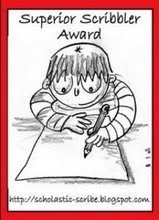
Surprise! I have been honored to receive a Superior Scribbler Award from fellow life writing blogger Sharon Lippincott (The Heart and Craft of Life Writing). This award has been in the blogosphere since October 2008 when The Scholastic Scribe, a high school journalism teacher and blogger, thought to share bloggy love with other scribbly writers. It’s always nice to know others are reading and enjoying your scribbles, because sometimes you can’t tell. Thanks, Sharon! Now, as part of the requirements of accepting the award, I must pass on the Superior Scribbler Award to five other super bloggers, and here they are:

Lisa Yanucci’s Mama Lisa’s World of cultural fun and learning
Mitali Perkins’ Mitali’s Fire Escape of multicultural book chats and poetry
Vivian’s Hip Writer Mama manages her writing life with kids
Katia Novet Saint-Lot’s Scribbly Katia writing from India about the world
Ronni Bennett’s Time Goes By for those who like being older and wiser

Here are the rules for passing on the Superior Scribbler Award:

1. Each Superior Scribbler must in turn pass The Award on to 5 most-deserving Bloggy Friends.

2. Each Superior Scribbler must link to the author and the name of the blog from whom he/she has received the Award.

3. Each Superior Scribbler must display the Award on his/her blog, and link to this post, (http://scholastic-scribe.blogspot.com/2008/10/200-this-blings-for-you.html ) which explains the Award.

4. Each Blogger who wins The Superior Scribbler Award must visit this post and add his/her name to the Mr. Linky List. That way, we’ll be able to keep up-to-date on everyone who receives This Prestigious Honor!

5. Each Superior Scribbler must post these rules on his/her blog.

Let’s see if some of my five respond. Some, I’m sure, don’t even know I stop by their blogs.

Posted in Uncategorized | 2 Comments

Tips for writing your story

Carol Newman is a writing coach specializing in life story writing. She is The Angel in Your Inkwell. If you’re ever around Mission, Kansas, sign up for one of her writing classes. For those not in Kansas, Carol’s website offers a good resource of tips for writing your own life story or that of a family member. How do I organize the story, how can I combine husband and wife stories, how do I find a story line, how do I handle transitions, how do I write about my difficult parents?

Don’t let questions like these daunt you. The point is to start writing and let it flow in any order it comes to you, get the details. THEN look at the pieces to see how it all fits together. Read some books on memoir writing, such as Tristine Ranier’s Your Life as Story, or Lisa Dale Norton’s Shimmering Images or Sharon Lippincott’s The Heart and Craft of Lifestory Writing. Read other memoirs as examples. Take a workshop – many colleges have adult education evening classes. Find a writing coach in your area. Above all, have fun creating something your family will treasure. Even if you don’t think it’s a literary masterpiece, it will be a masterpiece to those who love you.

Posted in memoir writing, writing skills | Comments Off on Tips for writing your story

WWII memories of the Japanese in the U.S.

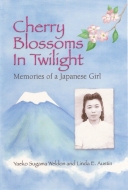
Continuing the thread of Japanese memories of WWII during this month of August, the anniversary of the end of WWII, there are many memoirs and historical fiction stories written about the Japanese internment camp experience. This subject was not in my school history books and I did not know about this until several years before writing my Japanese-born mother’s memoir, Cherry Blossoms in Twilight. When I told my mother about the internment camps, she was quite surprised, but seemed to accept that wars result in unusual situations and people do as they are told (at least in Japan).

Recently, I have become involved with a friend in video recording and writing the memories of an 89-year-old internment camp survivor who, several months after the War, went to Hiroshima with her husband in order for her husband to take care of family business. I used a tripod for the camera so I could sit on the floor at her feet, eyes big and mouth open, like a child filled with wonder. The Japanese tend to be reticent and do not like to speak about themselves or any “uncomfortable” experiences, so we were lucky to have an open, friendly storyteller who made us laugh even while she stunned us with some of her tales. The results of this project, which covers a Nisei experience in both the U.S. and Japan around the time of war, will not only enrich our storyteller’s family, but preserve an important part of history.

While Farewell to Manzanar may be the first and best-known book about the Japanese internment camp experience, there are other true personal narratives that followed:

Looking Like the Enemy by Mary Matsuda Gruenewald
Only What We Could Carry, Editor Lawson Fusao Inada (anthology)
Desert Exile by Yoshiko Uchida

Also, Topaz Moon by Chiura Obata (of the famous Obata family) is a beautifully done booklet of Obata’s stunning artwork mixed with some of his writings, capturing the bleak Utah camp he was sent to at age 57 when he was a professor of art at UC-Berkeley.

When researching internment experiences it is interesting to note that each experience is different, and often varies due to age at internment, temperament, and the particular camp sequestered at. Which makes each memoir fascinating.

Posted in war stories | Comments Off on WWII memories of the Japanese in the U.S.