WWII memoirs of the Japanese home front

Aspects of WWII still push hot buttons, cause arguments, and disgorge hatred. This August marks the 64th anniversary of the end of WWII, a monstrous war that resulted in monstrous atrocities and a monstrous loss of human life and potential. One of the hot button subjects is the behavior of the Japanese – both military and civilians. How could ordinary men – devoted husbands, gentle fathers, beloved sons – wish to fight to the death and torture and kill innocent civilians along the way? How could everyday citizens blindly follow their leaders, persuaded to either fight to the death with homemade spears or to kill their own selves rather than be captured by the enemy? While these questions may never be answered to our satisfaction, below are six memoirs or collections of memories written about the war years from the Japanese perspective – only six as narratives of the Japanese experience are rare.
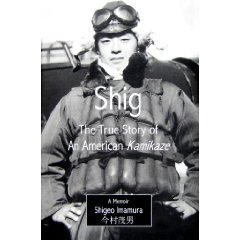
Shig: The True Story of an American Kamikaze by Shigeo Imamura is an unusual narrative of how loyalties can change when both “parents” are fighting. Imamura became a respected figure in ESL education for both his countries.

A Boy Called H by Kappa Senoh, while a fictionalized memoir, is based on a true story and is a highly educational, fascinating, and fun read that exposes much of the truth of Japanese civilian life around WWII.

Leaves from an Autumn of Emergencies by Samuel Hideo Yamashita is a varied selection of wartime diaries kept by Japanese school children, soldiers, housewives, storekeepers, etc., and while not exciting they are windows into the thoughts and everyday lives of those who lived during that time.
Senso: The Japanese Remember the Pacific War are letters to the editor of major Japanese newspaper Asahi Shinbun sent in 1986 and 1987 in response to a call for memories of WWII.

So Sad to Fall in Battle by Kumiko Kakehashi is a revealing study of the Iwo Jima battlefield based on interviews and the collection of letters and drawings General Tadamachi Kuribayashi (Letters from Iwo Jima) sent to his wife and young children describing thoughts of war and family.

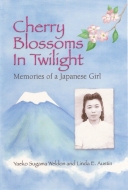
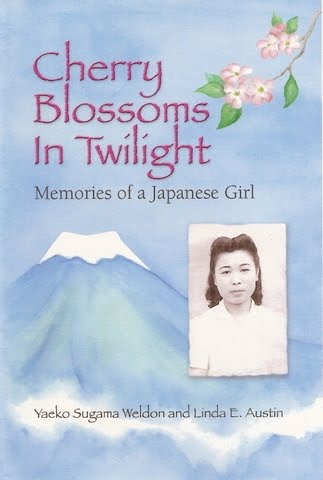
Cherry Blossoms in Twilight by Yaeko Sugama and Linda E. Austin is a simply told narrative of the Japanese culture of the time, a girl’s survival during WWII, and the Occupation experience.
Posted in book talk, war stories | 1 Comment

Frank McCourt view of memoirs

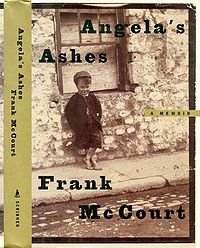
Frank McCourt has died but leaves a legacy in memoir with Angela’s Ashes, the story of his hardscrabble Irish upbringing. While he has been called the inventor of the “misery memoir,” and indeed his debut work has been followed by many other sob stories of abuse and disorder that seem to compete with one other for the worst of the worst, according to McCourt, “one of the good things about a memoir is looking for something bigger than yourself, you know; something important in your life, rather than just the life itself.” Such is what can make a memoir a cut above the others. A memoir should not be just a rehashing of tears, a perpetual whining, an unremittant complaining, but a look beyond to lessons learned, an enlightenment, a healing, a historical perspective.

McCourt has been accused of exaggerating too much, of making up conversations he couldn’t possibly have remembered as a small boy, but McCourt has an important comment about that, too, in his 2001 interview with Spiked magazine:

“A memoir is an impression of your life, and that gives you a certain amount of leeway. If an autobiography is like a photograph, then a memoir is more like a painting. So I’ve always said to my critics, This is my impression of my life, so what are you gonna do about it?’

McCourt states that memoir is the twin sister to fiction. There is a fine line between memoir and fiction, though, and while both aim to tell a good story the fiction line is crossed when you enter the realm of pure fabrication. Memoir writers are similar to artists who are free to take “artistic license” to re-create a real life snapshot. They add or subtract, alter colors and perspective. Memoir writers can do the same, but obviously in lesser degree to capture our own reality without outright lying or distortion of factual history. Isn’t that a nice thought – we are the Monet’s of the writing world!

Posted in capturing memories | Comments Off on Frank McCourt view of memoirs

Senior Care Centers filled with great stories

It was a storytelling kind of day. I have become friends with some of the ladies living in the senior care center with my mother. Kate is a good storyteller, and so I decided to type her childhood tales into a booklet. Today I brought six pages to her when I came to join the ladies at lunch. She was thrilled. She said she wished she had thought to keep a journal while she was growing up, or to have thought to write down her stories years ago because she is forgetting. She thought everyone should keep a journal so they can remember the details of how their lives used to be. Things change, you know.

Kate had lost both parents by age 13, during the Depression years. Surprisingly, no one came to take the kids to an orphanage. The oldest brother quit high school to work to support his young siblings. Kate had the house to take care of and three little brothers, the youngest only seven. She quit school soon after, during eighth grade, after spinal meningitis took away the use of her legs to where she could only pull herself along the floor. Somehow she recovered fully without ever going to the hospital or getting medicine. Kindly neighbors and their pastor kept an eye on the children, but everyone was struggling in those days, so the kids had to make do on their own with minimum help. I will leave her hilarious story of their first Thanksgiving on their own to a November blog post.

Edie cried as she told us her story today, the first time we had heard it. She was born in Germany and barely survived WWII. Her parents were gunned down by Russian soldiers – her mother’s last words to her, “Get down, get down!” Fifteen-year-old Edie was dumped alive into a big trash bin along with her dead parents. Her grandmother pulled her out. Not long after, the Americans were welcomed into town, the soldiers admiring Edie’s long blond hair. She and other orphans were sent to the United States, where she found a home with a relative. She carries treasured memories of her mother wearing a long skirt and waltzing with her in the living room.

Our senior residences and nursing homes are like libraries, each person a book waiting to be read. If we do not bother to open those books, the stories will die. What a shame to lose those historic, fascinating, funny, and sad tales. Imagine if I had not bothered to care, to ask, to listen… “I might have gone on my way empty hearted.”*

*from the Fascination waltz.

Posted in capturing memories, storytelling | 3 Comments