
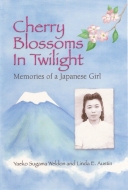
I’m an adult, but recently I enjoyed reading a middle-grade historical fiction book by Twitter friend Kathleen Burkinshaw. The Last Cherry Blossom is based closely on her mother’s stories of WWII and surviving the atomic bomb in Hiroshima. These days, whenever I search Amazon for “Cherry Blossoms” to find my mother’s memoir, Cherry Blossoms in Twilight, up pops The Last Cherry Blossom, first on the list, and that’s how I discovered Kathleen on Twitter.
Few memoirs have been written by Japanese civilians who survived WWII, which is why I published my mother’s story way back then. They are reticent to tell their stories, even to family. The past is over and nightmares are best kept in the dark. I appreciate the courage of Kathleen’s mother to tell such painful stories. Kathleen also decided to write for middle-grade kids, so they could easily learn about this history and to see that “the enemy is not so different from ourselves.” The effects of the bomb are told gently enough to be suitable for fourth-fifth grade and up, with the possible exception of a couple brief descriptions of horrifically affected people, but even young readers need to get the idea of how awful this was.
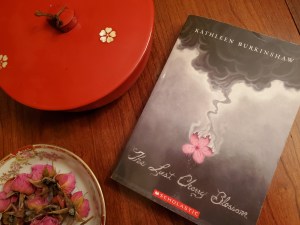 I like how the first page of each chapter features a piece of actual propaganda or news headline. Most people don’t realize the propaganda that went on in Japan, how the media was censored and bad news hidden, how children were indoctrinated in school. Like in Germany. Disagreeing could make you disappear in the night. The Last Cherry Blossom mentions this.
My surprise was that Yuriko’s family was so outwardly loving. My mother’s biggest regret in life was never being able to hug her father or tell him she loved him – it was simply not done, which was normal for that time. You bowed to show respect and love was only shown by work done for others. Overall, The Last Cherry Blossom is a sweet story of culture, family dynamics (including an intriguing family secret), the tragedy we know will come, and a ray of hope. A lot is going on in this book besides war, and for several reasons it is a story each generation needs to hear.
November is Family Stories Month and National Lifewriting Month. Will you be working to somehow save your family’s history?
*Kathleen’s blog recently featured a beautiful post about the International Friendship Bell in Oak Ridge, Tennessee, a town “born of war” to support the Oak Ridge National Laboratory which secretly produced enriched uranium for the atomic bombs.
Secret City and its Song, Part 3


 The Block Manager is a beautifully written, intimate story of life in the camps and in war-torn Japan. Janet and her husband and son were allowed to return to the US after 7 years of suffering and near death. Janet had to pay a lawyer to regain the US citizenship she was made to believe she had lost. They came to St. Louis where Janet’s parents had re-created a life after being released from Rohwer with nothing but some train fare. They were members of the Japanese American Citizens League. Janet’s story is a history of both the US and Japan that should never be forgotten. The story behind Seiwa-en, the garden of pure, clear harmony and peace, should not be forgotten.

 moonbridgebooks