WWII on the Home Front – a Woman’s Perspective

As Pearl Harbor Day was last week, it is fitting to write about a different kind of WWII memoir. Peter Green finished putting together his mother’s story of civilian life during WWII and published it in time for Veteran’s Day. I’ve just started reading it. Feisty Alice Green was raising two young children while her husband, Ben, was out among the Pacific Islands and acting as defacto manager of the Armed Forces Radio Station WXLI based on Guam. Both of Peter’s parents were writers, so Peter had well-written stories and letters to work from. His father’s letters to home are the basis of Peter’s earlier WWII memoir, Ben’s War With the US Marines.
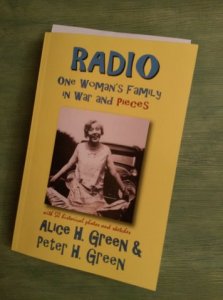
imag2592From the cover of Radio: One Woman’s Family in War and Pieces, I can see Alice is probably a fun character, and right away in the book that is confirmed in “A Fish Story.” The memoir starts with her childhood as spunky and somewhat unusual daughter of a stay-home mom and a civil engineer dad who is away most of the time. Her father designed some famous bridges and buildings in the US. The stories continue through starting a family with Ben who goes off to war at age 35, leaving Alice with two little kids and her ingenuity. When he comes home, he has to deal with a wife who has become not just independent, as many women were forced to become during the war, but independent-minded.

The book goes beyond being a memoir of just life during WWII, since it covers Alice’s childhood and goes all the way to Ben’s death in 1976. The final chapter wraps it all up, and the story is book-ended by what amounts to as prologue and epilogue, both touching. This is almost an autobiography. Alice is quite candid throughout, a pleasant surprise as many of this generation can be reticent in expressing true thoughts and feelings.

Radio is not just a story of life on the home front during WWII. It is about the effects of the advancement of technology. It is about women leaving their traditional roles and how society reacts. It is also, interestingly, about the changes in news media, as both Alice and Ben were writers and Ben worked in radio and advertising. Really it is about the changes in the whole cultural fabric of American life. If you have parents or grandparents still living who can tell about these times, be sure to ask them questions about it. That was a whole different world from now.

I am enjoying this book so far from reading and skimming, and I commend Peter on his accomplishments of putting together and publishing both his mother’s and his father’s stories. While his parents left behind a pile of letters and writings, I know how hard it is even to take written pieces of other people’s lives and put them into a cohesive whole, especially when they are no longer around to consult with. Alice never realized her dream of writing her own memoir, but it is done now and she lives on in written pages. It is a delight to meet her.
Posted in book talk, history, war stories | Leave a comment

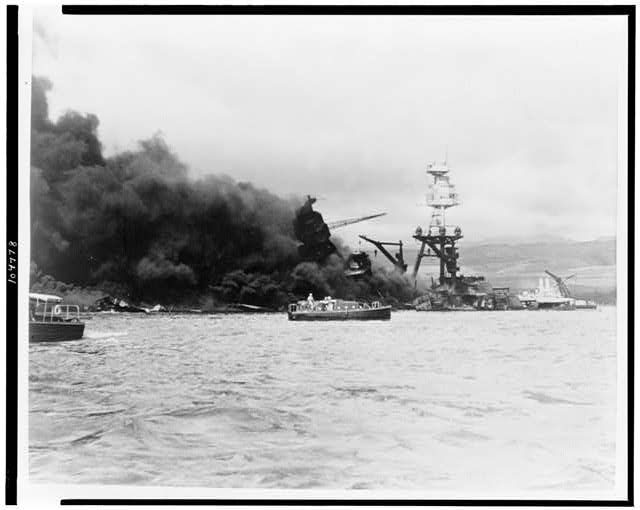
Pearl Harbor 75th anniversary stories

My mother was a 16-year-old living near Tokyo when the Japanese attacked Pearl Harbor. The war seemed far away to a teenager busy working to help support the family, but soon she was following radio broadcasts to hear of bombs dropped and damage to the enemy, but nothing was said about damage done by the enemy. Soon, however, things got bad. . .

My local newspaper has started publishing articles about WWII, readying for the Pearl Harbor 75th anniversary date of December 7, this Wednesday. A story carried today (by Michael Ruane and the Washington Post) features Ensign Wesley Hoyt Ruth, pilot of a small, brightly colored amphibious plane used to transport mail, Navy photographers, and sailors around Hawaii. The plane and Ensign Ruth were commissioned immediately after the attack to scout for the Japanese fleet nearby–a death sentence for those in the silver, orangey-yellow propeller plane with a bright green tail. Fortunately for the 4-man crew, whose only defense consisted of WWI-era rifles they pointed out the windows, they did not spot the enemy ships and warplanes and survived the return to land amidst nervous US military men ready to shoot down anything suspicious. Mr. Ruth died last year at age 101, but his stories of that day live in videotaped accounts and with the old plane hangared in storage for the Smithsonian and awaiting maintenance and restoration—someday.

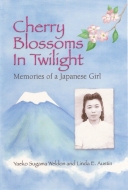
If you know someone still living from the WWII era, ask for their stories. Even civilians have interesting stories, like rationing and Victory gardening and diving under school desks for the bomb drills. Many elderly people have loved my mother’s memoir, Cherry Blossoms in Twilight, because even though she was the enemy’s child, many of her stories sound very familiar to them.

pearlharbor

PS: Also in the paper is how the Vietnam Veterans Memorial Fund has been collecting photos to go with the names of all those on the Vietnam Veterans Memorial Wall in Washington, DC. “People see the names, but behind every name there is a face and a story,” said Heidi Zimmerman, spokesperson. See the Wall of Faces website to submit a photo if you have one of a soldier who was killed in the Vietnam War. They are missing quite a few photos.


Posted in history, honoring veterans, war stories, WWII | Tagged , | 4 Comments

Lights Out – a memoir of life in Cuba before and during Fidel Castro

Fidel Castro is dead. I can’t say RIP. Coincidentally, I just finished reading Lights Out:  A Cuban Memoir of Betrayal and Survival by Dania Rosa Nasca. Dania spent her childhood in Cuba under Castro and despises him for what he did to her homeland and her family. Her parents supported Castro’s revolution to depose Fulgencio Batista’s harsh rule and supposedly end dictatorship. Batista may have been a controlling dictator, but life was still good for the people, although it is likely things were going downhill due to corruption.

A charismatic Castro promised to bring back “the rule of law established by the republic’s constitution,” and became the people’s savior. Instead, he imposed a totalitarian government. Dania’s mother was traumatized by this betrayal and its effects and then by leaving her beloved elderly mother and other family behind to escape in 1970 on a US-sponsored Freedom Flight. She gave her children a better life, but was left mourning the past, “Mi Cubita, mi Cubita, how I loved you and how I lost you.”

I wanted to read Lights Out because I didn’t know much about Cuba, and the country is in the news these days due to renewing relations with the US after years of embargo to punish Castro. Of course, Castro wasn’t hurt by the embargo but his people were. Dictators and their henchmen always live well while the regular people suffer. Ms. Nasca details how a diverse population and thriving economy (based on sugar cane) spiraled down under Castro, while he touted to the world Cuba’s healthcare improvements and racial harmony.  According to Ms. Nasca, the healthcare improvements were for the elite followers while already good healthcare for the masses disintegrated. And racial harmony had existed before, but now “Judas goats” were spying on others regardless of race and reporting “bad” behavior to the authorities in return for favors.

Lights Out was a fast read for me, fascinating and unpleasant to learn how Castro fooled his followers and how communism works—or doesn’t. How more people might have escaped on Freedom Flights except they didn’t want to abandon their young male relatives who were all forbidden to leave. Dania combines her own childhood experiences with stories from her family and friends and with lots of research (sources documented in the end notes). She is definitely bitter at the loss of what Cuba once was, before Castro’s takeover in 1959. I did a little research of my own to find complicated Cuba was not all rosy before, but Castro definitely turned things dark. He won’t be forgotten, but now there is a light of hope as his brother Raul may feel more free to implement more changes to unburden his people.

“Soon there will be no one to remember the character of our street or of Cuba before Castro.” With her memoir, Lights Out, Dania has done her part to capture the lived history and culture of a country she and her family loved long ago. I highly recommend reading this book.

Gloria Estefan on Fidel Castro’s death
Reactions to Fidel Castro’s death

lights-out

Perhaps a light of hope now for the Cuban people

Posted in book reviews, book talk, heritage, history, multicultural, Uncategorized | Tagged , , | 12 Comments