Writing about your roots: family history and life writing

Writing and publishing my mother’s memoir, Cherry Blossoms in Twilight, was perhaps the most brilliant idea I’ve ever had. Especially now that she’s gone, my sister and I really appreciate having a written record of her life story and knowing something about the grandparents, aunts, and uncle we’ve never met. All our elders have fascinating stories of their families and of living in near-history. I hope you are writing them down. I need to work with my dad to get the pieces of his family history and stories together – I think he’s stalled out. While it’s nice to audio- or videotape our parents, grandparents, or even ourselves telling the stories, stories are more easily preserved if written into a word-processing document file. Then when technology changes, and it will, the file can easily be converted to the next generation tech, and at no cost. Of course you’ll keep backup files.

Many people are interested in discovering the genealogy of their family. It’s surprising what might be out there in public records online or in obituaries or old news articles. Ancestry.com (free use at many libraries), familysearch.org, findagrave.com and usgenweb.org are a few sites to check. Many libraries have resources and helpful librarians or volunteers. There may be stories to glean to add life to the names.

Hopefully you or your elder relatives know a few (or many!) generations of ancestors and their stories. Don’t stop with parents and grandparents, ask the uncles and aunts, too. No need to make a fancy book, gather all you know and type it up, arrange lists and stories in some kind of order, insert photos, and make copies of the document at the local copyshop. Ask about the binding options. It’s even easy to make simple covers using an old family photo. If you want to create an actual paperback or hardcover book, read my post about using LuLu.com to make family-only books. If you want to fix up the document text to look more professional, see my Resources page about book design and layout in MS Word.

I hope you’ve enjoyed reading this month’s roots-themed posts. I’m stopping now and going back to posting once a week instead of daily. I need to concentrate on a Korean War memoir I’m putting together for a new friend, and he’s not getting any younger. Next Sunday I’ll post about a book that is an impressive re-creation of someone’s family history through the ages.

Cherry Blossoms Twilight

Posted in heritage, history | Tagged , , | 3 Comments

Teaching kids about their roots

Once again I was embarrassed because I don’t know how to speak Japanese. I was invited to dinner with some delegates from our city’s Japanese sister city, and one of them began speaking to me in Japanese. Eh, eh, sumimasen!

My mother did not raise her children to speak Japanese. Later, as in a few years ago, I was miffed that Mom didn’t teach me anything but some children’s songs and how to count to ten. I could also ask for more tea. I took private lessons one summer, but my older brain had a hard time picking up such a complex language. Plus, I didn’t have much time to study. I quit after I discovered that not only do the words for numbers change with the type of item being counted, but men and women use different words. Then there’s that politeness thing where the word usage changes if someone is higher in authority than you. Even the word “mother” is different depending on who you’re talking to.  It would be better if I just shut up. Except I really wish I could speak Japanese!

Mom did tell us stories of growing up in Japan, and we had interesting Japanese items in the house. I played down the Japanese half of me then, but nowadays mixed heritage is cool. Knowing a second language is not only cool but very useful as the world has gotten smaller. I’m love how the girls down the street are growing up speaking both German and English.

We have plenty of Japanese items in our house. I read Japanese fairytales to my kids when they were little and taught them the Shojoji song. I took them to the annual Japanese Festival. They were raised on Japanese rice (no American rice in our house), and like it with soy sauce and seaweed sprinkles, served in cute Japanese bowls. They are all-American, but touched by Japanese.

In St. Louis we are lucky enough to have lots of ethnic groups. There is an annual Hispanic festival, Chinese festival, and Japanese Festival. There is a Festival of Nations and an Asian-American festival. The Greek churches have festivals. The Scottish Games are held in October, and the Santa Lucia Swedish celebration in December. We have an Italian area (The Hill), Little Bosnia, and Chinatown. No excuse not to teach our kids about their heritage, and everyone else’s! That way, when we go traveling overseas we won’t be total gaijins.

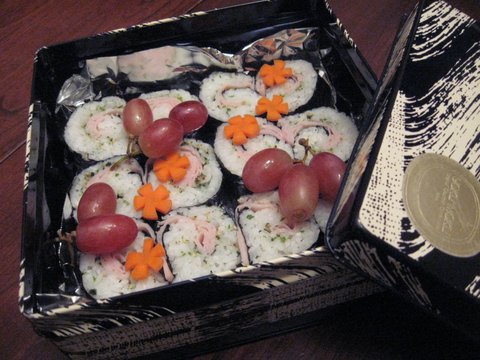
A bento box of deli meat sushi rolls for school lunch

A bento box of deli meat sushi rolls for school lunch

Posted in heritage | Tagged | 5 Comments

Finding your ancestry roots through DNA testing

DNA testing for ancestry has been a high-tech new boon to those wanting to dig deep for their family roots. Whether just curious or have nothing else to go on to find ancestors, people are happy to spend $100 or so to discover their “genetic haplo groups,” (people groups) and perhaps link up with others whose DNA markers are close matches.

In my last post I wrote about adoption and finding your roots. In the old days, closed records were the norm, but nowadays many states will open the records if both parties have given approval. Kansas has wide open records and an online database for those searching. Open adoptions have thankfully become common, so both birth parents and their children aren’t left sad and wondering for years. My online friend, writing coach Cate Russell-Cole, was adopted and unable to find her birth parents. She turned to DNA testing and is happy with the results. Although she still does not know her birth parents, she found her lineage is strongly Irish, with Viking and Jewish heritage.

Cate used genebase.com in Canada which lets users create an online family tree, similar to Ancestry.com. Genebase offers a number of DNA testing options, starting at $119 plus shipping and handling:  from paternal or maternal only to testing both lines, and from standard to highest resolution. The site even says it will test for immediate family, however that works. The tests require cheek swabs. Results, which are technical and complicated to read I hear, are viewable online through a personal profile. Cate chose to test through her maternal line of X chromosomes, but took the most extensive test to find “Mitochondrial Eve,” so she has a map of the movements of her ancient ancestors across Europe and even East Asia. She is periodically sent information about possible matches with others, but says these have been ancient lineage possibilities.

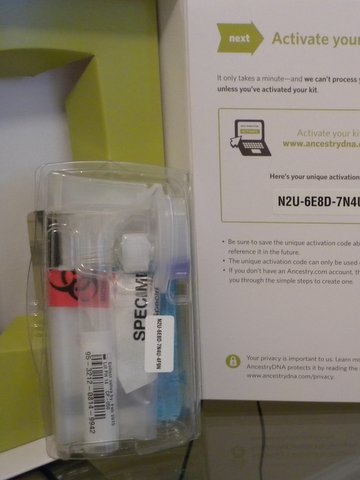
Author friend Kim Wolterman, who is not adopted and enjoys researching her own genealogy as well as the histories of old houses, had her DNA test done with AncestryDNA via Ancestry.com. “When they began offering their DNA test for $99, I decided to spit or get off the pot.” Ha, ha, Kim. The online results of Kim’s spit test took close to six weeks to receive. Here’s her response:

“To say that I was surprised when I went online to review my test results is an understatement. The pie chart indicated that I am 95% British Isles (England, Ireland, Scotland and Wales), and 5% unknown. My German and Swiss ancestors would be amazed to hear about this!”

Kim has documentation of numerous German ancestors and one Swiss. She is thinking of asking her brother to take the test to see if the same results come up. AncestryDNA also has a database of tested people who could connect with others who share DNA markers. Kim has found this “very disappointing,” with no close matches found.

Does DNA testing really work? From my own bit of research and from reading reviews, it seems to work if you just want a broad outlook and if the company has a huge database of results from all over the world (most don’t, especially not from Asia). For some people, results are in conflict with known heritage. And don’t expect to find lost parents or siblings. No1Reviews.com lists genealogy sites and some DNA test companies if you’d like to compare reviews by the site’s editor and by actual users of those companies. Before you spend the money, study up on the types of DNA tests and what kinds of results you can realistically expect. In the end, or rather in the beginning, we all came out of Africa. That’s your freebie result, no test needed.

Note: Women can have their mitochondrial DNA (mDNA) tested for maternal lineage. Men can have their mDNA tested for maternal lineage AND have their Y-chromosome male lineage tested. Autosomal chromosome tests will analyze not just the mDNA or Y sex chromosome but all 23 pairs of chromosomes in human cells. AncestryDNA, 23andme, and genebase.com’s combo packages test autosomal chromosomes. 23andme focuses on health and medical issues.

photo by Kim Wolterman

photo by Kim Wolterman

Addendum:  Through a pingback notice about this post, I found a wonderful family history blog with a post that talks about experiences with DNA testing. Note the comments, too.


Posted in adoption, heritage | Tagged | 7 Comments