The Gods of Heavenly Punishment: rare Japanese WWII perspectives

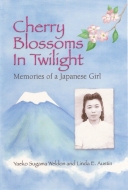
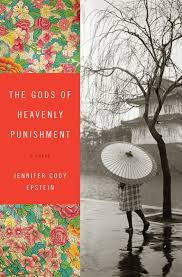
Gods of Heavenly PunishmentThis is the novel I wish I could have written, and now I don’t have to think about it anymore. The reason I published Cherry Blossoms in Twilight is because there are almost no other narrative books that cover WWII from the Japanese civilian perspective. Along comes The Gods of Heavenly Punishment, recently released, to cover not only the sad civilian side but the horrific military and the Manchurian occupation viewpoints as well as U.S. perspectives. The character stories are bound together by a green-stoned ring belonging to a young American woman waiting for her new husband to return home. This book is a hard-hitting historical epic that will take your breath away.

Characters include:

Lacy, who marries Cam only to lose him as MIA as she raises the son he’s never seen
Cam, Lacy’s new husband, a B-25 bomber pilot in the Doolittle Raid
Billy, who grows up in Japan and returns to work for the U.S. Occupation
Anton, Billy’s architect father, has built embassies, hotels, and homes in Japan and later uses his skills to help the U.S. research to destroy Japan
Kenji, Anton’s Japanese master carpenter who moves on to work with the Japanese military in Manchuria
Hana, Kenji’s Japanese wife who is lost between Japan and the West
Yoshi, Hana and Kenji’s daughter who survives the firebombing and must rebuild her life
Masahiro, minor character, son of Kenji’s mistress, who is broken by his military experience

Author Jennifer Cody Epstein lived in Japan for five years and did quite a bit of research for this book, interviewing firebombing survivors and former bomber pilots (her dad), reading about the Japanese wartime mindset and the colonization of Manchuria. Her details match everything I have read about Japan before, during, and after WWII, and she created a multi-faceted story to tell these details with well-developed characters and complex relationships. She tells it like it is, so note there are language usages, horror, and adult situations that reflect the reality of the times. She does, however, convey this with the elegance of restraint, so those who are sensitive and fairly conservative (me) get the picture without having to wallow in it.

I can’t say enough good about this book. It’s about time these perspectives were captured, and it was done with painful beauty and eloquence despite the sordid and hideous details of war. Yes, war is hell for everyone involved, and that’s a lesson that bears repeating over and over and over. Thank you to Amused by Books for my copy of The Gods of Heavenly Punishment.

Inscription in the front of the book:

“The war is dreadful. It is the business of the artist to follow it home to the heart of the individual fighters—not to talk in armies and nations and numbers—but to track it home.” – D.H. Lawrence

You may enjoy the interview with Jennifer Cody Epstein posted on Amazon about the writing of The Gods of Heavenly Punishment.
Posted in book reviews, book talk, history, multicultural, WWII | Tagged , , | Leave a comment

Blest be the ties that bind: a life writing vacation in the country

We just returned from a weekend visit to our relatives in the Tennessee countryside. While our family visits are always pleasant, they usually aren’t exciting and don’t offer new sights like a real vacation would, and I haven’t had one of those in about five years so I’ve been antsy. This visit, however, I was excited to see our expectant niece about to have her first child and to see all the innovative baby equipment invented since my kids were born. Have you seen these travel cribs-playpens lately?  I think some come with a kitchen sink to wash up after changing diapers. Oh, the other excitement was that 10-lb catfish my nephew caught in the cow pond and gruesomely slaughtered on the back porch. I’d like to forget about that.

I do love visiting my husband’s country relatives. Open spaces, inky nights full of stars, quiet broken by bird calls or the buzz of hummingbirds, so relaxing sitting on the porch when there’s not a monster catfish flopping around on it. Going to a little church of friendly people who hug me even though I can’t remember their names. My in-laws have big vegetable gardens so on our summer visits I help pick beans or okra or whatever is ripe and get to take a bounty of fresh veggies home. Last year I helped prep tomatoes for canning. My girls even enjoy helping pick, and I like that they see how food grows.

My mom-in-law, well known for her fine Southern cooking, fixes mass quantities of food and everyone gathers for dinner.  I am working on a book of recipes she is particularly famous for, mixed in with her life stories. During this visit we had a lot of fun going over the draft version. We talked about life in the old days, which was a lot of work if you were from a farming family. Little kids chopping cotton (hoeing weeds from between cotton rows) was not unusual. I took a lot of “ordinary” photos of food, the house, the old chicken houses, hay rolls, the garden.

* * * * *

Fried Squash Recipe

Peel and slice yellow squash. Add flour and cornmeal in a half-and-half mix. Sprinkle salt and pepper. Add one chopped up onion. Pour into a pan of a quarter-inch of hot grease and fry at medium high heat, flipping the mix often to keep from burning. Squash is done when soft and the mix is browned.

* * * * *

I had been thinking of tackling my father-in-law’s life story next, but thought he would balk and say he just had the usual farm life. I think of him as the quiet type. But, this visit he opened up with a bunch of eye-popping stories of his boyhood all because I asked him a question about his wife’s father. Dad, how in the world could you have plowed a field with a mule when you were only four years old?! Apparently kids were pretty tough then and expected to work like little adults. School shut down during planting and harvesting so the kids could work the fields with their parents. Next time Dad’s brother is in town the same time I am, I’m going to sit those two down and get some more stories!

I’ve got the green beans and corn blanched and frozen, and a big pot of creamed corn cooling. Tomatoes are set on the back porch table. Tomorrow I make zucchini bread and cucumber salad. In my world, there’s not much that’s more soul-satisfying and filling as a visit with my in-laws in the rolling hills of west Tennessee. I might have some country-life stories of my own.


Posted in capturing memories, family gathering, recipe | Tagged | 6 Comments

On Gold Mountain: making family history come alive

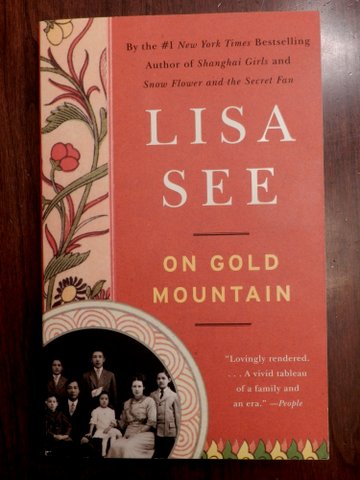
Author Lisa See may not look Chinese, but she certainly is. She is known for “Snow Flower and the Secret Fan,” “Peony in Love,” and “Shanghai Girls,” but I know her for “On Gold Mountain,” the detailed history of her family and the 100-year history of west coast Chinese-American culture. Lisa, who is one-eighth Chinese and very much assimilated with her Chinese-American family, interviewed over 100 family members and friends, researched for historical information, and traveled to China to her ancestral villages. She added photos and included the family tree. Instead of a dry, factual book of names and nonfiction, she created a story—lived the story, and with dialog!—that captured mostly her Chinese side, but also the sparse Caucasian side of her heritage. Her white great-grandmother grew up unhappily with an older brother’s family after her mother died, but left as soon as she could and became estranged from her family.

I found it curious how Lisa used real stories of her ancestors and real history to create imagined scenes so that the book reads like a historical novel, yet is still considered a biography/memoir. She weaves in the finer points of working on the transcontinental railroad, of the imported antiques business and the restaurant business, of carpentry and of the immigration system. She seamlessly mixes past tense omniscent (all-knowing) narrator storytelling with present tense dialog—very impressive to do this well and keep tenses straight.  Despite all the facts, the book focuses on story and relationships. Lisa brings her family members and even their friends and acquaintances to life with thoughts and feelings, definite personalities. She’s got a wealth of relationships to look at, too—the drama between family members, between cultures, between old world and new. Her family history, like everyone’s, is against a backdrop of sociological changes and how everyone adapts.

Most of us won’t be creating a dramatic novel-like history of our families, but reading “On Gold Mountain” can inspire us to dig for our roots, ask for the stories, learn about the history our ancestors lived through, and imagine how it was for them. Lisa was lucky that when she thought about writing the family history many of her numerous elder relatives were still alive and forthcoming in their stories. And they remembered stories passed down to them. Those of us who do not have the old stories can still find records and information and meld the sociology and history of what our ancestors lived through to re-create some of what their lives were like. We can still make our family histories breathe a little and be fun to read.

If you do read “On Gold Mountain,” be sure not to skip the beautiful epilogue.

Gold Mountain


Posted in book talk, history, lifewriting, multicultural | Tagged , | 4 Comments