More on making family stories and genealogy come alive: “Yokohama Yankee”

The story begins at a funeral marking the “fading presence in Yokohama of a family that witnessed Japan’s transformation from a feudal nation ruled by samurai into one of the world’s greatest industrial powers.” Yokohama Yankee: My Family’s Five Generations as Outsiders in Japan is a very readable quest of journalist Leslie Helm to learn more about his famous German-Japanese family. Helm is a quarter Japanese. He was born and raised in Yokohama, where his family’s roots go back to 1869. The funeral that begins the book is for Helms’ father, the last (and reluctant) heir of the illustrious Helms Brothers company that provided stevedoring and other transporation-related services to the ships loading and unloading in Yokohama harbor, later in Kobe and other major Japanese ports. Leslie Helms was not close to his half-Japanese father, although both were similar in that they were uncomfortable being part-Japanese. Most of the Helms “felt insecure in the country of their birth.”

Leslie Helm added fascinating tidbits of historical information beginning with his great-grandfather Julius leaving farm work in Germany (and, as the family joke goes, escaping an arranged marriage) to try his luck in Minnesota where he was soon disheartened, then he missed a boat to China and took the next ship out—to Japan. Leslie had Julius Helms’s autobiography to work from, but did plenty of research and interviews with remaining family and friends to weave facts and imaginings of how it was for a burly German man to break cultural barriers by marrying a Japanese woman and raising “mixed bloods” in insular Japan. The story reminds me of Lisa See’s On Gold Mountain epic of her Chinese and American family.

Helms brings to life history and the delicate dance of living through WWI (Julius Helm had taught samurai the German fighting techniques) and WWII and the Occupation as German/Japanese with the American enemy mixed in. He takes us through the flames of hell rising from the Great Kanto Earthquake of 1923. He muses about the complexities of father-son relationships through generations. Those interested in genealogy will thrill to walk beside him as he discovers and follows clues that solve mysteries of family heritage. With all this to hold readers fast, Helms really drives deep with the main storyline—his and American wife Marie’s adoption of two Japanese orphans. I found this international adoption journey to be startling, painful, and raw as Leslie opens his heart to readers with his own misgivings, confusion, pain, and discovery. Adoption in Japan is no easy thing, both legally and emotionally, and add to that parents who do not look or act Japanese.

I advise those who want to write their life stories to read plenty of memoirs, particularly those that hold similar stories. I bring up Yokohama Yankee and On Gold Mountain because adding genealogy and history can be a daunting task with so many different stories that need to be integrated into one. Reading other memoirs will give you ideas of how to organize and write your own, what to include—or not. Farewell to Manzanar helped me write Cherry Blossoms in Twilight. I liked the simplicity and the added historical details and that it was about the memories of being a little girl living a WWII experience few outsiders knew about. Other than that, these memoirs are not very similar.

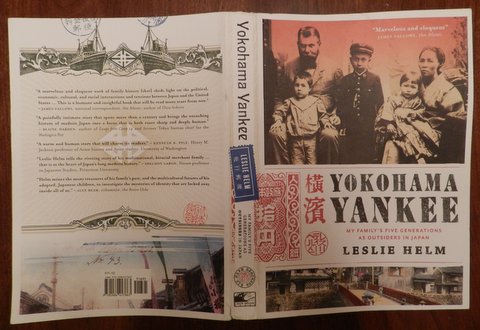
Yokohama Yankee is a 5-star book for me. Not only was it exciting to follow Leslie Helm’s discoveries of his family history and learn about Japanese and world history at the same time, the physical book itself is a work of art. Book designer Joshua Powell is a JET (Japan Exchange & Teaching program) alum and his time in Japan probably influenced his sense of aesthetics. He used Helms’s collection of old photos, postcards, and ephemera to turn the book into a visual delight.
Yokohama Yankee


Posted in adoption, book reviews, book talk, heritage, history, memoir writing, multicultural | Tagged , , | Leave a comment

Words like pearls: Poetry, Alzheimer’s, and eldercare

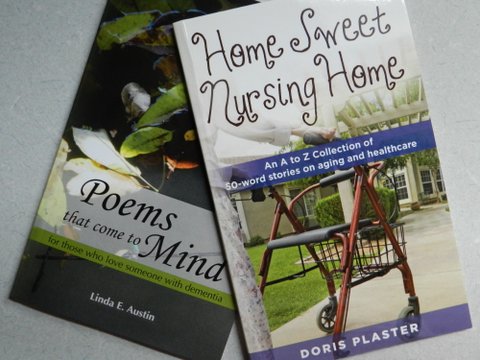
Doris Plaster is one of those angels who works at a nursing home, loving and caring for elders and listening to the voices so many others have forgotten about. I loved her book, Home Sweet Nursing Home, of sweet short-short stories (flash nonfiction) based on real people she attended to as a social worker. I have the honor of being featured on her blog this week, with a short-short story I wrote about my mother in keeping with the style of posts Doris writes for Hold My Hand:  A Social Worker’s Blog. Stop by and read A String of Pearls.

Home Sweet Nursing Home

Home Sweet Nursing Home is available on Amazon and on Barnes & Noble online.

Posted in aging, book talk | Tagged | 2 Comments

Nora Jo Fades Away: finding laughter and love in an Alzheimer’s memoir

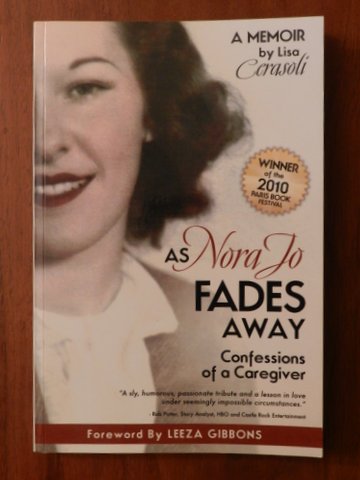
Nora Jo Fades AwayI read Nora Jo Fades Away:  Confessions of a Caregiver several months after my mother died of Alzheimer’s, but I’m just now getting around to writing about it. I was shocked, shocked I tell you by the first few pages. Author Lisa Cerasoli has an outrageous memoir of caring for her feisty grandmother, Nora Jo, who had Alzheimer’s. Lisa left her career in acting and writing, and—with a new marriage and stepson and a toddler daughter—she took in her brandy-loving, swearing, blunt-speaking Gram. Friends said, “Are you crazy? Are you looking to get divorced?” She did survive, she only went crazy a lot, and she did not get divorced because of it, thanks to an easy-going and patient husband. The kids were troopers.

Taking care of an Alzheimer patient is no piece of cake—especially if you’ve got kids to look after, too. Lisa is very open and tells it like it is, colorful language (both hers and Gram’s because that’s just how they talk) included. She says, “A memoir is taking your story and laying it ALL out there. The only way to write a book on Alzheimer’s is to get downright personal.” The kinds of things our loved ones can say and do when the disease gets a good grip on their minds are important for caregivers to know. “The Iraqis have poisoned my lettuce.” “Leave me in here to die, goddamnit!” If caregivers are armed with knowledge, they are better equipped to deal with the disease, and this disease can drop your jaw daily. There is also a cold comfort knowing that others are going through the same astonishing horror and feeling the same draining emotions and exhaustion. And there is hope in hearing there are beautiful moments of incredible sweetness (see also my Poems That Come to Mind).

Lisa walks us through life with Alzheimer’s with wit and learned wisdom. We’re right there experiencing and learning with her. She waters down Nora Jo’s brandy on the sly, then at least succeeds in getting her to switch to beer, which Nora Jo likes warm. Lisa has to figure out how to get Gram to stop putting her beer cans in the microwave. How will she get her out of the bathroom? How will she get her through Christmas?

Being feisty herself, Lisa is blunt and she laughs at and teases her Gram. Some readers (me) may find this shocking at first, but I quickly saw how Lisa was mostly laughing at the situation, that her teasing made her Gram feel better, and that Lisa loved her Gram dearly. Nora Jo is quite the character herself and gives as good as she gets. Laughter releases stress in both the dementia patient and the caregiver, and believe me that stress level regularly gets very high for all involved! Laughter is a way to feel close and loving even if a minute ago both were angry and frustrated. Lisa and her family became very good at calming Nora Jo and making her feel good about herself. Once it involved ravioli.

Those who are fairly conservative may not appreciate this book (language [sh*t, hell, damn], drinking, a past secret exposed). I found an instance of political incorrectness. The book is brash and funny, but also sensitive and heart-breaking. It gives facts about Alzheimer’s and puts the reader into the Alzheimer’s experience with total candor. The memoir itself is a fast read at 116 pages, the sections that follow are of family photos and of other peoples’ memories of their loved ones with dementia. I fell in love with Nora Jo, and I want to tell Lisa, “Well done.”

From Lisa:

My Gram got “interviewed” for the book a bunch, so she felt like she was a part of the process, even if she couldn’t remember it. It kept us both busy. When the book got published, she absolutely adored the photo I put on the cover, which was a shot of her when she was twenty-five. She looked like a Hollywood starlet, truly. She’d walk by the book and say, “Who is that gorgeous girl on the cover of that book? Oh, for God’s sake, it’s me!” She was so proud. And I felt like I had figured out how to build a bridge between the life I had left behind and the one I had now as a caregiver. I guess you could call that “purpose.”

Lisa is also author of the novel On the Brink of Bliss and Insanity and produced the short documentary 14 Days With Alzheimer’s

Posted in aging, book reviews, book talk, grandparents, relationship | Tagged , | Leave a comment