This Mobius Strip of Ifs: Essays as Lifewriting

I patted myself on the back after finishing This Mobius Strip of Ifs by Mathias Freese. I felt challenged and smarter from the brain exercise. Freese turned his philosophical essays into a book—not a memoir, but readers will know who he is, how and what he thinks, and read some very personal stories about him and his family. Essays can be a fulfilling type of lifewriting since they can delve deeply into the heart and mind of a person. They can be written advice and explanation to children and grandchildren.
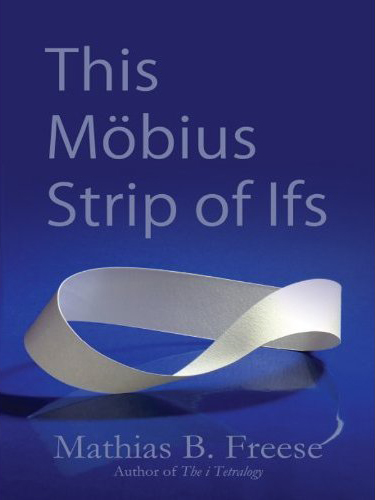
This  Mobius Strip of IfsFreese was a high school teacher, then a psychotherapist. He’s had a childhood without much love. He is very honest about himself, befitting as he espouses the goal of becoming self-aware—stop sleeping through your life! The first section of the book covers his philosophies about the education system, therapy, the Holocaust, the words on the Jefferson Memorial, whatever he’s had experience in or finds meaning in. He weaves his  stories into his essays. The second section (Metaphorical Noodles) contains his thoughts about a few favorite movies and actors (mostly older). In the final section, Freese gets more personal and writes eloquently and poignantly about his family. He’s crusty, but he values love.

What’s a Mobius strip, you ask? It is a ribbon twisted and attached end-to-end to form a continuous strip, there is no front or back or end! It is an exciting curiosity to mathematicians and physicists (and a useful concept in factory assembly lines). Freese’s wife writes in the foreword that to her husband it is a metaphor for possibilities outside our perception. “We can only remember the past and how we thought our future might have been.”

“I see this book as a statement of who I am,” writes Freese. He says it is a “powerful and nourishing feeling for me to have paused long enough to have observed the passage of time and my place in it.” I found many philosophical “truths” in his book that I wanted to highlight in yellow.

I recommend this book for those interested in writing their own philosophical essays as a legacy for their families, and for those who enjoy intellectual discourse. You don’t have to agree with Freese, but he will provoke you to think about your responses. Likewise, your family doesn’t have to agree with you, hopefully they will be interested in what you have to say about life, what you’ve learned from your experiences, and so discover who you are.

Posted in book talk, lifewriting | Tagged , | 3 Comments

Mrs. Lincoln’s Dressmaker wrote a memoir

A few weeks ago I listened to Jennifer Chiaverini talk about Mrs. Lincoln’s Dressmaker. Her name was Elizabeth Keckley, and she was a slave who had scrimped to buy freedom for herself and her son from her half sister and husband ( Keckley was daughter of a white slave owner and a slave woman). Keckley was well-known in St. Louis in the mid 1800s for her dressmaking skills, and was obviously held in high regard as some of her patrons offered to loan her the $1200 to buy her freedom, knowing she would leave immediately to find her fortune on the East Coast.

Mrs. Lincoln's DressmakerKeckley became dressmaker to the leading families in Washington, D.C., including to Mary Todd Lincoln, the president’s intelligent and vivacious but troubled wife who had many detractors. After Lincoln was assassinated, Keckley remained close to Mary until Keckley published her tell-all memoir of life in the capitol. Chiaverini took this memoir and built it into a novel, imagining between the lines of Behind the Scenes: Thirty Years as a Slave and Four Years in the White House. She said the memoir is short and did not even mention Emancipation Day.

Slave narratives were being published by that time, mostly by white abolitionists writing the stories of slavery for illiterate former slaves. The brilliant orator Fredrick Douglass himself wrote three autobiographies covering his slavery, those published from 1845-1881. Keckley’s memoir, however, was something else. It only briefly describes her life as a slave, but it exposed the personal relationship she had with Mary Todd Lincoln. Imagine in 1868 a former slave giving the inside scoop about the daily life and marriage of the President of the United States!

No one really knows if Keckley wrote her own memoir. She may have been literate—she was half white and the main wage-earner in her owner’s 17-person family, and the slave man she thought was her father had encouraged her to educate herself. Many believe her memoir was ghost-written, though (the writer misspelled “Keckly” as “Keckley”). In an interview late in life, she said she was “tricked” into telling her stories, and the publisher betrayed her by including her personal letters from Mrs. Lincoln.

Lizzie Keckley did mean to show Mary Lincoln in a good light, albeit not without blemish. The East Coast public, however, happily pounced on verification of that “Western” Mrs. Lincoln’s faults since they didn’t like her anyway. At the same time, they were appalled a black woman would dare publicly expose a white family’s personal lives, and many refused to patronize Lizzie again. Her memoir did not sell well. Mary, understandably, did not appreciate the invasion of her and the President’s privacy and severed the relationship with Lizzie. Lizzie died in poverty.

I haven’t read Mrs. Lincoln’s Dressmaker, but I own a signed copy now and am looking forward to Chiaverini’s imaginings and research. I haven’t seen the movie Lincoln yet either, but I do know the black woman accompanying Mary Lincoln in a few scenes is not her maid. She is Elizabeth Keckley, dressmaker extraordinaire, a free woman, and one whose memoir would cause irreparable damage to her reputation and to her deep friendship with Mary.

(At the time of this posting, the Behind the Scenes Kindle e-book  is free on Amazon)

Posted in book talk, history | Tagged , | 3 Comments

The Poetry of Alzheimers

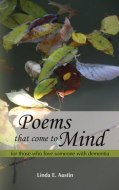
Most people wouldn’t think poetry and Alzheimer’s disease go together. Alzheimer’s is a tragedy. Poetry is beautiful. Poems That Come to Mind, however finds the beauty and the tragedy. Alzheimer victims may not know their families and friends, they may not be able to make sense of their surroundings, but they still enjoy friendly visitors, holding hands, a warm breeze. I wrote this book in honor of my mother and the other residents of the nursing home she was in. I hope it helps other caregivers find comfort in knowing they are not alone, and that it brings a sense of respect and understanding towards those who suffer dementia.

Poems for AlzheimersThe e-book version of Poems That Come to Mind is free through Valentine’s Day to spread love and understanding. Please share this message with anyone you know who cares for someone with Alzheimer’s or other dementia-causing disease.

Free Poems That Come to Mind on Amazon (downloads to Kindle, PC, and other readers except Nook)


Posted in aging, poems | Tagged | 3 Comments