That’s The Way It Was black history stories of segregation in St. Louis

That's The Way It Was Vida Goldman PrinceFebruary is Black History Month, so seeing Vida Goldman Prince the other night was especially fitting. She introduced her brand new book, That’s The Way It Was: Stories of Struggles, Survival and Self-Respect in Twentieth-Century Black St. Louis. She was proud of her 30-year undertaking, but more proud of the black interviewees who opened their hearts to her, a white Jewish stranger, and told her what it was like to live in segregated St. Louis in the first half of the 1900s. Each chapter of the book is a different person’s stories.

In 1987, Vita Prince interviewed Marian O’Fallon Oldham, a civil rights activist, who attended a Missouri Historical Society exhibit called “I, Too, Sing America: Black St. Louisans in the 1940s.” Prince wanted to dig deeper into Oldham’s statement of how “our parents went ahead with life and made something out of themselves and their children…despite the real outside world.” She wanted to know what was it like for black people to live in this real outside world, what did the children think and what did their parents have to say about this world.

Ms. Prince interviewed 24 people and then struggled for years to find a publisher interested in capturing these historical, personal perspectives of segregation in St. Louis, the “most southern city in the north.” Finally, The History Press came to the rescue.

Stella Bouie, who as a child had banana curls and wanted to be Shirley Temple, stood up to introduce herself at the book event. Bouie had worked as an elevator girl for a local department store and was promoted to display coordinator. She still remembers all the places she wasn’t allowed to eat at. She said she enjoyed every moment of the interviews and that Vida asked questions nobody else ever asked. Ms. Prince said the time must have been right to tell the stories, and no one she interviewed ever asked why she was doing the project.

DSCN2336-001

Vida Goldman Prince is delighted to see Stella in the audience

The book includes stories by Richard A. Martin, Jr., a nephew of Josephine Baker. By age eight, he was tap dancing to attract customers to his shoeshine at Union Station. Clifton Fitzpatrick remembered blacks finally being allowed to work skilled factory jobs, and how even though they didn’t like the coloreds-only roped off cafeteria seating or the toilet sign, they “tried to work with the system…and get a piece of the pie.”

Edna McKinney said Grand Avenue was a dividing line in the city then between poor blacks and the professional blacks allowed to live in a pocket to the west. Blacks coming up from the South were another class of people, and their cooking was different and their stories were fearful. She said there was prejudice even amongst the black people based on where they lived, where they were from, how much money they made. St. Louis blacks resented the southern blacks coming in and competing for jobs. This sounds like the way white people can behave, too.

The interviews are edited but seem barely so because the voices shine through. In the introduction, Ms. Prince says Salimah Jones told her in an interview that her father talked about black history but “the last thing he wanted was for somebody white to write his history.” Prince replied, “You mean like I’m trying to do? But this history is going to be in your words.” Yes, I can hear Stella, Richard, Edna, and others talking. I hear them telling me their stories, and I’m listening. Ms. Prince hopes high school and university libraries will be interested, and I hope so, too.

See the post on Sugar Hill: Where the Sun Rose Over Harlem for a personal perspective on growing up in Harlem in the 1950s-60s.

Posted in book talk, heritage, history, multicultural | Tagged , , | 1 Comment

Stan “The Man” Musial and life stories of everyday legends

Even I, a transplant to St. Louis and not much of a sports fan, knew who Stan “The Man” Musial was and what he represented. Cardinal Nation and many others mourn his passing on Sunday. As sportwriter Bernie Miklasz said in today’s St. Louis Post Dispatch, “…his death is a loss for civility, sportsmanship and character.”

The St. Louis Post Dispatch put together a beautiful special section in Sunday’s paper as a tribute to Stan. I learned how Stan’s father, a Polish immigrant, had to be persuaded to allow his firstborn son to join a Cardinals affiliate league instead of going to college. Stan’s mother, a daughter of Czechoslovakian immigrants, also wanted her son to attend college and escape the Pittsburgh steel mills and mines, but saw how much he yearned to play ball. The story goes that Mary, arm around her crying son, told her husband, “In America, a boy is free NOT to go to college if he doesn’t want to.”

There are plenty of books about Stan that tell his stories—he was a legend, after all. Since I don’t care much about sports, for me his biggest legacy was as a kind man unaffected by fame, a family man who loved his wife for 71 years, the son of struggling immigrants who escaped a life in the mines. I think even if Stan hadn’t been famous, he would have had a good story.

In one of the online groups I follow, a woman posted what her grand-nephew had written about his father as a tribute marking what would have been his 46th birthday. This young Marine said he was glad he had had almost twenty years with his dad and that his dad knew he loved him. But, he wished he knew his dad’s stories, his history. “I know who you left us as, but what I long for the most is to know the path you traveled to become the man, the myth, the legend, and most important, the father I knew you as.”

Everyday legends are important, too.

Stan Musial

Latest news: for anyone wanting a copy of the St. Louis Post Dispatch Stan Musial special section, you can buy one. Not sure how long the offer will last.

Posted in capturing memories | 3 Comments

Memories lost in the changes

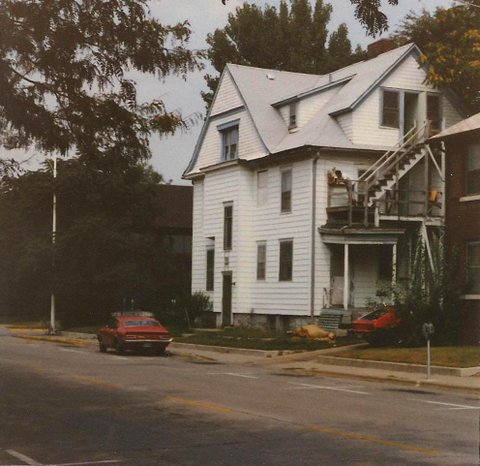
Yesterday my husband and I visited our daughter who is starting grad school at the University of Illinois Urbana-Champaign, our old alma mater. I haven’t seen it much since I graduated in 198x (long ago!) and the area has changed a lot with tear downs and new construction. The two houses I had lived in, very near to each other, were gone—the whole block replaced by a massive new fire station and a tidy strip of restaurants and little shops. We had to drive by twice trying to find where those houses used to be.

We called this "Deppe Palace" and you can see why it was torn down!

We called this “Deppe Palace” and you can see why it was torn down

We recognized a handful of landmarks; the stately Quad was the same. From my horticulture classes, I recognized only Mumford Hall. There was the old cemetery where a friend (now my husband) had taken me one night to see the tombstones rising from the fog–cheap thrills, and yes, I love old cemeteries. On the northern end of campus my husband pointed out big new halls for engineering (nanotechnology!) and computer science and the awesome Beckman Institute. We did find the dark wood apartment building he had lived in, looking small and out-of-place sandwiched among newer complexes.

The Quad is still lovely

The Quad is still lovely

Only a few places, like Follett’s and Busey Bank, were the same around Green Street, where the fun was. No more Garcia’s Flying Tomato Brothers pizza! We had lunch at Legends which used be a joint with lots of pool tables but now there’s two. Legends has The Chief in a box. I loved Chief Illiniwek (not a real tribe), the most respectful and respectable mascot of any major university, who was deemed too offensive to be allowed (Florida State Chief Osceola and the Washington Redskins are fine), but seeing a life-sized human in a plastic exhibit box was weird to me.

I was lost among ghosts of memories. Trying to find them was a challenge, but there was the little corner bar (then Treno’s) where my equally poor roommate and I would go on Friday nights for free hotdogs and quarter beers. We’d stuff a hotdog or two under our shirts or jackets and carry them home for lunch the next day. Across the street was Krannert Center for Performing Arts where I got to see dress rehearsals for the plays because one of my roommates was a theatre major. I walked out at the intermission of Carmen because I didn’t understand what they were singing and thought it was over. I heard William Warfield boom out “Ol’ Man River” and croon “Summertime” there, and after my babies were born I sang  “Summertime” to them as a lullaby (note the lyric and your daddy’s rich and your ma good-lookin’!).

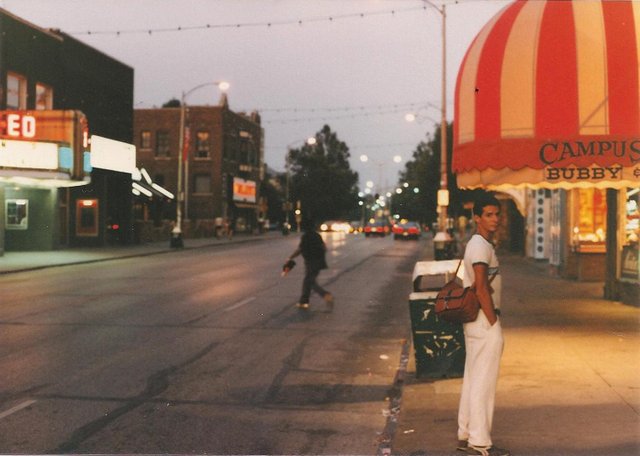
Green Street in the 1980s. The theater on the left is gone. Sadly, so is our friend.

Green Street in the 1980s. The theater on the left is gone. Sadly, so is our friend.

Going back in time is not always a good thing. I was disappointed, almost as badly as when I visited the house I grew up in and found the owners had chopped all the trees down. I didn’t find the tree-lined charm of the old U of I in the midst of modern monster buildings, even though the new university buildings kept the same style as the old, for the most part. All was impressive, just too new, too much, too jarring for my old memories. Unlike for my childhood home, though, I will return to look at the university, at least while our daughter attends. I like the Alma Mater statue’s message, “To thy happy children of the future, those of the past send greetings.”

My advice to everyone: take photos to document your home, your school, your town. You’ll be glad you did.

(Alma Mater the statue is out getting cleaned)

(Alma Mater the statue is out getting cleaned)

Here's Alma from the old days, with friends Labor and Learning

Here’s Alma from the old days, with friends Labor and Learning

Posted in capturing memories, memories, photos | Tagged | 5 Comments