We Hope You Like This Song: Healing from a death

Soon after my mother died, I caught Bree Housley at Left Bank Books talking about her memoir,  We Hope You Like This Song. The subtitle is “an overly honest story about friendship, death, and mix tapes”. The writeups said the book was funny, and I thought it would cheer me and give me a brighter outlook on losing someone I loved.

HopeYouLikeThisSongBree lost her best friend since childhood when Shelly developed a severe form of preeclampsia she didn’t recover from. The book brings attention to this common pregnancy condition as a warning, but it is mostly a tribute to the power of friendship and to Shelly, who brought light and laughter to Bree and a small town in Iowa.

Four years after Shelly’s death, Bree still suffered from her loss. Friends talking of week-long New Year’s resolutions versus the long form got Bree thinking to make a resolution per week in honor of Shelly’s memory. She would do something Shelly-like, something outgoing, different and maybe crazy every week. Bree’s sister Courtnee joined her, and the two started a blog called “Fifty 2 Resolutions” to document their yearlong endeavor. It was a big hit.

We HopeYou Like This Song really is a hoot, but it is also serious and sweet. You see the hole in Bree’s heart, you also see how doing Shelly-stunts brings her healing and peace. Behaving like the outgoing, happy-go-lucky Shelly gave her a sense of freedom and a greater appreciation for the moments in life. “We make life a gift.”

Yes, this book is crazy funny. It’s written in a very open, personable style most appealing to someone a little younger than me (like a couple decades younger), but I loved it. You wouldn’t guess Bree used to be shy. She drinks and swears (f-bomb warning), mentions personal body parts and making out with guys—like what you might expect from a young person influenced by a social butterfly BFF. (Bree says she is still introverted.) She plans her wedding during this time (orders a Ho-Ho cake and chooses pizza buffet) and moves around advertising jobs. Commentary is hilarious. The moves from past to present and back again are done amazingly well—the stories and timeframes stitched together and I got neither lost nor side-tracked too far off the main path. (Note: Time-jumping is difficult to do well. Bree is a copywriter and had a pro editor through Seal Press.)

And what an endless supply of stories there are: planning an ex-boyfriend’s death by peanuts, dressing up pretty and going to the World’s Largest Truck Stop for fried cauliflower before the high school dance, imitating New Kids on the Block. Resolutions included going out wearing old clothes hidden in the back of the closet (t-shirt with the painted-on sheriff’s badge and belt), eating weird food (beef tongue tacos), and singing karaoke for the first time (“Snoopy vs the Red Baron”). It’s not really about the resolutions, it’s about the stories around them and how Bree felt after each week was up. Lots of happy photos with funny captions. Mentions of many songs and their stories, because we all know one song can bring on a flood of memories. My book came with a CD mix tape of pertinent songs.

When writing a memoir about a non-famous person, we have to speak to our readers who have no vested interest in this stranger. Why should they care? What is the basic human-interest aspect lots of people can relate to? It took Bree awhile to distance herself enough and to find this aspect. I love this line on the back cover:  the book “reminds us that friendship has the power to transform our lives—even after death.” It’s about more than Shelly. Yes, I felt good reading this memoir about death.
Posted in book reviews, book talk, death | Tagged | Leave a comment

When traditions die

So I’m not quite up to speed in my life yet due to missing the whole month of November (see Nov 21 post, Loss of a Loved One), taking care of after effects, being busy at work and trying to catch up with home business while handling the holidays. I lost a weekend attending our daughter’s college graduation in another state – so proud of our aerospace engineering girl! After she and we returned home I realized Christmas was the next week and all I had done was get my mother’s cards in the mail and thrown some lights on the front bushes. The tree! The cookies! Our cards! Oh, no!

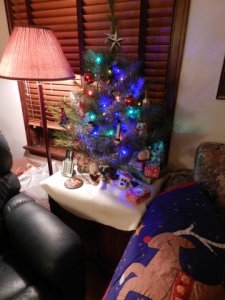
The thought of putting up the usual full-size live and messy tree was overwhelming. As in emotional breakdown overwhelming. So I stuffed the three-foot office party Christmas tree into the back seat of the car, ornaments and all, and brought it home to set on an end table in a dark corner. “See, it doesn’t look bad at all at night,” I pleaded with my girls, hoping they’d agree to toss tradition to the winds and accept this little faker. They took pity on me (they didn’t want to take over the work, not for just a week of tree enjoyment). I felt guilty, but I got over it.

Talking to others who have had to change their Christmas traditions made me feel better. I remembered that it’s okay to alter the old ways or make do with less to accommodate new conditions. Conditions may be permanent, like kids growing up and having families of their own and other places to visit, and some are one-off like having to deal with a family or business issue that pops up. Adaptability is the key to less stress, letting go of expectations and grabbing on to what makes the most sense.

Hope you all are having a wonderful holiday, of altered traditions or not. I like this little fake tree!

DSCN2136

Posted in holiday, traditions | Tagged , | 3 Comments

Pearl Harbor and war memories

Today is Pearl Harbor Day. My Japanese mother was sixteen years old then, living outside of Tokyo, and had no idea what was in store for her…

Recently I attended a powerful book release event. The venue was filled with war veterans, from those quite young who had been to Iraq or Afghanistan to the elders, including a white-haired Vietnam vet with a denim jacket emblazoned on the back with military patches. They were there to read their stories, and hopefully the audience had brought Kleenex.

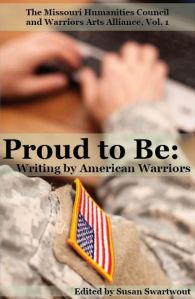
Proud to Be: Writing by American Warriors, an anthology of stories written by war vets, is the result of one woman’s persistence. Deborah Marshall, President of the Missouri Writers Guild, believed in the power of writing to help heal the spirit and thought that our war veterans’ voices ought to be heard. She founded Warrior Arts Alliance and arranged poetry workshops at Jefferson Barracks in St. Louis. Then she had an idea for a book. The Missouri Humanities Council joined in her vision and Volume 1 of Proud to Be:  Writing by American Warriors was born.

I was at the event only long enough to hear a handful of stories, all told with voices that cracked in pain somewhere or another along the battle lines of sentences. One fresh-faced, confident young man who looked like a kid in college amused us with his wit until he faded, describing how he joined a Gulf War veterans parade only to feel small and unworthy even among his military peers. “How could I, at 20 years of age, be in the same category as all those venerable old men of The Greatest Generation and the crotchety Vietnam vets on the bus?” He, Colin Halloran, was injured and couldn’t even finish one tour. He was “No Hero.”war veteran

A “crotchety” Vietnam vet stood up, the one with the jacket patches and the white head like an eagle, to tell us he was “Between Wives.” Pain broke through his eloquent belligerence as he explained how war can take away the ability to get emotionally close to someone. Describing a fellow Vietnam vet friend, Jay Harden read he “knows he is forever separated from his living gifts to the world [his children] by a chasm of combat consequences so violent, so vast, so beyond their experience, they can never comprehend or even offer forgiveness.” I pulled out a Kleenex for one of the most raw and poignant essays I have ever heard.

Lauren K. Johnson read about living under “A Rock Called Afghanistan.” About coming home the summer of 2010 to discover this “shocking” Lady Gaga and being the “last person in the universe to learn the name Justin Bieber.” About missing the earthquake in Haiti and finding her sister suddenly with six-month-old twins. About how she and the world had aged a year, “But we had grown up separately. We no longer recognized each other.”

There are a lot of stories and a good number of poems in Proud to Be: Writing by American Warriors. Listening to these few, I saw how it took guts to write them, for these vets to dig into their pain and find the words for it, to dare to share their secrets, worse yet to read them in front of a roomful of others. I have a lot of respect for military vets anyway, but it grew that night.

Interestingly, most of these stories are by vets who are writers, some with MFA degrees. Their bios seem to indicate they took writing classes after they came out of the military. Does war bring out the writer in a person? Maybe war experiences make a person think about big questions in life and writing it all down is a way to process what happened.

Geoff Giglierano, Executive Director of the Missouri Humanities Council, wrote in the foreword that he had once interviewed over 100 WWII veterans for a museum exhibit. He said often he found he was the first person to hear the stories, almost 50 years after they happened. Imagine keeping something bottled up inside for that long.

Proud to Be: Writing by American Warriors

Posted in book talk, war stories | Tagged | 4 Comments