
Today is Pearl Harbor Day. My Japanese mother was sixteen years old then, living outside of Tokyo, and had no idea what was in store for her…
Recently I attended a powerful book release event. The venue was filled with war veterans, from those quite young who had been to Iraq or Afghanistan to the elders, including a white-haired Vietnam vet with a denim jacket emblazoned on the back with military patches. They were there to read their stories, and hopefully the audience had brought Kleenex.
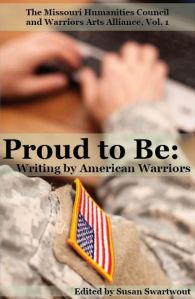
Proud to Be: Writing by American Warriors, an anthology of stories written by war vets, is the result of one woman’s persistence. Deborah Marshall, President of the Missouri Writers Guild, believed in the power of writing to help heal the spirit and thought that our war veterans’ voices ought to be heard. She founded Warrior Arts Alliance and arranged poetry workshops at Jefferson Barracks in St. Louis. Then she had an idea for a book. The Missouri Humanities Council joined in her vision and Volume 1 of Proud to Be: Writing by American Warriors was born.
I was at the event only long enough to hear a handful of stories, all told with voices that cracked in pain somewhere or another along the battle lines of sentences. One fresh-faced, confident young man who looked like a kid in college amused us with his wit until he faded, describing how he joined a Gulf War veterans parade only to feel small and unworthy even among his military peers. “How could I, at 20 years of age, be in the same category as all those venerable old men of The Greatest Generation and the crotchety Vietnam vets on the bus?” He, Colin Halloran, was injured and couldn’t even finish one tour. He was “No Hero.”
A “crotchety” Vietnam vet stood up, the one with the jacket patches and the white head like an eagle, to tell us he was “Between Wives.” Pain broke through his eloquent belligerence as he explained how war can take away the ability to get emotionally close to someone. Describing a fellow Vietnam vet friend, Jay Harden read he “knows he is forever separated from his living gifts to the world [his children] by a chasm of combat consequences so violent, so vast, so beyond their experience, they can never comprehend or even offer forgiveness.” I pulled out a Kleenex for one of the most raw and poignant essays I have ever heard.
Lauren K. Johnson read about living under “A Rock Called Afghanistan.” About coming home the summer of 2010 to discover this “shocking” Lady Gaga and being the “last person in the universe to learn the name Justin Bieber.” About missing the earthquake in Haiti and finding her sister suddenly with six-month-old twins. About how she and the world had aged a year, “But we had grown up separately. We no longer recognized each other.”
There are a lot of stories and a good number of poems in Proud to Be: Writing by American Warriors. Listening to these few, I saw how it took guts to write them, for these vets to dig into their pain and find the words for it, to dare to share their secrets, worse yet to read them in front of a roomful of others. I have a lot of respect for military vets anyway, but it grew that night.
Interestingly, most of these stories are by vets who are writers, some with MFA degrees. Their bios seem to indicate they took writing classes after they came out of the military. Does war bring out the writer in a person? Maybe war experiences make a person think about big questions in life and writing it all down is a way to process what happened.
Geoff Giglierano, Executive Director of the Missouri Humanities Council, wrote in the foreword that he had once interviewed over 100 WWII veterans for a museum exhibit. He said often he found he was the first person to hear the stories, almost 50 years after they happened. Imagine keeping something bottled up inside for that long.



 moonbridgebooks