An almost-memoir immigrant story, Girl in Translation

Jean Kwok was in St. Louis the other day to talk about her bestselling debut novel, Girl in Translation, recently released in paperback. In a personable style peppered with humor, she presented the true story behind the book, which is a horrifying immigrant tale of a mother and young daughter coming from China to a better life in the U.S. The “better” life turns out to be working in a sweatshop garment factory and living in a roach-infested tenement. Ms. Kwok related that her descriptions of the stifling hot factory, steam venting from pressing machines into a big concrete room with windows shut and blocked against prying eyes, fabric dust everywhere, and the trashed and beaten, bug-covered apartment were exactly as those her family worked and lived in. This was in the 1990s in New York. Jean went to the factory every day after school until she went off to college. Audience mouths fell open in shock. Fortunately, the young protagonist(Kimberly) – and Jean herself – were blessed with school smarts which helped them escape from poverty and the grinding slave work for pennies. As Kimberly comes of age, she must decide between two young men and the different paths they will take. Jean married a Dutchman and now lives in the Netherlands.

Jean wrote Girl in Translation for three reasons: to let others know what it is like to be an immigrant lost in a new country and language, to encourage others to look beyond the curtain of differences that separate them from immigrants, and to commemorate the struggle of her life and the lives of her mother and brother who worked so hard and held the family together. Jean’s older brother was also brilliant in school and pulled himself out of poverty through education. He saved his pennies to buy her the gift of a blank diary, which started her on the path of writing: “Whatever you write belongs to you,” he said to a little girl who had nothing. I asked Jean if she had considered writing her memoir versus a novel, and what made her decide to write her story as fiction. Her answer was one my own mother had to overcome:  she was ashamed of her rough early life. Jean laughed as she told us she thought she could hide behind the fiction, that no one would know she used her real life as a basis for the story. And maybe we would never have known except she had become rightfully proud of overcoming adversity. She also had a message for the world, particularly one for insular Americans, many of us having no clue what it’s like to be suddenly and permanently immersed in an alien culture where everyone is speaking apparent gibberish and impatient for you to understand. Add being trapped in poverty to that equation. Jean also knew she needed a good plot, and there was freedom in being able to deviate from the truth. A book that will sell well, and thus pass its message on to more people, must have a well-developed and entertaining storyline (Jean also praised her very critical editor). I can’t wait to read Jean’s book. The first chapter is great.
Posted in book talk, multicultural | 3 Comments

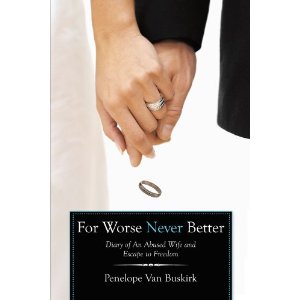
A Domestic Violence Memoir: For Worse Never Better

Penelope vanBuskirk knows what it’s like to run for her life. She suffered both verbal andphysical abuse at the hands of her husband for nearly eighteen years. I justfinished reading her memoir, For Worse Never Better, appropriate for Octoberwhich is Domestic Violence Awareness Month. Penny* is one of the luckysurvivors as many women who try to escape are murdered, sometimes along withtheir children, by their enraged husbands. As Penny says of her ex-husband, “Heis now deceased. I am alive. I always thought it would be the other wayaround.”

For Worse NeverBetter: Diary of an Abused Woman and Escape to Freedom helps readers understand some of the reasons women put up with spousalviolence. Penny is not the stereotypical abused wife, beaten to a mere shadow.She is feisty and headstrong; she says that was her defense against adomineering father. That feistiness also makes it seem odd that she would staywith a violent man, until we see the rest of the story. Penny was neitherperfect nor always wise, sometimes pushing her husband’s hot buttons on purposein response to her frustrations with his cheating, his bossiness, his refusalto let her have any choice in what should have been family decisions. It ispainful to read how he beat her, and how—ever loyal, ever hopeful—she coveredup for him, lying about the bruises, “I didn’t hold on to the stair rail,” “Mommygot hit by a ball.” It is infuriating to read how he spoke to her, “Where thehell’s my dinner”—accusing, dominating, belittling—while she tried to salvageher self esteem.

Penny’s bookgrabbed me by the collar and pushed me to the end. My forgotten tea grew cold.I had to see how she escaped to write the book. At what cost, and what happenedto her little girls, the friends who tried to help? Wasn’t she afraid to writeher story? The book is not all doom. There are many happy moments mixed in,many times when love is strong and beautiful. They make the spider sweet, theweb sticky and complex. Penny does well at creating setting and expressing her thoughts. Her sharp sense of humor, which helped her keep going during the abuse, shines through. A number of typos didslip by, like small stones in a whitewater river. The end is satisfying, with atwist of smile.

Penny kept a diarythroughout the abuse. It is the basis for this cathartic book which she dared to write onlyafter her husband died. Of course, all names have been changed to protect theinnocent as well as the guilty. While Penny feels emotionally healed for the most part, she suffers permanent physical damage that worsens with age.

Penny now works with a shelter for women and hopes her book will give abused women “a mirrorof hope, understanding and strength. The book is also a must-read for anyonewho knows an abused woman. For Worse Never Better is available on Amazon inprint or e-book, but Penny will receive more dollars from a print copy sale ifit is through Authorhouse, and 50% of proceeds will benefit Chrysalis, aservices organization for victims of domestic violence. Visit Penny’s Live Free website to find articles, resources, and a link to her blog(Surviving Domestic Violence). Thank goodness there is help now for abused women (and men), unlike during the years when Penny was suffering.

*Due to the publicnature of online articles, the author’s nickname has been altered to a commonspelling to help maintain her privacy. Her current last name is unknown to most of those who knew her during the abusive years.

Posted in bad memories, book reviews | Comments Off on A Domestic Violence Memoir: For Worse Never Better

A Study for Memoir Writers: Night by Elie Wiesel should have been darker

Finally, I have read Elie Wiesel’s famous memoir Night, his harrowing story of survival through several WWII Nazi concentration camps. How interesting that no publisher wanted the 245-page memoir (originally titled And the World Remained Silent) because it was too dark! Who wanted to read about such “morbid” stuff. Finally it was chopped into books half the size of the manuscript and published in Spain and then France, not reaching the U.S. until 1960 where it languished until we caught on to its importance and turned it into required reading by many schools. The book has never won an award, although Wiesel has been honored many times.

I read the newer 2006 translation of Night by Wiesel’s wife, which is said by reviewers to be more poignant than the previous clipped versions. I still felt it was somewhat wooden and that so much detail was left out as to be confusing in many instances. Only Wiesel knows what the original Yiddish manuscript held, but perhaps it held no more detail than the hyphenated, translated versions give us. How many of us can remember exactly what happened and all the details of a traumatic event, not to mention even the everyday events? What did you have for dinner last Monday?

It is interesting to me how the first half of Night seems distant and sparse — as though the author were numb, which perhaps he was. He was also a new writer. The second half is a little better, as though another writer took over to bring in some feelings and some exploration of inner thoughts. Here is where the book starts to shine. And this is what would make it an interesting study for memoir writers. Examine the differences between the halves so you understand the importance of bringing yourself deeply into your memoir, not just reciting the facts of what happened but letting readers into your psyche and what you were thinking. I can deal with incomplete events and details, but I want to hear what’s going on in your mind because that’s what separates dry history from vivid memoir. Tell us how you wish your father was dead so you could be free to struggle for your life without worrying about him, too; tell us why you lost your faith in God and how that affected you.

Night is thought to be fictionalized, although Wiesel is said to become angry when questioned about it. Even if parts of it are, they do not detract from the truth of what happened. Wiesel did not lie to make better sales, he probably embellished to give us a better understanding and more flowing account of how hideous the Holocaust was. It was hideous, and that is the truth. Its most important lesson, as Wiesel tells us, is that “Silence encourages the tormentor, never the tormented.” While the memoir could have been better, it still stands iconic in that it was one of the first Holocaust memoirs to be published.

Your story is important, too, even if someone says it could have been written better.

Linda Austin
“Cherry Blossoms in Twilight”
http://www.moonbridgebooks.com

Posted in book reviews, writing skills | Comments Off on A Study for Memoir Writers: Night by Elie Wiesel should have been darker