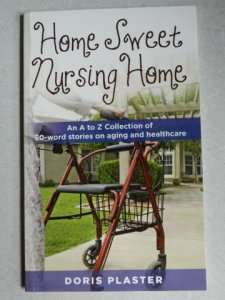
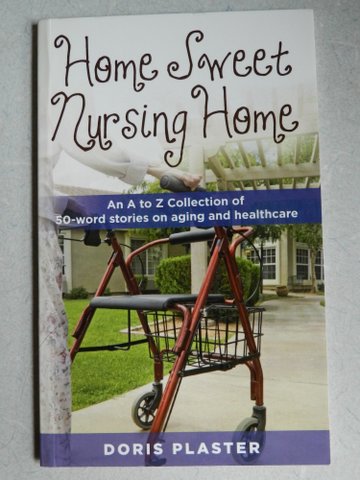
Pat Robertson was in the news recently for saying Alzheimer’s was “a kind of death” so it would be okay for a man to divorce his dementia-disabled wife and marry someone else –but, he should at least arrange for her care. While this may sound harsh, there are many people who won’t bother to visit an elderly, disabled relative because it’s too depressing, they don’t want to make the time, they don’t have patience, or they think the person wouldn’t notice anyway. On the other hand, there is Doris Plaster, a Licensed Clinical Social Worker who has enjoyed working with the elderly for eight years now. Last year she started a blog and began writing about some of her nursing home experiences with residents, maintaining their privacy by changing names and genders or creating composite characters. This year she has a book out, Home Sweet Nursing Home, of super-short stories based on those experiences, and they are spot-on. Anyone who has spent time visiting a loved one in a nursing home will love this sweet little book. I am so pleased Doris agreed to discuss her work with me.
*****
Doris, my mother has Alzheimer’s and is in a nursing home, and I think the staff there are all angels from heaven. Working with elderly dementia patients, who are usually physically disabled, too, is rough and requires a whole lot of patience and understanding. What is it about your job that you like?
I am passionate about working with the elderly population. When I started my practice as a social worker, Geriatrics was not of my interest. Back then, Youth and Communities were my preferred areas of intervention. But eight years ago, when I was unexpectedly offered a job in a nursing home, my career took a drastic turn. It was as if I had discovered an unimaginable treasure in my professional path. I found out my elderly patients had vast and rich experiences I wanted to learn about, and determine how that past could help them to deal with their present challenges. I learned that in each elderly nursing home resident there was a fascinating world to unveil and understand, especially with those residents with dementia, and I wanted to help them find meaningful moments in the last days or years of their lives.
Your blog posts are sensitive and caring. I can tell you must be well-loved by your patient friends. What made you decide to write your blog, and ultimately your book?
One day, while observing a nursing home resident with dementia who was having a moment of increased restlessness and confusion, I began to see more than just a demented elderly man. I focused on the person that was still there, his essence as a human being, as the father and husband he was, the neighbor and friend he was to others. I saw a respectful, caring, and prideful man behind that facade of mumbled words. The interaction with my resident that day touched me emotionally, and I thought that maybe I should write what I was seeing, not in an academic language, but in the form of stories that anyone could understand, and possibly project the same feelings of compassion and caring I was experiencing. That’s why I started blogging in 2010, posting inspirational stories based on true situations in the nursing home.
My book, Home Sweet Nursing Home, was an unplanned publication. The collection of stories was part of a blogging project in which the participants were to post daily for a month. Wanting to take part in that writing challenge, I opted for writing 50-word stories since I wouldn’t have the time to work on longer stories. At the end of the writing challenge, I received a lot of compliments, and my list of followers and readers increased tremendously. Some of them suggested that I publish the collection of stories since they were so unique and well-written. After giving it some thought, I finally decided to do it. That was an interesting path into the world of writing and publishing. Another world I have discovered now.
It’s amazing how each story in the book is like a flash of light illuminating a scene for just a second, leaving us with something to think about. You’ve got a setting, an action, and then that clever twist at the end. Have you studied writing? What made you think to write your book as super-short “flash” pieces versus short stories?
I once read a couple of interesting 50-word stories, and I was amazed at how with such limited number of words someone could actually assemble a story with characters, a plot and a surprising end. I thought I’d try that technique on my A to Z writing project, plus I added dialogue. I haven’t formally studied writing. English is actually my second language. But I like to read a lot and I began to explore the craft of writing by reading, attending a local writers’ guild and interacting with writers through blogging.
Some of these stories are pretty funny, some poignant, some disconcerting. Even though I had to laugh at Mrs. Miller telling her aide to go get herself a blob of green goo if she thought it was so yummy, you tell these stories with obvious respect and love for the residents. You also have a story about a husband and his Alzheimer-affected wife. What would you tell Pat Robertson about patients with advanced dementia?
I understand the stress that caregivers experience when their loved ones have Alzheimer’s or any other type of dementia. Life and marriage is not the same, and will never be the same. But the loved one with dementia didn’t choose that path, neither the loved one who was diagnosed with cancer, or with multiples sclerosis. The difference is that the loved one with advanced dementia cannot understand what is happening, cannot rationalize about his/her situation. That makes the loved one with dementia a more frail and vulnerable person and patient. He/she needs love, support, companionship, the touch and voice of the people that have been part of his/her life. Abandoning a loved one with advanced dementia is an unkind act. Rev. Robertson may want to find in Alzheimer’s an excuse for that husband to compensate for his guilt-ridden decision to move on, but the only one he is fooling is himself.
*****
Doris’s stories remind me of my own experiences visiting with my mom and her friends in the nursing home. As Doris said, each person there has vast and rich experiences — experiences to fill a lifetime. They are worth asking about and writing about. I loved Doris’s book. My only complaint is that her book is so short – just 26 stories, one for each letter of the alphabet, beginning with “A for Alzheimer.” I hope she writes a longer book next time, but in the meantime, we can enjoy her blog stories at Hold My Hand, A Social Worker’s Blog. Bless you, Doris, for all you do.
(Special thanks to personal historian Wayne Groner for introducing me to Doris and her book via his blog, Your Memories, Your Book




 moonbridgebooks