The Postmistress and memoir writing

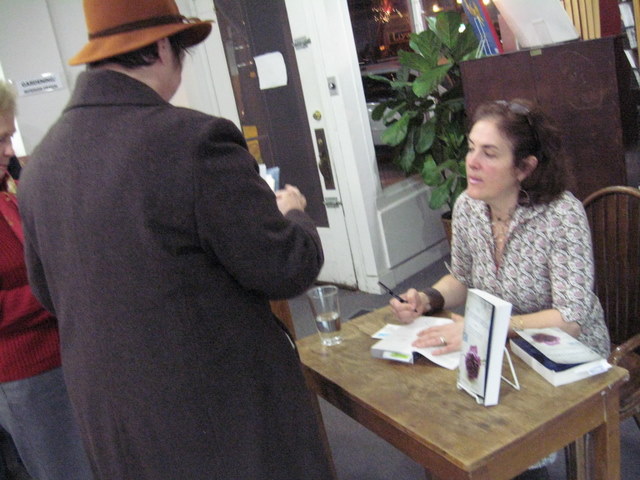
http://rcm.amazon.com/e/cm?t=cherrybloss03-20&o=1&p=8&l=bpl&asins=0425238695&fc1=000000&IS2=1&lt1=_blank&m=amazon&lc1=0000FF&bc1=000000&bg1=FFFFFF&f=ifrA few days ago, I went to see Sarah Blake, author of the bestselling book The Postmistress, at one of our local independent bookstores. I had just started reading this book about WWII on the European front and at home in small-town America, and was quite engrossed already. Sarah explained how her book somehow put itself together over the ten years she wrote it, no plan in mind to start. Then she read a chapter about the woman war correspondent, Frankie, who works with Edward R. Murrow, finding herself one moment at a bar dancing with a stranger and the next emerging from a bomb shelter with a newly orphaned boy. So poignant, her words taking their time uncovering intimate details of the scene yet insistent with trepidation and anxious waiting. The audience seemed to hang onto her words, breathing in their meaning until the silent end. And to think it all started with Sarah wondering if the postmistress of her tiny New England town ever read other people’s postcards on the sly, and if she did, did she whisper the details to others or keep them to herself.
In an interview with NPR, Sarah spoke of Edward R. Murrow’s power—his “ability to bring home the war in tiny details, to give the human side, but stay neutral.” He simply told stories of the voices from the street—the real stories of what was happening in faraway London during the Blitz. And I thought of my ghostwriting, which is telling the stories of everyday people, but staying neutral to let their voices and opinions come through without my own lens distorting to reflect what I think. In The Postmistress, reporter Frankie has a difficult time being neutral, until she finally loses her voice from the madness of not telling everything she knows and feels. (Not a spoiler: this is not the end of the book.)

Edward R. Murrow changed the way news was reported. By bringing home those little bits of real people stories to the Americans back home, he was able to give them something personal to relate to. Not the big picture of horror that was too large to grasp without seeing, but the intimate stories that burn in people’s hearts. And so it is with lifewriting and memoir—taking history and making it small and real to strike the hearts of those who hear. Murrow’s reporting technique also let the American people understand the gravity of the war they would soon join at a time when news was censored to avoid panic, but that’s a different story.

Posted in book talk, history | 3 Comments

Black History Month and The Warmth of Other Suns

February happens to be Black History Month, and I happened to read a little book called Suitcase Full of Dreams, a memoir of a girl growing up in the 1940s-50s deep in Jim Crow South—Mobile, Alabama. Author Hoy Kersh tells her stories with the flourish of a poet. Her glorious wording sometimes distracts from the poverty and injustice she and her family and friends endured, but she was a child who could not be pushed down, and reveled in the simple glories of nature and mischief. She became more and more rebellious to the unfairness and meanness she saw in the white people around her, yet she saw that not all were against her; they were just as constricted by the rules as she was. The bravery of the civil rights leaders inspired her, and the call of the northern states pulled her, at age 16, onto a train for Chicago. There the book ends, waiting for Part II to be written.

Suitcase Full of Dreams was a preview to a recent event here featuring Isabel Wilkerson. She was in town to speak of her experiences writing The Warmth of Other Suns, a current best-seller about the great migration of black people from South to North and West over several decades, ending in the 1970s when things in the South started to change. Ms. Wilkerson was a joy to listen to, very articulate and funny. Oh she had stories, from over 1200 interviews with migrants. Her own parents were migrants who met in Washington, D.C. The full-house audience was transfixed at tales of separate Bibles in courthouses, the no-passing-white-folks rule for Negro drivers, and invisible rules that could get a person killed if they failed to obey them. Other Suns follows three different people from three different states in three different decades as they left the South for three different northern cities. Wilkerson discovers they were not much different from immigrants that come to America looking for a better life. Did they find their dreams? Not always.

Wilkerson said, “I had a great job [Chicago Bureau Chief of the New York Times]. Why did I quit and go into a cave for ten years to do this book? Because I wanted to recognize what it took for us to get here… to honor those before us.” And that’s what memoir is all about: honor and respect for those who came before us, and learning where we came from. Wilkerson told us, “Ask the questions. It validates [our elders] and their experiences.” She inadvertently rebuts Neil Genzlinger’s January 28 snarky New York Times op-ed of memoirs where he says, “There was a time when you had to earn the right to draft a memoir… Unremarkable lives went unremarked, the way God intended.” Wilkerson and Kersh prove with their books that unremarkable lives are well worth remembering, the way God intended.

My book review of Suitcase Full of Dreams is posted on Amazon, but also in The New Book Review, where small and indie press books get reviewed, too. Scroll around to see some of the other books reviewed there.

Posted in book talk, multicultural | Tagged | Comments Off on Black History Month and The Warmth of Other Suns

Personal Historian Wayne Groner

Today I have ghostwriter and lifewriting coach and teacher Wayne Groner posting on how he became interested in writing memoirs and helping others write theirs. I “met” him through the Yahoo group, Lifewriters Forum and we share a similar passion. This week we are sharing our stories via each other’s blogs. You’ll see that once you start writing life stories, you can’t quit! And Wayne has turned his fun into a business helping others.

* * * * *

I embrace all of the reasons for writing family memoirs: personal satisfaction, set the record straight, honor family members, healing, make a permanent record, leave a legacy, and many more.
I started when my longtime friend Dorsey Levell approached me early in 2008 about the fortieth anniversary celebration planned by the Council of Churches of the Ozarks, Springfield, Missouri for the fall of 2009. He thought it would be an excellent time to write a history of the Council from his perspective. The book became a combination corporate history and memoir.

Dorsey retired in 1999 after thirty-one years as the Council’s founding executive director. He and I wrote a book that same year to help pastors and other church leaders fund ministries (we both have backgrounds in fundraising). With that book in our resume we were comfortable proposing to the Council that we write a history for its fortieth anniversary. The Council agreed to be the publisher and we agreed on payment for our work. Dorsey’s name would be in large type as the author. My name would be below his in an “as told to” line.

We did a series of fifteen recorded interviews which became the basis of a manuscript. We also interviewed more than twenty-five key players in the Council’s history. Throughout the interviews, Dorsey kept using the phrase “dumb luck or divine guidance” to refer to his successes. We turned that into the title of the book, Dumb Luck or Divine Guidance: My 31 Years with the Council of Churches of the Ozarks. Dorsey tells his story in a folksy, easy style with deeply personal accounts of his successes and failures. Readers have told us the book is like talking with Dorsey over a cup of coffee, which is great because that’s exactly what Dorsey is like.

The book was a lot of fun to do and I wanted to do more. I joined the Springfield Writers’ Guild and the Missouri Writers’ Guild to let other professionals know of my interests in writing memoirs. I started a website and a blog, had business cards printed, and ordered retractable ballpoint pens with my contact information. In 2010 I began teaching a monthly library class, “Writing Family Memoirs for Fun and Profit.” My students keep me sharp and often send me for more research.

Of all the reasons for writing family memoirs, the one I like most is that it’s fun.

Wayne E. Groner lives in Battlefield, Missouri. He is the author of three books and numerous magazine articles; a speaker, writing coach, and workshop presenter. Stop by his inspirational blog on life writing, Your Memories, Your Book.

Posted in memoir writing | Comments Off on Personal Historian Wayne Groner