National Poetry Writing Month – Day1

I have signed up the Cherry Blossom Memories blog to the NaPoWriMo site. I can’t believe I did this. This means I am publicly committed to writing one poem a day for each day this month, National Poetry Writing Month. Now, I do write a lot of haiku, but I don’t like feeling I HAVE to. I mean, creativity must be inspired, right? Except if you ask professional writers, they don’t wait for that special moment; they work every day writing whether they feel like it or not. Just like we go to our everyday jobs whether we feel like it or not. And so it is with you who are inspired to write your lifestories. Get busy. Write something every day or at least one day a week. On schedule. And I will try to write a memoir poem a day. Here goes. And I don’t do rhymes.

Am I an April fool,
Signing up to write a poem a day
When I really am so busy
I sometimes can’t think straight?
But maybe in poetry
One doesn’t always have to think straight.
Usually it’s the crooked line
That’s most interesting.

Posted in memoir writing, poems | 3 Comments

Japan Earthquake-Tsunami relief and remembering

During the Kanto earthquake of 1923, my Japanese grandmother rushed to the bamboo forest with her babies, thinking the fibrous mass of roots would keep the earth from cracking open. I doubt if that would stop the giant shifting of the earth, but she did survive to tell the story to my mother, who was born two years later. I know my relatives are safe, being west of Tokyo, however I can’t speak Japanese so I’ve arranged for a friend to call them, mostly to let them know we are thinking of them.

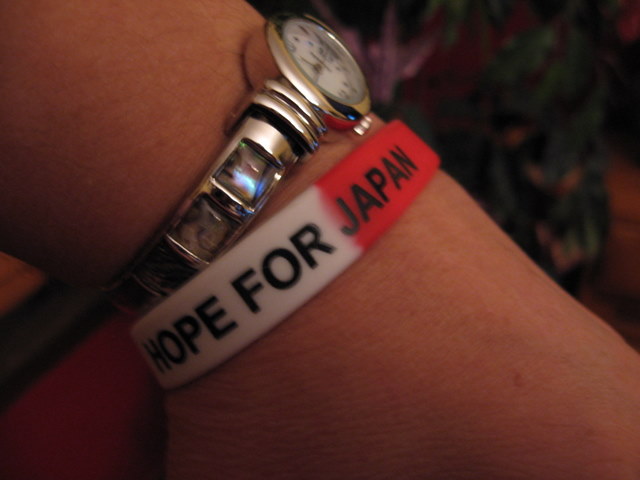
We are doing what we can for Japan. I’m involved in local Japan-America groups and we’re all brainstorming fundraisers. Many university student groups are selling rubber bracelets, while others are putting together dinner events or creating graphic arts items to sell. A group I am a member of is providing bracelets to local schools so the kids can have their own fundraisers, and we are donating to our Japan America Society St. Louis earthquake fund. Students from one university immediately created handmade cards to encourage the Japanese people. Wells Fargo and Novis International are coming through with large donations. Wasabi Sushi in the St. Louis area and in Colorado is donating all March 30th dinner meal proceeds.

President Obama told Prime Minister Naoto Kan that the United States was ready to send assistance. He said, “You know, I’m heartbroken by this tragedy. I think, when you see what’s happening in Japan, you are reminded that, for all our differences in culture or language or religion, that ultimately, humanity is — is one.”

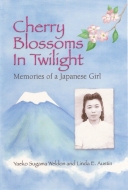
Obama spoke the message of the book I wrote with my mother. I am offering proceeds from sales of my mother’s story, Cherry Blossoms in Twilight, about her life around WWII in Japan, to Save the Children’s Japan aid fund. Orders must be received via the PayPal button on the Moonbridge Books website. This story also shows the humanity of all peoples, even those we think of as the enemy. After WWII, the U.S. became the friend of the Japanese people, helping them rebuild after disaster just as the U.S. offers to do again after a different kind of disaster.

It is so heartwarming to hear the encouragement of the world yet again as yet another horrifying disaster unfolds. For all our arguing and fighting, for all our differences in opinion, underneath we all laugh and cry the same. But it is when we cry that our eyes really open to our love for each other as brothers and sisters in this life together. Earthquake-tsunami stories will not be pleasant, but the memories of help from strangers will be treasures.

Posted in Uncategorized | Comments Off on Japan Earthquake-Tsunami relief and remembering

Joyce Carol Oates and the healing memoir

Joyce Carol Oates was in town last week to talk about her memoir, Widow’s Story. Her hand was probably still tingling from shaking hands two days earlier with President Obama as he awarded her a National Humanities Medal for lifetime literary achievement. “He’s tall,” the diminutive Oates was awed. “And Michelle is even taller.” But Oates was impressed, too, with her St. Louis event—her first book event during a tornado watch—with nearly a full house at the large library despite the sudden dump of rain that left me to sit with the front of my pants sopping wet. If only I’d arrived two minutes earlier.

I am not a fan of Joyce Carol Oates. Her books are full of violence and the dark side of life, just not my reading style. But I was curious about her sudden turn of topic to a genre I read a lot of. And how could I pass up a chance to hear what a literary giant had to say? So I braved the storm.

This literary giant from the East Coast is slightly built, frail looking, but her thin voice read the death scene of her husband of 47 years with barely a stutter, and surprisingly no tough East Coast accent. Ray died two years ago, while recovering from pnemonia in the hospital, from sudden onset of secondary infection. Oates read from the book about the “memory pools.” “Forever after you will recognize those places—previously invisible, indiscernable…” which are the corners, the rooms, the halls where the mind will fill with remembrances of moments, of smells, of feelings. She continued to read to us several super-short, rambling yet raw and insightful—and occasionally amusing—chapters (essays?) of how her life as a widow began.

Oates said the book started out as journal entries, written every night when she couldn’t sleep, as a way of making sense of the crash of her life. She explained, “You write something about what’s haunting you, what you really care about.” She recommended everyone keep a journal, especially those who have busy lives, because it’s a way to remember what happened and how you felt about things, because otherwise you forget and the years pass by. Widow’s Story contains pieces from her journal, but she came back later to explain them, since a journal does not make a book, thus the smattering of italics in third person that some readers have complained about. Also included is “real writing” of the history of the relationship, and e-mails.

Joyce Carol Oates thought her feelings during new widowhood were not particularly normal: anger (“how can I forgive you, you’ve ruined both our lives”), a need to be punished, instead of becoming fearful she didn’t seem to care about her safety or health. She intended to write a book of survival tips for widows, but instead ended up with not just a memorial to her beloved husband, but a book that could help other widows (and widowers) feel not so alone. I recommend Widow’s Storybecause it will be helpful to many of us when our own time comes or when our friends face this, and because it is written in the beautiful literary style of Joyce Carol Oates.

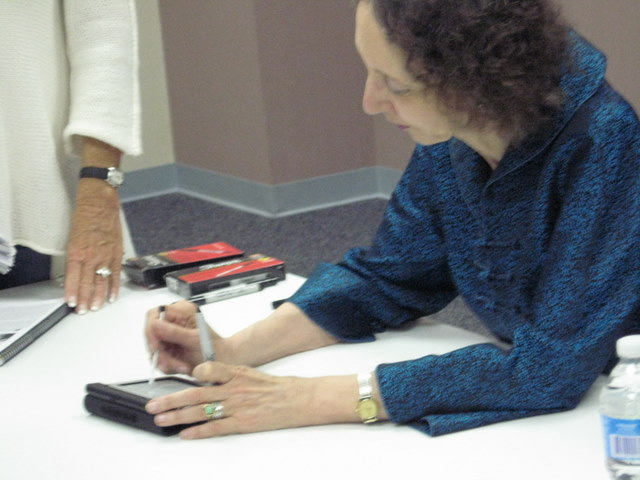
Joyce Carol Oates signs an e-book page on a Sony e-reader.
Posted in death, journal | 4 Comments