A Novel Thought About Fake Memoirs

Ben Crair, assistant editor of The Daily Beast, recently mused about the state of memoirs in his article “Who’s Afraid of Fake Memoirists?” Some may speculate that this age of materialism, of the quest for fame through any means, has contributed to a rash of literary exaggerations and embellishments-gone-too-far. But Crair speculates, “Maybe now, with new tools at our disposal, we are simply detecting a condition that has long gone underreported. Maybe the symptom of our age is not the fake memoirists themselves, but the catching of fake memoirists.”

That leads us to a sticky ball of wax rolling down the hill. Yeah, so what about those older memoirs? Are they totally true in the authors’ eyes, and does it matter to us now? Should we go back and try to fact-check them? Is Winston Churchill’s six-volume Memoirs of the Second World War totally truthful or is it a political ploy and public relations stunt? I would argue that, yes, we would be annoyed to find fakery in Confessions of an English Opium Dealer (Thomas deQuincey, 1821). Anyone, from long ago or recently, who embellished their memoir to the point of it becoming a novel deserves to be outed. Their book will still have value, as James Frey still has fans, but readers deserve a warning notice. A memoir that attempts to perceive history to one’s benefit is another story (and often someone else produces a book or essay to refute it – In Command of History: Churchill Fighting and Writing the Second World War, by Charles Jeanfreau).

Many modern memoirists are unafraid to throw every sordid detail of their lives into the public eye in an attempt at fame. (Did Madonna start this trend with her do-anything-for-attention, shove-the-envelope actions?) In Inventing the Truth: The Art and Craft of Memoir, William Zinsser compares older memoirs such as Angela’s Ashes (1996) with the new memoirs, “The national appetite for true confession has loosed a torrent of memoirs that are little more than therapy” or “self-indulgence and reprisal.” He goes on to state that a good memoir elevates the past to a larger truth. Amen.

So what’s the line between a novel and a memoir? A good novel strives to become a memoir, and vice versa – both must make the reader feel part of a reality – but, a memoir is a true reality, a true remembering – right or wrong (does that make sense!?). Ben Crair thinks that nowadays, in light of the many fake memoirs out, “If anything, you could argue that the fact-checkers are doing too good a job. There seems to be some risk that, in attempting to hold memoirs to journalistic standards of factuality, the watchdogs miss the forest for the trees, fixating on minor details in books whose general pictures are correct.” And he has a point there.

So, the little details of a memoir should not have to be fact-checked by an investigator, it is the bigger picture that is important. Of course fake memoirs should be rooted out, but let’s not go too far overboard and toss all the babies out with the bathwater. Authors do need to be honest enough to call it like it is – a novel based on facts may not be as impressive, but it is not any less a story than the real thing, and is sometimes better than the real thing.

PS: Don’t you think even Disney movies need a disclaimer? “Pocahontas is based on a true story, but fictionalized for entertainment purposes.” I swear people will believe anything, even stories about a girl raised by wolves.

Posted in memoir writing | Comments Off on A Novel Thought About Fake Memoirs

Funny in Farsi, Gems in Japanese

I finally got around to reading Funny in Farsi by Firoozeh Dumas. This Iranian-born woman regales her readers with tongue-in-cheek stories about growing up in a family of immigrants struggling to make sense of the U.S.A. From getting her reputation as the best key-chain maker in the family, to being horrified by her Muslim father’s dreams of ham, to discovering America – Land of the Abundant Free Samples, the author lovingly portrays the oddities of her family as they make their way in a country so foreign to their roots.

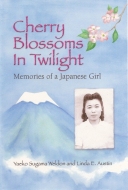
Beyond sharing laughter and culture, though, Dumas’ stories include serious illuminations such as when father Kazem expounds about religion – “You have to look and see what’s in their hearts. That’s the only thing that matters, and that’s the only detail God cares about.” Or when Dumas writes about her father, who couldn’t find a job in the U.S. because of hostilities after the Iran hostage crisis, and how he loved his native country but believed in American ideals – “He only said how sad it was that people so easily hate an entire population simply because of the actions of a few. And what a waste it is to hate…” He sounds like my Japanese grandfather whose similar words are immortalized in Cherry Blossoms in Twilight.

Yes, Funny in Farsi reminded me of growing up with my Japanese mother who survived WWII, married an American and moved near Chicago. Like Firoozeh, I thought my immigrant parent was “not with it.” How odd were her ways compared to my friends’ mothers! Unlike Firoozeh, I did not know much about the “old country” social ways, nor did I completely understand how poverty had affected my parent. It wasn’t until I was an adult that my mother’s stories went beyond simple childhood fun and festivals. It wasn’t until then that I heard the wisdom of my long-gone grandparent’s – “It doesn’t matter what your religious belief, as long as you are facing your god. That’s more important than my religion or your religion.” And “Don’t hate anyone, it doesn’t do any good. They are only doing their duty. This is war.” We may think our parents and older relatives are “not with it,” but pearls come in unlikely packages.

Perhaps this is why I love memoirs of those from different cultures – yes, “those people” seem so foreign, those immigrants seem backwards and funny as they make their own paths between countries – but beyond the differences is the commonality. Reading about others’ experiences is a way of sharing lives and growing bonds. And we all know this world could use more bonding!

Posted in book reviews, multicultural | 6 Comments

Miley Cyrus Too Young For a Memoir?

Singer/actress Miley Cyrus, still wet behind the ears at a mere 16 years old, is getting flack for writing a memoir. How can a kid have a life story? According to Merriam-Webster dictionary (online version) the definition of memoir is

1 a : a story of a personal experience b : autobiography – usually used in plural c : biography

Merriam-Webster people, don’t you know that a memoir is not at all the same as an autobiography or biography? The latter two are lifetime encompassing works of information about somebody’s life. A memoir is a personal reflection of only a portion of one’s life, hence Miley is quite qualified to have one. I’m sure plenty of youngsters will be delighted to read how Miley had similar experiences as they did growing up while at the same time superblasting into the teen stratosphere. Bullying, breakups, family relationships are the stuff of everybody’s lives, and plenty of writers have used those common experiences as the subject of their memoirs. So give the child a break! She’s living a life most of us older folks can’t even imagine. Miley fans will want to know how she handled her problems, what she learned, what advice she is going to give them, as well as get the skinny on what it’s like to be so young and famous. Let’s face it, Miley is a money-making machine that Disney is cranking the most out of. That’s just good business, whether you like it or not.

Did you know that many, if not most, of our kids today are writing life stories? Yes, they are – in school. Communication Arts teachers get the kids writing in daily journals at an early age. They also ask the kids to write stories about their life experiences – a trip to the zoo, getting hit with a baseball, a special birthday party. Sometimes the teachers even produce simply bound books out of their students’ stories. The kids won’t have a professional ghostwriter like Miley, they won’t have amazing tales of fame, but they do have something to say. And I think we should listen, encourage, and enjoy.

According to a 2008 MSNBC article, Miley’s memoir will actually have a lot about her mom in it. Miley says, “I hope to motivate mothers and daughters to build lifetimes of memories together and inspire kids around the world to live their dreams.” Now that’s a grown-up thought.

PS: Miles to Go has gotten good reviews on Amazon

Posted in memoir writing | Comments Off on Miley Cyrus Too Young For a Memoir?