Snow Days – Are You Too Old to Play?

Culture Feast carried a Feb 3 post, “A Grown-Up Snow Day,” mentioning the initial thrill of being able to sleep late on those rare days when your office shuts down due to weather… until you have to get up and tackle the human snow plow activities of the day, and then household chores. “What do you do on snow days?” Jenny Hammitt asks.

Most of us above the Mason-Dixon line have seen plenty of snow this winter. While some folks have had to slip-slide their way to work anyway, others are able to work from home on bad days or the office actually does shut down. Some have to stay home with kids off from school. The kids sure know how to have fun in the snow, but do you?
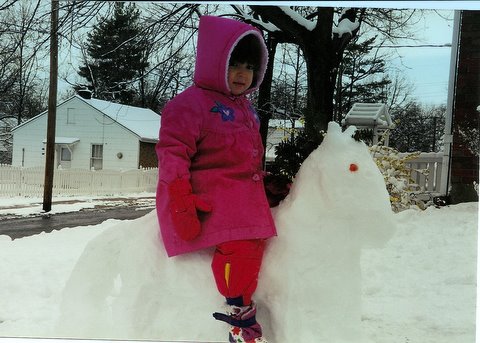
Turn loose your inner kid! After you’ve finished the shoveling and rested with a cup of hot cocoa, tea or coffee, have a little fun! Don’t you deserve it? If you’ve got kids, join them in sledding or making snowmen. Personally, I like to make snow ponies for the kids to ride on, with yew clippings for manes, but recently saw a photo online of someone’s snow kitty – how cute! One year adults joined the neighborhood kids in a big snowball fight. It’s fun, too, to put on the boots and take a walk in the snow – providing it’s not thigh-high. Our lab-mix, Buddy, loves snow and loved to participate in snowball fights and chases and go along for walks in the white stuff. He’s too old now, but still enjoys sticking his nose into the whiteness, adding to his already white muzzle.

This reminds me of the old days when I was a kid and global warming was global cooling. We had so much snow in the Midwest that most winters my dad made an igloo for us, with stairs to a steep sled run on top. Ah, those were the days.


Posted in seize the day | Comments Off on Snow Days – Are You Too Old to Play?

The Longest Trip Home – Good or Boring?

Not long ago my daughter and I saw the movie Marley & Me. I thought it was great, at least from the viewpoint of one who hadn’t read the book first. I like dogs, but mostly I like how they go home with other people, so I remained horrified by the destructive, misbehaving Marley. I do, however, have an aged and ill Labrador mix who is as mild-mannered and sweet as they come so the movie’s ending was a painful reminder of a sad day approaching. Mostly, though, I enjoyed watching the maturing of the husband-wife relationship.

So now there’s another Grogan memoir out. How many memoirs should one person write? The Longest Trip Home has disappointed some Marley fans in that there is no dog there. It has also disappointed others because it is about common life experiences…we’ve all heard about ruler-whacking nuns, voyeuristic teen boys, and young adults who abandon the religion they were brought up in. Chauncey Mabe, Sun Sentinel book reviewer, complains that the book lacks the misery of best-selling memoirs (mis-mems) such as Angela’s Ashes or Running With Scissors and suggests Grogan could have written a fictitious version – a novel – with added angst that could have better sustained interest and got the same points across about relationships. On the other hand, The Book Lady loved The Longest Trip Home, calling it “refreshing and wonderful” compared to the usual trauma-filled memoirs. She states the book is “a testament to the idea that all of our life stories are important and have something to offer.” Hear, hear. I would argue that Marley is about common life experiences, too, and the dog is what sells it so well.

So what do YOU think about Grogan’s Trip?

To read a great interview with John Grogan on BookReads, click here.

Posted in memoir writing | 1 Comment

The Great Recession, The Great Depression

So we’re in a recession that our economic leaders were afraid to tell us about for a year. Fear breeds more fear, and this reminds me of the Great Depression when fear ran rampant and helped destroy the stock market and people’s lives.

The Depression years left a huge mark that carried over to the next generation. My mother to this day hoards basics such as canned goods, shampoo and tissues – just in case. And I am like her in scraping out the contents of near-empty jars and saving leftovers no matter how small. “Don’t waste food,” I always heard growing up, as well as the implied “Don’t waste money” as my mother would drive the path from Jewel to Kroger to Honiotes grocery stores, coupons and sale papers in hand, aiming for the bargains. Many who made it through the Depression came to think that having money was most important and they would work hard and live smart so they would be ready for the next hard times and so their children would never have to go without.

A fellow lifewriting devotee queued me in on “Conversations With America,” a collection of the late Studs Terkel’s interviews with people across the country which he used as a resource for his many books and radio programs. Taken from the website, part of the Chicago History Museum site:

“Studs Terkel is regarded as the great spiritual father of oral history…his ongoing legacy is built … on his interview style and two powerful convictions that informed them: First, that the common person had profound experiences in everyday life and could speak about them in a compelling and illuminating fashion if they were asked; and second, that the American people deserved to have a voice and share with their fellow citizens their different perspectives about social injustice, civic issues, intolerance, and personal struggles.”

Terkel’s recordings used for his book “Hard Times” include an interview with a physician in a public health clinic who noted (in the second half of the recording) how the poor came as usual, the occasional rich person (now the “well-dressed destitute”) would park their fancy car down the street a bit and walk to the clinic so the social workers wouldn’t think they still had the means to pay, while the middle-class (now poor) people were too ashamed to come at all and so suffered from lack of health care. People were fainting in the streets from hunger, eating scraps from dumpsters while thousands of pounds of wheat were being dumped into the Chicago River. You will need Real Player, which can be downloaded free (see the website for a link), to listen to these interviews.

The interviews are historic and priceless, but you probably have some historic and priceless memories locked up inside your own parent or grandparent, aunt, family friend or neighbor. Or maybe there is treasure within your own memories. Is it story time?

Posted in history, memories | Comments Off on The Great Recession, The Great Depression