National Lifewriting Month – ask a veteran

A few weeks ago I attended a showing of an 85-year-old WWII veteran’s home movies of sorts. Actually, he had put together a film documenting his war experiences. His photos, along with a helpful map or two, were strung together and he then narrated his story and turned it into a movie. He flew transport planes and fortunately didn’t see combat, but he still had plenty of stories. Like being frightened by what turned out to be little wallabys making a huge noise stomping through grasses at night, and coffee tasting like the iodine tablets put into rainwater collected in lister bags and used for drinking. Of being taken for a ride by a buddy who told him to take over the plane’s controls while he leaned out the window with an Al Capone-type submachine gun to strafe a nearby Japanese base, just for fun.  The former military men in the audience were disappointed not to see his 25 photos of plane artwork, but he said they were not fit for women and children to see . . . something about “oversexed guys.”

Perhaps this veteran’s big claim to fame was that he was sent to Seoul to fetch the Japanese government officials there back to Tokyo—they came peacefully because they were afraid the Koreans would kill them.  Meanwhile his buddy flew the first Americans to Hiroshima to study the damage. While the veteran said he always felt safe, others in the audience piped up to remind us he had to fly without proper maps and even in bad weather. The veteran was in the first group of American planes to fly into Tokyo after the war, but was the only one to make it as he noted a landmark and altered course while the others depended on their improper maps and crashed.

I don’t know what kind of program the veteran used to make his film. He divided his story into three parts and showed us Part II. Part I was about his training and Part III was the notorious nose art—I think he sent a copy to a museum somewhere. A few years ago, I made a set of family-story movies using the free Windows Movie Maker; Macs have their own version. The movie I made is the flipside of this veteran’s story, that of a Japanese-American internment experience followed by what it was like to live in bombed-out Hiroshima right after the war. I edited a lengthy videotaped interview, broke it into sections, and incorporated photos and added a little bit of music during the titles and the ending credits. Windows Movie Maker is a pretty amazing program for being free. See my old blogpost Windows Movie Maker Makes You Look Professional. I should write an updated version.

Veterans Day is tomorrow, and November is National Life Writing Month. Maybe it’s time to capture your favorite veteran’s stories. Be sensitive to post-traumatic stress, though. Me, I’m putting together a Korean War memoir for a new friend. In July I submitted what I had done with Chapter 2 so far to the Proud to Be:  Writing by American Warriors, Vol 2, anthology and it was accepted! My friend is excited and will read an excerpt this Friday at one of the book release events. If you’re in St. Louis, stop in and listen to some powerful stories – see the Warrior Arts Alliance Facebook page for info. There will be a Volume 3 next fall, so if you know a veteran, warm up your typing fingers or let him or her know to get writing! See Lifewriting Questions for Veterans under the Resources tab above to get started.

Proud to Be: Writing by American Warriors

Salute to all veterans! Thank you for your service.
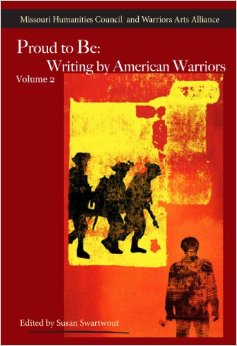
Proud to be

Posted in capturing memories, history, honoring veterans, war stories, WWII | Tagged | 2 Comments

Publishing Your Book, and NaNoWriMo for nonfiction

November is National Novel Writing Month, when writers around the world frantically try to write 50,000 words by the end of the month to finish a first draft of their novel. NaNoWriMo, as it’s nicknamed, is a great way to put a fire under the seat of any writer. I can always use a fire under my seat when it comes to writing, but I don’t write fiction and November is a lousy month for me to meet any big writerly deadlines. I’m busy doing yardwork and then there’s Thanksgiving when we sometimes have visiting family. This year, though, I am taking on a writing challenge–to finish off a short book of my mother-in-law’s childhood, including some of her recipes with color photos. I’m mulling over how to get a few copies of a family-only book with color interior. Color interiors cost a lot, but then won’t this book be priceless anyway? What a great Christmas present.

Those of you narrative nonfiction (memoir) writers might want to sign up for Nina Amir’s 2013 National Nonfiction Writing Month (NaNonFicWriMo) challenge. It’s not too late! You can write your first draft, polish up a second, or aim to finish a project. I didn’t sign up, but I will try to get my project to the printer by the end of the month. If I get done early I’m in the midst of a second memoir project that needs a fire under it.

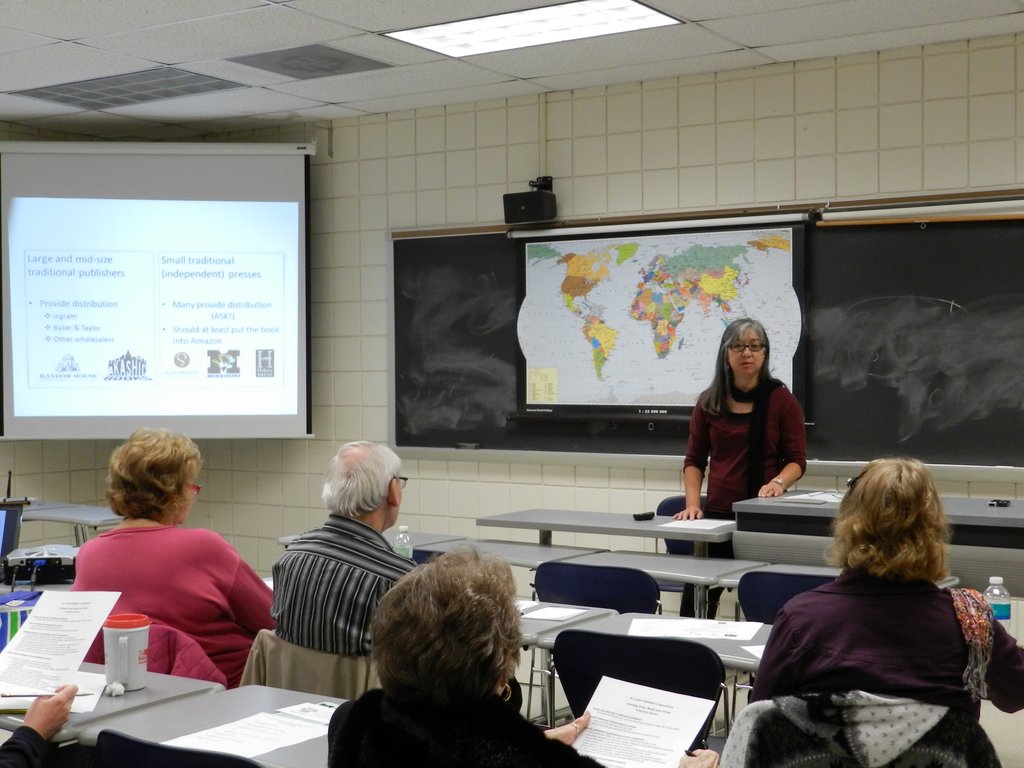
After NaNoWriMo is over, plenty of writers start wondering how to get their work published. I helped teach a class on that yesterday at the community college, with three other St. Louis Publishers Association members. The class is always a big hit because we fill everyone’s head to overflowing. There’s a lot to learn, and a four-hour class is really just a teaser. But, that’s what attending SLPA monthly meetings is for. Since the publishing world changes so fast, I had to update my presentation from last April’s class. Today, I tackled updating the publishing articles on this website. So, for those of you interested in publishing for the public, click on the Resources tab above and look at the articles on Methods of Publishing, Amazon CreateSpace, and Lightning Source. There’s even a new article on e-book publishing. Enjoy!

A world map is an appropriate backdrop when talking about distribution

A world map is an appropriate backdrop when talking about distribution

Posted in publishing, writing | Tagged , | Leave a comment

Eighty Days, a race around the world: Bringing someone else’s history to life

Wouldn’t that be exciting to find a stranger has discovered a stack of letters written by one of your ancestors and wants to write a book about her? Matthew Goodman wrote Eighty Days about a historic race around the world that caused great excitement in the late 1800s. Pioneering women journalists Nellie Bly and Elizabeth Bisland both aimed to be the first person to travel around the world in less than eighty days, to break the fictional record of Phileas Fogg from Jules Verne’s novel Around the World in Eighty Days. Feisty investigative news reporter Bly had the idea in the first place, and Bisland’s magazine editor persuaded her to race against Bly going in the opposite direction. Bly didn’t even know she had a competitor until she reached Hong Kong, and boy did she get mad about that.

Matthew Goodman did two years of research before he felt ready to begin putting together the story of these two very different women. Bly worked for Joseph Pulitzer’s The World, the most influential newspaper of the time, and boldly chased after sensational stories, particularly those that exposed social injustice. Bisland was a refined and quiet woman, a poet and essayist, who was literary editor for The Cosmopolitan, an upscale magazine (now known as Cosmo, a very, very different sort of read). Like Bly, though, she was also an advocate for social justice and women’s rights.

While a lot has been written by and about the outgoing Nelly Bly, Bisland shunned the spotlight and after the race went to live in England for a year to escape the height of her fame in the United States. I asked Mr. Goodman how he found enough material to write about Bisland. Besides reading whatever he could find, including a few books she wrote, he discovered Tulane University held a stash of letters she had written, letters Bisland’s own family didn’t know about. Some of Bisland’s descendants are avid genealogists who shared their information and an unpublished family history with Goodman. A great-grandniece let him see other letters by Elizabeth written about subsequent travels. The family is pleased that someone has written all about their amazing but almost unknown relative, to share her historic achievements and open-minded perspectives. My advice, though, is to not hope for a stranger to come along to write about you or your ancestor. Get busy and write, and get it published, too, even if it’s just for your own family.

Anyone who enjoys reading about history, adventure, world cultures, bold women forging their way through male-dominated society, and the complexities of personality (listening to Goodman talk, I thought Nellie Bly a particularly interesting person) should pick up a copy of Eighty Days: Nellie Bly and Elizabeth Bisland’s History-Making Race Around the World. While Goodman writes about these women as for a history book, he skillfully intersperses dialog and third-person storytelling to make the book much more pleasant to read than straight history. In his hands, this works. Many details of daily life in the times and the intimate storytelling tell us he had a wealth of letters and historic information to work with. I opened the book to find Elizabeth in Japan so of course I had to buy a copy. Goodman said she loved Japan and returned there in later years. I need to save up for my own visit.

Photo325

Posted in book talk, history | Tagged , | Leave a comment