The Japan WWII civilian experience

What a beautiful cover!Yay, I just won a book, and not just any book. Amused by Books reviewed The Gods of Heavenly Punishment, a multi-faceted novel that covers WWII experiences in Japan on different fronts, including the civilian story of Yoshi and her parents. Of course I had to throw my name in the hat for this giveaway. The author, Jennifer Cody Epstein, has an impressive background with a BA in Asian Studies and MFA from Columbia. She taught at Doshisha University, Tokyo, and has written for international publications. For those who don’t know yet, book giveaways can be found on book blogger sites as well as on Goodreads. Jennifer Cody Epstein is on a blog tour and has more stops yet for those wanting to try for a free copy of her book.

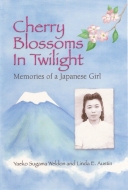
Researching about The Gods of Heavenly Punishment, I found reviewer comments saying books about the Japanese civilian WWII experience were rare, “a side of war that is often forgotten.” I’d say it’s almost completely unknown outside of Japan, and that’s why I published Cherry Blossoms in Twilight. At the time, the only other narrative book covering this was a long novel based on a true story, “A Boy Called H,” an excellent read. Sadly, it looks like it’s now out of print, along with The Girl With the White Flag, a poignant story of a child’s survival of the battle of Okinawa.

Shig: The True Story of an American Kamikaze came out in 2009. It is the memoir of a Japanese-American man caught in Japan during WWII. Shigeo joined the Japanese military, so there’s pre- and post-WWII story, but little wartime civilian detail. His military training is certainly interesting, though. Gail Tsukiyama’s The Street of a Thousand Blossoms (2008) is a novel covering the Japanese civilian experience during WWII. It is a worthy read that teaches about sumo and Noh. That’s it for the narrative stories I know of about life in WWII Japan.

Sometimes I think of turning Cherry Blossoms into a novel. More people would read it, I think. Shig has been turned into a novel, yet to be published. There is value in having true stories, though. Those are real history worth saving. Novels don’t get into university research libraries as Cherry Blossoms has. Cherry Blossoms may be a small, simple story, but I like that it is honest and real. History is mostly made up of regular people going about the small drama of their daily lives. Some of us are curious about those lives. I’ll let novels like The Gods of Heavenly Punishment provide the big drama – I can’t wait to read it, and to compare it to the true stories I know.
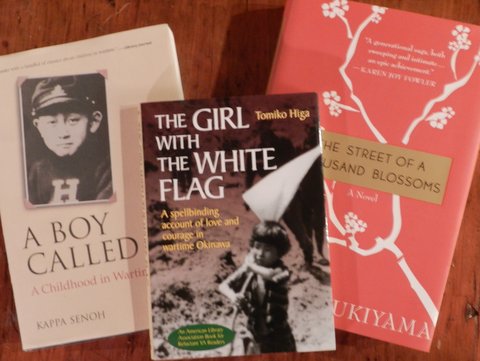
Books on Japan WWII civilian experience

Posted in book talk, Cherry Blossoms in Twilight, multicultural, war stories, WWII | Tagged , , | 2 Comments

Mother’s Day, relationships, and missing moms

My Mother’s Days have been spent making sure my own mother was happy. Usually that made me happy, too, but really it was all about her. This time, I’m the only mom in the immediate picture, and I’m not ready to embrace that yet. I do, however, feel a bond with lots of other daughters out there who have lost their mothers. Facebook has been full of beautiful sayings about moms in heaven but also in our hearts, and I’m taking comfort in those. Postings show no matter how long ago they lost their mothers, daughters still miss them very much. What is it about that daughter-to-mother relationship that seems to have an intensity stronger than that of son-to-mother? All those X chromosomes make a tangled web.

My relationship with my mother was not an easy one. That she was born and raised in a different country added to the generation gap. While working on Cherry Blossoms in Twilight, I cried to learn some of the reasons she behaved as she did—our past experiences reflect who we grow to be, and I didn’t understand her at all until I discovered those experiences. How I wished I had known sooner. That didn’t make things easier for me, but I learned to better accept what would never change. Despite our difficulties, I loved her for what she could be, and was honored to care for her through the end of her Alzheimer’s. She loved me the best she knew how. And I loved her the best I knew how.

Happy Mother’s Day to all who love as mothers.

Missing mother haiku

Posted in death, holiday, lifewriting, relationship | Tagged | 8 Comments

Letters From the Other Side of Haiti

Jillayna Adamson was doing a booksigning at the Book House, a charismatic 150-year-old Gothic Revival house in Rock Hill (St. Louis), Missouri, that is literally stuffed with new and used books. The book store was recently served an eviction notice by the land owner. I had fun wandering through the maze of books, admiring the cozy dormer filled with poetry books, carefully climbing down a winding, narrow staircase, all perhaps for the last time, and then meeting Jillayna (Jill-anna) and her husband, Rod. Letters from the Other Side of Haiti is the name of Jillayna’s new book.

The couple traveled twice to the impoverished village of Pignon on the northern side of Haiti. They worked with Haiti Home of Hope Orphanage and its feeding clinic and with Haiti Outreach. They visited Meds and Food for Kids and want to bring a Medika Mamba program to Pignon to save the starving children. Medika Mamba is the Creole name for the protein-vitamin- packed peanut butter paste created by a St. Louis doctor. Jillayna wrote about their trips and turned the writings into a book.

Letters from the Other Side reads like a series of travel-blog posts, which many are (some have been removed and put in the book instead). I found the short entries touching. Some are mini-profiles of the people Jill and Rod met, as in the heartbreaking chapter “Faces of Orphans.” Some are like journal entries of what happened that day, like a lesson in meticulously doing laundry by hand (“I have never seen my whites so white”), or the quest for coffee in a land that doesn’t seem to have any. Some are descriptions of how things are. All are cultural revelations—extreme, shocking revelations. All exude a love for the people and the land.

Letters From the Other Side is an easy, fast read with a lot of black and white photos. Although it could use a bit more work in editing and interior design, it is a sweet and fascinating (horrifying) look at a way of living that most of us can’t imagine. These are “stories you won’t hear on the national news.” I loved the last chapter, which is an insightful summary with takeaway message. Jillayna says, “I write from a side of Haiti that I have come to love, understand, and deeply respect. They suffer, but they smile, they are a beautiful, kind and passionate people. Haiti is not all about devastation or tragedy.”

Jillayna and Rod like working with smaller, more remote villages, places where other aid organizations don’t reach. Proceeds from book sales go toward helping these villages by providing food and supplies, particularly to orphanages. Donations can also be made through Jillaynas blog.

They crowded around us and sang God is Good in broken, accented English. We tried not to cry.

Jillayna Adamson

Posted in book reviews, book talk, journal, letters, multicultural, Uncategorized | Tagged | 2 Comments